Author: blockchainwebdir@gmail.com

  • Gas Optimization Part 4: Solidity Tips for Cheaper Contracts

    Gas Optimization Part 4: Solidity Tips for Cheaper Contracts

    Every line of your smart contract costs something.

    Some lines cost more than others.

    In this part of our gas saving series, we’ll explore how to write smarter Solidity code that keeps your contract lean and efficient.

    Here are six simple and practical ways to reduce gas costs while writing Solidity smart contracts.

    1. Use payable Only When Needed, But Know It Saves Gas

    In Solidity, a function marked payable can actually use slightly less gas than a non-payable one.

    Even if you’re not sending ETH, the EVM skips some internal checks when the function is marked payable.

    See this example:

    function hello() external payable {}    // 21,137 gas

    function hello2() external {}           // 21,161 gas

    That tiny difference may not seem like much, but across thousands of calls, it adds up.

    • Only use payable when your function is actually meant to accept ETH

    2. Use unchecked for Safe Arithmetic When You’re Sure

    Since Solidity 0.8.0, all arithmetic operations automatically check for overflows and underflows. While this makes contracts safer, it also uses extra gas. When you’re certain that overflow won’t occur, you can use the unchecked keyword to skip these safety checks.

    uint256 public myNumber = 0;

    function increment() external {

    unchecked {

    myNumber++;

    }

    }

    Gas used: 24,347 (much cheaper than using safe math)

    Warning: Use unchecked carefully. Only when you’re confident there’s no risk of overflow.

    3. Turn On the Solidity Optimizer

    The Solidity Optimizer is like a smart helper that cleans up and tightens your compiled bytecode.

    It does not change how your contract works, but it removes waste and makes it cheaper to run.

    If you’re using tools like Hardhat or Remix, always enable the Optimizer before deploying to mainnet.

    4. Use uint256 Instead of Smaller Integers (Most of the Time)

    Smaller types like uint8 or uint16 might look more efficient, but they can cost more gas during execution.

    That’s because the EVM automatically converts them to uint256 behind the scenes.

    So, if you’re not tightly packing them in a struct for storage savings, just use uint256.

    Use smaller types only in structs when trying to save storage space.

    5. Understand Storage Costs: Read + Write Costs Almost Same as Write

    Storage operations are expensive. But here’s something surprising:

    Reading a storage variable before writing to it doesn’t cost much more than writing directly.

    Example:

    • Read + Write = 2,100 (read) + 20,100 (write) = 22,200 gas
    • Write only = 22,100 gas

    That means if your code needs to read before writing, it’s okay, you are not losing much.

    Plan your storage usage wisely. Reuse variables and avoid unnecessary writes.

    Reference: https://ethereum.github.io/yellowpaper/paper.pdf

    6. Use < Instead of <= in Comparisons

    When comparing numbers, use < instead of <=.

    Why? Because:

    • < needs just one check
    • <= takes two checks (a comparison and an extra step to flip the result)

    Fewer steps mean lower gas usage.

    Example:

    for (uint i = 0; i < limit; i++) {

    }

    This small change saves gas on every loop iteration and comparison operation.

    Conclusion

    Gas optimization is about understanding how the EVM works and making informed decisions about your code structure. Each of these techniques might seem to save small amounts of gas individually, but combined and applied across a large contract, they can result in significant cost savings.

    Remember: Always test your optimizations thoroughly. Sometimes gas savings come at the cost of code readability or safety. Strike the right balance for your specific use case.

    Key Takeaways:

    1. Use payable functions when appropriate
    2. Apply unchecked carefully for safe arithmetic
    3. Enable the Solidity optimizer
    4. Prefer uint256 for most variables
    5. Understand storage access patterns
    6. Choose efficient comparison operators

    By implementing these strategies, you’ll create contracts that not only work well but also cost less to deploy and interact with, making them more accessible to users and more profitable for developers.

  • Gas Optimization Part 3: The Foundation of Gas in Solidity and Smart Contract Efficiency

    Gas Optimization Part 3: The Foundation of Gas in Solidity and Smart Contract Efficiency

    You just deployed a smart contract, and it’s costing 98 gas to run a function that does nothing. Literally.

    See for yourself, Why?

    Because even doing “nothing” on Ethereum still means something to the Ethereum Virtual Machine (EVM).

    Welcome to Part 3 of our gas optimization series, where we will look at how gas really works behind the scenes and how you can make your Solidity smart contracts use less gas by removing anything that’s not needed.

    The Building Blocks: OPCODEs Are the DNA of Ethereum

    In Solidity, saving on gas is like saving fuel in your car. To do that, you need to know about OPCODEs – the basic commands that tell Ethereum what to do. They’re the ABCs of Ethereum’s language.

    When you write Solidity code, it doesn’t run directly on the Ethereum network. Instead, it gets compiled into a set of OPCODEs that the Ethereum Virtual Machine (EVM) can understand and execute. Think of it like translating English into machine language that computers can process

    What Are OPCODEs?

    OPCODEs are low level instructions that perform specific operations:

    Arithmetic Operations: ADD, SUB, MUL, DIV for mathematical calculations

    Memory Operations: MLOAD, MSTORE for temporary data storage

    Storage Operations: SLOAD, SSTORE for permanent blockchain storage

    Program Flow: JUMP, JUMPI for conditional logic.

    Cryptographic Functions: SHA3, ECRECOVER for security operations

    Contract Interactions: CALL, DELEGATECALL for inter-contract communication

    And here’s the catch:

    Each OPCODE consumes gas, and some cost way more than others.

    Pro Tip:

    You can see the full list of OPCODE gas costs here: ethereum.org/en/developers/docs/evm/opcodes

    The Secret Code: Function Selectors

    Here’s something that might surprise you: when you compile your Solidity code into bytecode, the names of your functions don’t actually show up in the final assembly output. Instead, what ends up on the Ethereum network is something like a secret code called function selectors

    How Function Selectors Work

    Function selectors are created by taking the first four bytes of the hash of the function’s signature. Let’s look at a real example:

    function doNothig() external pure {}

    After compilation, this becomes:

    46aad107

    So when someone sends a transaction to your contract, they don’t send the name doNothig(),they send the selector 0x46aad107.

    That’s how the EVM knows which function to run, without storing long names on-chain.

    Gas Optimization Tips Every Developer Should Know

    1. Keep It Light

    The less code you deploy, the less gas you’ll use during deployment. Think of it as packing light for a flight – every extra byte costs money.

    Code size optimization strategies:

    • Remove unnecessary functions and variables
    • Use libraries for common operations instead of duplicating code
    • Implement proxy patterns for upgradeable contracts
    • Strip out debugging code and comments in production

    Real impact: A 1KB reduction in contract size saves approximately 200,000 gas units during deployment

    2. Choose Wisely: OPCODE Selection

    Certain commands are cheaper than others. Picking the right ones is like choosing a budget airline over a luxury carrier.

    Cost-effective choices:

    • Some instructions (like ADD) cost less than others (like SSTORE).
    • Store fewer variables
    • Avoid unnecessary require checks
    • Minimize state changes

    3. Pack Data Tight: Transaction Data Optimization

    The more data you send in a transaction, the more you spend. Keep your transaction data lean.

    Data packing techniques:

    • Use struct packing to fit multiple variables in single storage slots
    • Compress arrays and use fixed-size arrays when possible
    • Batch multiple operations to reduce transaction overhead
    • Use events instead of storage for data that doesn’t need to be queried on-chain

    4. Minimize Memory Use

    Memory is temporary, but still costs gas.

    Avoid creating new memory variables when not required.

    Use calldata instead of memory for function inputs when possible

    5. Be Smart About Storage

    Storage is the most expensive operation.

    • Only write to storage if you must
    • Use events to log non-critical data instead of storing it
    • Don’t overwrite storage values unless necessary

    Every time you write to SSTORE, you’re paying a premium.

    The Compound Effect

    A little bit of gas saved on every transaction can add up to significant savings over time. If your contract processes 1,000 transactions per day and you save 500 gas per transaction, that’s 500,000 gas units daily – potentially saving hundreds of dollars monthly at current gas prices.

    Understanding OPCODEs and function selectors is just the beginning. In Part 4, we’ll explore advanced Solidity techniques that can dramatically reduce gas consumption

  • Gas Optimization Part 2: Timing Strategies and Batch Processing

    Gas Optimization Part 2: Timing Strategies and Batch Processing

    You’ve learned what gas fees are and how they’re calculated. Now comes the practical part: how to actually save money on every transaction you make. The difference between a novice and an expert Ethereum user often comes down to understanding when and how to execute transactions efficiently.

    Haven’t read Part 1 yet? Check out our introduction to gas fees and how they work to understand the fundamentals before diving into these optimization strategies.

    Let’s explore the proven strategies that can cut your gas costs by 50-90% without compromising transaction security or speed

    Strategy 1: Master the Art of Timing

    Weekends: Saturday and Sunday typically see 20-30% lower gas fees as business activity decreases.

    Off-peak hours: Between 2 AM and 6 AM UTC, when both American and European users are asleep, gas prices often drop significantly.

    Avoid these high-traffic periods:

    • NFT mint launches
    • Major DeFi protocol updates
    • Market crash periods (panic selling drives up demand)
    • Weekday mornings (8-10 AM UTC)

    You can use trackers like:

    Pro tip: Set up gas price alerts on your phone. When prices drop below your target threshold, that’s your window to execute pending transactions.

    Strategy 2: Batch Processing

    Why send 10 separate transactions…

    When you can send one batch?

    Batching reduces overhead, saves time, and lowers gas.

    Let’s explore 3 Ethereum standards that enable powerful batching:

    1) ERC-3005: Batched Meta Transactions – https://eips.ethereum.org/EIPS/eip-3005

    This standard lets users combine multiple actions into one meta transaction.

    Example:

    1. Approve token
    2. Swap on DEX
    3. Send output to wallet

    All in one call, reducing gas and relayer fees.

    Great for:

    1. Wallet apps
    2. Gasless UX
    3. Relayer-backed platforms

    2) ERC-7821: Minimal Batch Executor –  https://eips.ethereum.org/EIPS/eip-7821

    This one’s about delegations and shared execution.

    Think of it like batching multiple on-chain delegations, such as:

    • Voting
    • Staking
    • DAO participation

    With atomic execution, if one part fails, nothing gets through so it keeps safe and predictable.

    Perfect for:

    • DAO tools
    • Governance app
    • Delegation-heavy protocols

    Example scenario: You want to withdraw from a liquidity pool, swap the tokens, and deposit them into a yield farming protocol. ERC-7821 ensures all these operations happen atomically, preventing scenarios where only part of your strategy executes

    3) ERC-4393: Batch Micropayments – https://eips.ethereum.org/EIPS/eip-4393

    When you need to make multiple small payments, ERC-4393 shines. This standard enables multiple tips or payments in a single transaction call.

    Use case: Tipping multiple content creators or making several small purchases. Instead of paying gas fees for each micropayment, you pay once for the entire batch

    Strategy 3: Wait for gas to go down

    Gas prices go up and down every twelve seconds based on how congested Ethereum is. When gas prices are high, waiting just a few minutes before making a transaction could see a significant drop in what you pay.

    Strategy 4: Use Layer 2 Solutions

    Layer 2 solutions like zkSync, Arbitrum, and Optimism reduce gas fees by up to 95%. By bundling a large number of transactions together, these solutions reduce the number of on-chain transactions.

    Popular options:

    • Arbitrum
    • Optimism
    • Base
    • Polygon (PoS)

    Many dApps are now L2-ready. Just bridge your ETH once, and you’re good to go.

    Wrap-up

    Ethereum gas fees aren’t going away, but you can outsmart them with:

    1. Good timing
    2. Layer 2 networks
    3. Batched transactions using ERC-3005, ERC-7821, and ERC-4393
    4. Wait for the gas to go down

    What’s next?

    While timing and batching strategies can dramatically reduce your transaction costs, the next frontier in gas optimization lies in smart contract efficiency. In Part 3, we will explore advanced Solidity techniques that developers use to minimize gas consumption at the code level.

  • Gas Optimization Part 1: Understanding Ethereum Gas Fees

    Gas Optimization Part 1: Understanding Ethereum Gas Fees

    “I paid $62 just to send $100. What?”

    That’s the kind of reaction many new users have after making their first Ethereum transaction during peak congestion.

    No NFTs. No DeFi. Just a simple ETH transfer.

    Yet the gas fee was more than half the value of the transaction.

    And they thought it was a bug.

    But it wasn’t.

    It was Ethereum being busy.

    Welcome to the world of gas fees.

    What Is Gas, Really?

    If you’ve ever driven a car, you already understand gas.

    Think of your Ethereum transaction as a car trip. To drive (process your transaction), you need fuel, and on Ethereum, that fuel is called Gas.

    Just like fuel powers a car, gas powers your transaction on the Ethereum network.

    But there’s a catch: The busier the road, the higher the fuel price.

    So when the Ethereum network is crowded (say, during a hyped NFT mint), gas prices shoot up because everyone’s trying to get their transactions through.

    Why Gas Prices Change

    Back to our highway example:

    If traffic is light, fuel is cheap, and if traffic is jammed, fuel costs more to cut through

    Ethereum works similarly.

    You can pay a higher gas price to get your transaction picked up faster by validators

    Or you can set a lower price and wait.

    Understanding the Components

    Gas Limit

    This is the maximum amount of gas you’re willing to use.

    For simple ETH transfers, it’s usually 21,000.

    Gas Price

    This is how much you’re willing to pay per unit of gas, measured in Gwei.

    Gas Usage:

    This is the actual amount of gas consumed by your transaction. It’s often the same as your gas limit for simple transactions, but complex operations might use less than the limit you set.

    Breaking Down Gas Fees: A Real Example:

    • Gas Limit = 21,000
    • Gas Price = 35.06 Gwei
    • ETH Price = $3,492.21

    Step 1: Calculate Gas Fee in ETH

    21,000 × 35.06 / 1,000,000,000 = 0.000736 ETH

    Step 2: Convert to Dollars

    0.000736 × 3,492.21 = $2.57

    So, the fee for that simple transaction is about $2.57.

    But when the network gets congested, gas prices might 10x,  and that’s how people end up paying $50+ just to send ETH.

    The Game-Changer: EIP-1559

    In August 2021, Ethereum introduced EIP-1559, which revolutionized how gas fees work. Instead of the old auction-style system where users had to guess appropriate gas prices, EIP-1559 brought predictability and efficiency.

    How EIP-1559 Works

    The new system introduces several key components:

    Base Fee: This is a fixed price per unit of gas that the network automatically adjusts based on demand. Here’s the interesting part: this base fee gets burned (destroyed), permanently removing ETH from circulation.

    Max Fee: The maximum amount you’re willing to pay for the transaction. This acts as your safety net.

    Max Priority Fee: The tip you’re willing to give to miners to prioritize your transaction.

    A Real EIP-1559 Example

    Let’s say you’re making a transaction with these parameters:

    Base Fee: 70 Gwei

    Max Fee per Gas: 90 Gwei

    Max Priority Fee per Gas: 15 Gwei

    Here’s what happens:

    1. 70 Gwei gets burned (the base fee is destroyed)
    2. Miners receive 15 Gwei (your full priority fee since Max Fee – Base Fee = 20 Gwei, which is higher than your 15 Gwei priority fee)
    3. You get 5 Gwei refunded (90 – 70 – 15 = 5 Gwei back to your wallet)

    This system eliminates the guesswork. You know exactly what you’ll pay upfront, and any excess gets refunded automatically.

    Looking Ahead

    Gas optimization isn’t just about understanding current fees. It’s about developing strategies to minimize costs while maintaining transaction reliability. In the next part of this series, we’ll dive into practical techniques for optimizing your gas usage, including timing strategies, transaction batching, and smart contract optimization tips.

    The key takeaway? Gas fees might seem complex, but they follow predictable patterns. Once you understand these patterns, you can navigate the Ethereum network like a pro, saving money and avoiding the frustration of failed transactions.

    Remember: every Gwei saved is money back in your pocket. And in the world of DeFi and NFTs, where you might make dozens of transactions per month, those savings add up quickly.

  • How to spot Phishing Zoom Call Scams: Real Stories and Safety Tips

    How to spot Phishing Zoom Call Scams: Real Stories and Safety Tips

    Millions use Zoom every day, but imagine sitting down to join an important video call, only to realise minutes later that your computer is acting strangely and you have been hacked. This is the reality many people face with a phishing Zoom link. So let’s explore in this article what the phishing Zoom call scam is and how to stay safe.

    Before we continue, I would like to add that in most of these video meeting scams, the problem is not due to a bug/vulnerability in the official Zoom app or website, but scammers are targeting Zoom through a fake, phishing look a like link. 

    What are phishing Zoom Call Scams?

    Simply put, phishing Zoom call scams are fake video call invitations or messages that pretend to be from Zoom or someone you trust, but are designed to trick you. 

    Scammers might send an email saying you have missed a meeting or that your Zoom account has been hacked, prompting you to click a link that looks real but isn’t. Once you click, you might be taken to a fake login page that steals your username and password or downloads harmful software onto your device.

    Most common is that they would ask you to join a Zoom call from a phishing link (look-alike website with a few character differences). If you join the call, you will see their video, which is also not a real live video but a deep fake video, and you will not hear their voice. They will ask in chat, “We cannot hear you, maybe it is an issue from your Zoom, try updating it and rejoin the call.” Once you download and install it from their link, they will get remote access to your system, which will give them access to your data, passwords, etc. In case you or anyone in your network installs such software, one solution would be to disconnect your laptop from the internet to cut access and format/hard reset your operating system.

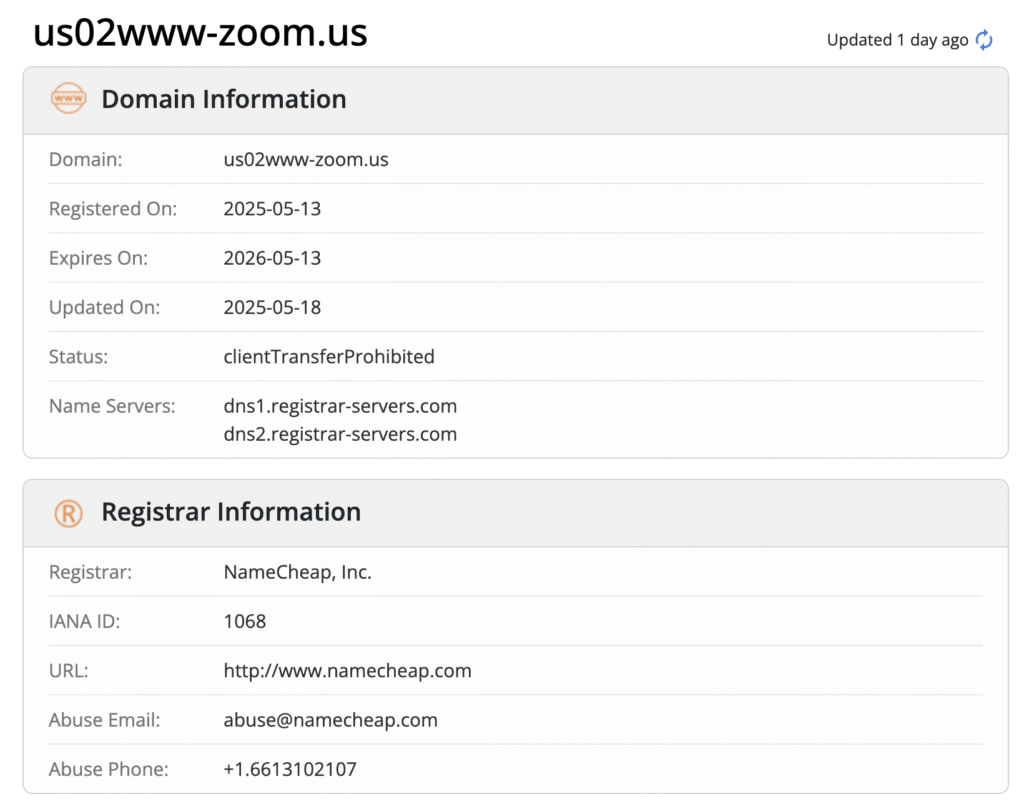
    You can see in the image below, Domain us02www-zoom.us, created in May 2025 and registered through NameCheap. Domains like this are often designed to look almost identical to Zoom’s official web address, tricking users into believing they are clicking a safe meeting link. Scammers use such lookalike domains to send fake Zoom invitations, aiming to steal login details or launch malware attacks. The fact is that this domain was registered recently, which is a red flag, and you can check this using Whois.

    How to spot Phishing Zoom Call Scams: Real Stories and Safety Tips

    Using tools like ScamBuzzer, you can also save yourself. This tool detects phishing sites and blocks such fake Zoom call links

    How to spot Phishing Zoom Call Scams: Real Stories and Safety Tips

    Real stories of people:

    • Daavya Vaishnav shared how scammers contacted her claiming to be part of the Avalanche team and expressed interest in organising a side event at Token2049. They reached out to her through Telegram groups and fake Zoom meeting invites, pretending to be trusted community members to gain her trust. The scammers aimed to trick her and others into clicking harmful links or sharing sensitive information.

    Check out the thread she shared:

    • Sagar Jethi recently shared how he was targeted by scammers on Telegram when an old contact, Zhixi Zhang (known as @build_on_bob), sent him a Zoom meeting link that turned out to be fake and part of a scam. Sagar suspects the Telegram account of this well-known marketing head might have been hacked or compromised by scammers

    Check out his tweet:

    • @chainyoda had their main Twitter handle hacked through a social engineering scam linked to a fake “Bloomberg interview”.

    He shared this on X:

    • Kaavya almost became a victim of a phishing Zoom scam involving deepfake technology. Someone she knows personally sent her a seemingly friendly message and a Calendly link to set up a catch-up call. But when the call started, instead of Google Meet, she was sent a Zoom link to a “team meeting,” which felt strange. On the Zoom call, she saw a deepfake video of Polygon’s founder, Sandeep Nailwal, and another person, moving and looking very real. Realizing this was a trick, she left immediately and asked to switch on Google Meet call. The scammer then disappeared, blocking her and erasing their profile.

    Check out this thread:

    Types of Zoom Call Scams

    There are a few common tricks scammers use:

    Fake Meeting Invitations: Emails or messages that tell you a meeting is scheduled or missed, containing malicious links.

    Phishing Login Pages: Fake Zoom sign-in pages that steal your username and password.

    Malicious Software Updates: Scam links pretending to be Zoom updates that install malware.

    Account Compromise Alerts: Emails claiming your Zoom account is hacked, prompting you to reset passwords on fake sites

    How to spot fake Zoom Scam Calls:

    • The email doesn’t come from an official Zoom email address but from a weird or suspicious one.
    • The email displays a link that, when hovered over, shows a strange or unrelated web address.
    • The message pushes you to act immediately, playing on your fear or urgency.
    • The email claims you missed a meeting you didn’t know about, or asks you to download updates directly from links.
    • In the call you can see but cannot hear their voice so they ask you, “Maybe you need to update Zoom”
    • Strange Meeting Links,  If the link doesn’t match the official company domain, don’t click.
    • If they are offering an investment return that seems impossible or a prize you didn’t enter for, it’s likely a scam.

    Zoom Call Security Best Practices

    • Only click meeting links from trusted sources.
    • Whenever possible, open your Zoom app directly and enter the meeting ID instead of clicking a link.
    • Keep your Zoom software updated by opening the app yourself, not through email links.
    • Check the sender’s email address carefully.
    • When in doubt, contact the person who supposedly sent the invite via another method to confirm.
    • Use two-factor authentication for your Zoom account.
    • Only enter login credentials in the official Zoom site, which is zoom.us and their official app.
    • Do not download or update Zoom software if they told you to do it now, and share the link in the call.
    • If something feels wrong, it probably is. Your instincts are usually right. It’s better to be slightly rude and protect yourself than to be polite and get scammed.

    Zoom has become an essential tool for connecting people worldwide, but like any popular tool, it attracts scammers looking to exploit trust and convenience. By knowing what phishing Zoom call scams look like and following simple safety steps, you can protect yourself from falling victim. Next time you get that unexpected Zoom invite, pause, look closely, and keep your online meetings secure.

    Do check out BlockchainHQ for more articles


  • They Lost Millions by Clicking ‘Sign’ – Here’s How to Never Make That Mistake

    They Lost Millions by Clicking ‘Sign’ – Here’s How to Never Make That Mistake

    Picture this: You’re the treasurer of a major crypto exchange. Your phone buzzes with a notification – another routine transaction needs approval. You glance at your screen, see familiar addresses, and click “approve” without a second thought. Within minutes, millions of dollars vanish into thin air.

    This isn’t fiction. This exact scenario played out when Bybit, one of the world’s largest cryptocurrency exchanges, fell victim to a sophisticated hack executed by North Korean cybercriminals. The culprit? A signer who didn’t fully verify a transaction, leading to a critical Safe UI vulnerability that drained millions from their multi-signature wallet.

    The harsh reality is that even the most secure wallet setups can crumble with one careless click. But here’s the good news: these disasters are completely preventable when you know what to look for.

    Don’t want to be the next victim?

    Let’s walk through how to verify calldata, use multi-sig safely, and pick the right wallet for your level.

    The Wallet Hierarchy: Choosing Your Guardian

    Before diving into verification techniques, let’s address the elephant in the room: which wallet should you even use?

    Total Beginner with Small Amounts: Start with custodial wallets or keep funds on reputable exchanges. Yes, “not your keys, not your crypto” is true, but losing $100 to exchange risk beats losing $100 to your own mistakes.

    Beginner with Small Money: Browser wallets like MetaMask or Phantom work well. They’re user-friendly and perfect for learning the ropes with amounts you can afford to lose.

    Intermediate Users with Medium Amounts: Hardware wallets like Ledger or Trezor become essential. They keep your private keys offline and away from internet threats.

    Intermediate Users with Large Amounts: Combine multi-signature wallets with hardware wallets. This creates multiple checkpoints that hackers must breach simultaneously.

    Advanced Users with Significant Holdings: Multi-signature wallets with social recovery, or custom solutions. At this level, you’re building Fort Knox for your digital assets.

    For wallet comparisons and security audits, check out walletscrutiny.com – it’s like a Consumer Reports for crypto wallets.

    Hot vs Cold Wallets

    Hot wallets stay connected to the internet (MetaMask, Phantom, and mobile apps). They’re convenient for daily transactions but vulnerable to online attacks.

    Cold wallets remain offline (Ledger, Trezor hardware devices). They’re like keeping cash in a physical safe, much harder to steal remotely.

    Important:

    Even a cold wallet becomes hot if you connect it to a Safe multi-sig UI!

    Always be aware of when you’re online vs offline

    Verifying Simple Transactions: Your First Line of Defense

    When using MetaMask or similar wallets, you’ll sometimes see transaction details that look like gibberish. Don’t panic,  here’s how to decode them:

    Check These Three Things:

    1. Estimated changes – What’s actually moving in and out of your wallet
    2. The “to” address – Where your money is going
    3. Hash data – The first 4 bytes reveal the function being called

    For example, if you see “0xa9059cbb” in your transaction data, you can decode it using Cast (a developer tool):

    cast sig “transfer(address,uint256)”

    This returns the function selector you can compare against your transaction. If they match, you’re calling a transfer function. If they don’t match, stop immediately.

    To verify the specific parameters of a transfer:

    cast calldata-decode “transfer(address,uint256)”

    This shows exactly where your tokens are going and how many.

    Multi-Sig Transactions: Where Things Get Complicated

    Multi-signature wallets require multiple people to approve transactions before they execute. Think of it like a shared bank account where both you and your spouse need to sign checks for large purchases

    Critical Point: A signature request is NOT the same as a transaction request. You’re not sending money yet, you’re just adding your approval to a pending transaction.

    How to Verify a Multi-Sig Transaction

    Step 1: Install the Right Tools Get Cyfrin’s Safe_hashes tool from GitHub

    https://github.com/Cyfrin/safe-tx-hashes?tab=readme-ov-file#curl

    This tool decodes Safe transactions into a human readable format.

    Step 2: Run the Verification Command

    safe_hashes –address –network –nonce

    If no transaction appears, use –untrusted mode in above command

    Step 3: Manual Verification (Advanced) For complete independence from APIs, use Cast:

    cast calldata “approve(address,uint256)”

    Then verify with Safe hashes:

    safe_hashes –address –network –nonce 2 –data –offline –to

    The Golden Rules That Could Save Millions

    Never sign and execute simultaneously. Some wallets try to streamline this process, but convenience is the enemy of security.

    Watch for operation codes. If you see “operation = 1” in your transaction, you’re looking at a DELEGATECALL – essentially giving another contract permission to act with your wallet’s full authority. This is extremely dangerous and should only be used in very specific circumstances.

    Always verify these three elements before any signature:

    • The destination address (where is this going?)
    • The function selector (what action is being performed?)
    • The value or amount (how much is involved?)

    Why This Matters More Than Ever

    The Bybit hack wasn’t an isolated incident. Similar attacks happen regularly because people skip verification steps. The difference between a secure transaction and a devastating hack often comes down to spending 30 seconds to verify what you’re actually signing.

    Remember: in the world of cryptocurrency, there’s no “undo” button. Once a transaction is confirmed on the blockchain, it’s permanent. The few minutes you spend verifying could be the difference between protecting your assets and reading about your loss in tomorrow’s crypto news.

    The tools and techniques outlined here aren’t just for crypto professionals – they’re for anyone who values their digital assets enough to protect them properly. Start with the basics, build good habits, and gradually level up your security practices as your holdings grow.

    TL;DR

    1. Pick the right wallet for your level
    2. Always verify the transaction before signing, especially calldata
    3. Never trust the UI blindly
    4. Use Safe_hashes or Cast for decoding
    5. Multi-sig ≠ automatic safety

    One wrong click can empty your wallet. Take 30 seconds and verify,  your future self will thank you.

  • Meet Pandit Dhamdhere: Building Against All Odds

    Meet Pandit Dhamdhere: Building Against All Odds

    In a quiet village in Pune district, far from any startup hubs or big tech campuses, a young man decided to teach himself how to code. With no degree, no formal training, Pandit Dhamdhere entered a space where talent and persistence mattered more than certificates. Today, despite a recent setback, his journey proves that passion and persistence can overcome even the most challenging circumstances.

    While working 16-hour days for $100 a month, he would spend another 4 hours at night learning JavaScript and Solidity, often sleeping only 4 hours before starting over again. In 2020, a single introduction to Web3 changed the direction of his life.

    Pandit’s journey is a reminder that in Web3, you don’t need perfect conditions, you need the courage to start and the persistence to keep going.

    This conversation with Pandit reveals the mindset needed to keep building despite self-doubt, the power of community in an online-first industry, and why sometimes the biggest battles aren’t with code but with your own limiting beliefs. His story is still being written, and the recent interview rejection that crushed his four-year dream might just be the setup for something bigger.

    The Interview: Pandit Dhamdhere on His Web3 Journey

    1. Tell us a bit about yourself.

    Pandit Dhamdhere: I’m Pandit Dhamdhere, and I’m from a village in Pune district, Maharashtra. I was recently laid off from the company I was working for, so currently I’m working part-time with many startups while building my own stuff.

    2. What were you doing before Web3?

    Pandit Dhamdhere: I’m a college dropout from 11th standard, and I come from a farming background. That was pretty much my reality before I discovered this space.

    3. How did you first hear about Web3?

    Pandit Dhamdhere: I first heard about Web3 on Twitter back in 2020. That’s where it all started for me.

    4. What was your first step into the space?

    Pandit Dhamdhere: While I was doing JavaScript and frontend stuff, a friend introduced me to Solidity. I loved it immediately and started with the basics. My first project was creating an ERC-20 token after doing the usual Hello World programs.

    5. What was one big challenge you faced early on?

    Pandit Dhamdhere: The challenge wasn’t really technical. It was a battle with myself. It was hard to believe in myself because I don’t have a degree. I used to think, “You’re learning and building, but who’s going to hire you when you don’t have a degree?” That self-doubt was the biggest obstacle.

    6. What helped you push through?

    Pandit Dhamdhere: The Twitter community and some of my friends who helped me throughout my journey. I used to ask questions by DMing people on Twitter and Discord. I would ask questions to people in Twitter Spaces. That helped me a lot. It’s really the community that kept me going.

    7. What are you most proud of so far in your journey?

    Pandit Dhamdhere: I’m proud of the skills I learned despite unfavorable conditions. Once upon a time, there was a period in my life where I had to work 16 hours for $100 a month, and I used to learn and code for 4 hours and sleep for 4 hours. I’m proud that I didn’t give up during that time.

    8. Any major failure or learning moment?

    Pandit Dhamdhere: Recently, I failed to crack an interview at one of the biggest Web3 startups, which I’ve been dreaming to work with for the last 4 years. That was a major setback, but it’s also a learning moment about persistence and not giving up on your dreams.

    9. Where can people find or follow your work?

    Pandit Dhamdhere: You can find me @panditdhamdhere on X and LinkedIn.

    What makes Pandit’s story special isn’t just the skills he learned or the projects he built. It’s proof that in this space, hard work matters more than having the right degree. When he messaged strangers on Twitter asking for help, he found something powerful: people who were willing to teach and guide him.

    The numbers tell his story best. Four hours of sleep, four hours of learning, sixteen hours of working just to survive. Most people would have given up. Pandit kept going, choosing to grow even when it was the harder path.

    This space needs more people like Pandit, who know what struggle feels like and still choose to build. His story is far from over.

    Read to start your own journey no matter where you come from? Do what Pandit did: start building, ask questions, and don’t let doubt stop you.

    Want to build, learn, and grow in the Web3 space alongside like-minded developers? Join the BlockchainHQ community where builders share knowledge, collaborate on projects, and support each other’s growth. Sign up from here: https://blockchainhq.xyz/auth and follow us on X https://x.com/blockchainhqxyz to become part of our invite-only Telegram community where the real conversations happen.

  • From First Principles to First dApp: Learn Blockchain Dev in 2025

    From First Principles to First dApp: Learn Blockchain Dev in 2025

    Have you ever used an app and thought… “Why am I giving away all my data just to use this?”

    Or maybe you’ve wondered:

    Why can banks freeze your money without warning? Why are the games you buy online not really yours? Why do the same tech companies control everything we do?

    The answer lies in one word: trust.

    Or rather, the lack of it.

    That’s where blockchain steps in.

    In 2025, blockchain isn’t just about Bitcoin or NFTs anymore. It’s becoming the foundation for a new kind of internet, one that doesn’t ask you to trust companies, platforms, or middlemen blindly.

    But here’s the problem: most people are stuck on the sidelines.

    They hear the buzzwords. They see the headlines.

    But they don’t know where to start.

    This guide fixes that.

    Whether you’re a student, a curious developer, or someone who just wants to build something real, this is your step-by-step path.

    Real skills. Real tools. A mindset that helps you keep going.

    Let’s start with what really matters, and  the why behind it all.

    We’re still early.

    Ethereum co-founder Vitalik Buterin recently said:

    “There are still many unsolved problems in scalability, privacy, user experience… We need more developers focused on these layers.”

    The reality is this: the blockchain ecosystem is not “done.”

    It’s still being built, and it needs builders.

    Whether it’s making DeFi safer, improving wallets, exploring zero-knowledge proofs, or helping people own their digital identity, there is a real, growing need for smart developers who can understand and ship in this space.

    Why Blockchain? Start With First Principles

    Before we talk about coding, let’s talk about why blockchain exists at all. Because if you don’t understand the “why,” you’ll struggle with the “how.”

    Imagine you want to send money to your friend in another country. Right now, you need banks, clearinghouses, and payment processors. Each one takes a cut. Each one adds delay. Each one becomes a potential point of failure.

    What if you could send that money directly? No middlemen. No extra fees. No waiting three business days for “processing.”

    That’s blockchain’s core promise: removing intermediaries from systems that have always needed them.

    But money is just the beginning. What about voting systems where everyone can verify results? Supply chains where you can track products from farm to table? Digital identities that you actually own?

    Public vs Private Blockchain:

    You’ll come across different types of blockchains. They are not all the same.

    Public Blockchains

    These are open to everyone. Anyone can read, write, and build.

    Examples: Ethereum, Solana, Bitcoin

    Private Blockchains

    These are permissioned. Only selected people can participate.

    Examples: Hyperledger, Fabric

    Many people assume private blockchains are more secure because they offer control. But as Sandy Kaul rightly said:

    “The fewer nodes and simpler security models in private chains make them more vulnerable than public chains.”

    Serge from Chainlink added:

    “All private blockchains will eventually have to connect to public blockchains. Their liquidity and relevance will shrink.”

    That’s why most developers today are building on public chains,  it’s where the action is, and where the opportunities are

    Choosing Your Lane: Types of Chains

    Not all blockchains are created equal. Each has different strengths, different communities, and different opportunities.

    • Ethereum is the most widely used and secure. It’s great for learning and building, but can be slow and expensive during high traffic.
    • Solana is super fast and cheap, best for real-time apps and games. It uses a different coding language (Rust) and has fewer validators.
    • Polygon is a faster, cheaper version of Ethereum. It uses the same tools and is ideal for testing or scaling Ethereum apps.
    • Avalanche offers high speed and flexibility, letting you even create your own custom blockchains.
    • Arbitrum and Optimism are “Layer 2” networks built on top of Ethereum to make it faster and cheaper, using the same code.

    Each has strengths. Start with Ethereum to learn the basics, then explore others as you grow.

    Pick a Niche and Stick (For Now)

    You don’t need to learn every chain.

    Pick one and go deep.

    Examples:

    • Ethereum → Use Solidity + Foundry or Hardhat
    • Solana → Use Rust or JavaScript with Anchor
    • Aptos/Sui → Learn Move language
    • Starknet/Polygon zkEVM → Explore ZK circuits

    Choose one based on what excites you.

    DeFi, NFTs, ZK proofs, gaming, DAOs,  pick your playground

    Core Concepts Before Coding

    Before you write your first smart contract, make sure you understand these fundamental concepts:

    Cryptographic Hashing is how blockchain ensures data integrity. Every block contains a hash of the previous block, creating an unbreakable chain.

    Digital Signatures prove that transactions are authorized by the rightful owner of an address.

    Consensus Mechanisms are how the network agrees on what’s true. Proof of Work, Proof of Stake, and other algorithms each have different trade-offs.

    Gas is the fuel that powers blockchain operations. Every computation costs gas, and understanding this is crucial for writing efficient code.

    Smart Contracts are programs that run on the blockchain. They execute automatically when conditions are met.

    These aren’t just academic concepts. They affect every line of code you’ll write. A smart contract that doesn’t consider gas costs might be too expensive to use. A DeFi protocol that doesn’t understand consensus mechanisms might have security vulnerabilities.

    Smart Contract Security Essentials

    Here’s something that might surprise you: smart contract security is still a mess.

    Samczsun, one of the most respected security researchers in the space, noted that “almost every ticket that we got was a smart contract hack.” This isn’t ancient history. This is happening right now.

    What does this mean for you as a developer? Opportunity. The ecosystem desperately needs developers who understand security.

    Learn about common vulnerabilities like reentrancy attacks, integer overflow, and access control issues. Understand how to use tools like OpenZeppelin’s secure contract libraries. Practice writing tests that try to break your code.

    Security isn’t something you add at the end. It’s something you build in from the beginning.

    Gas Optimisation: Write Efficient Code

    Every operation on the blockchain costs gas. Users pay these costs. Write inefficient code, and nobody will want to use your application.

    Learn how to:

    • Pack storage variables
    • Minimize external calls
    • Use view and pure functions

    This isn’t premature optimization. This is fundamental to blockchain development. A function that costs $50 in gas fees won’t get used, no matter how clever the code is.

    And so on.

    Take a course on this and start learning these techniques

    Don’t Just Learn. Ship.

    This is the most important point.

    You will learn more by building one simple dApp than by reading 50 articles.

    Even if it’s small,  a todo list on-chain, a voting contract, or a basic NFT mint page just ship something.

    Break things. Fix them. Ask questions. Improve.

    Where Are the Opportunities? Jobs, Hackathons, Communities

    Blockchain is not just a tech stack. It’s a community.

    To grow fast:

    • Join hackathons: ETHGlobal, DoraHacks, Encode, Devfolio
    • Explore job boards: Web3.career, CryptoJobsList, Remote3
    • Hang out in Discords and Telegrams of your favorite protocols
    • Learn from:: Cyfrin Updraft, Alchemy University, Speedrun Ethereum and more

    The earlier you show up and ship, the faster you’ll stand out.

    Stay in the Game: Learn in Public

    Building in public is a superpower in the blockchain space. Share your learning journey. Tweet about the bugs you’re fixing. Write about the concepts you’re understanding. Stream your coding sessions.

    This isn’t just about personal branding. It’s about accountability. When you commit to learning in public, you’re more likely to stick with it. You get feedback from the community. You build relationships with other developers.

    Balaji Srinivasan, former CTO of Coinbase, talks about blockchain as the infrastructure for future digital societies. He’s working on projects that use blockchain to create new forms of governance and community. This vision shows blockchain development is evolving beyond financial apps into building tools for entire digital civilizations.

    Checklist: What You Should Have Built After 30 Days

    By the end of your first month, aim to have:

    • Fundamentals of Blockchains
    • A wallet setup (Metamask or others)
    • At least one deployed smart contract
    • A frontend that interacts with your contract
    • A GitHub repo or site link to share your project
    • A basic understanding of gas and security

    A note of 5 things you’d do differently next time

    Blockchain Learning Loop: (Read → Code → Break → Fix → Share → Repeat)

    Learning blockchain development isn’t linear. It’s cyclical. Here’s the loop that works:

    Read documentation, tutorials, and other people’s code. Don’t just skim. Really understand what’s happening.

    Code your own version. Start with copy-paste if you need to, but make sure you understand every line.

    Break things on purpose. What happens if you change this parameter? What if you remove this check? Breaking things teaches you how they work.

    Fix the problems you created. This is where real learning happens. When you fix a bug, you understand the system better.

    Share what you learned. Write about it. Talk about it. Teach someone else.

    Repeat with something more complex.

    This loop works because it combines multiple learning styles. You’re reading, writing, experimenting, and teaching. Each reinforces the others.

    Staying Current and Continuous Learning

    Blockchain evolves fast. Stay up to date by:

    • Subscribing to developer newsletters (Week in Ethereum, Starknet Weekly)
    • Watching talks from ETHGlobal, Devconnect, ZK Summit
    • Reading protocol docs regularly
    • Following devs who ship: Austin Griffith, Patrick Collins, 0xfoobar, and others

    Keep your learning tight. Build in the open. And don’t stop.

    Final Thoughts

    You don’t need to be a genius to become a blockchain developer.

    You just need a clear roadmap, a community, and the courage to start.

    There’s never been a better time to build.

    The tools are better. The community is bigger. The problems are real.

    Blockchain isn’t just about finance anymore.

    It’s about rewriting how the internet works,  and you can be part of it.

    Ready to start your journey?

    Check out our Resource Page( https://blockchainhq.xyz/resources ) to find everything from beginner tutorials to advanced guides

    The blockchain ecosystem is waiting for what you’ll build next🫡
  • Para: Go Beyond Web3 Onboarding with Universal Embedded Wallets

    Para: Go Beyond Web3 Onboarding with Universal Embedded Wallets

    The Problem: Crypto is Too Hard for Normal People

    If using crypto was as easy as checking your email, would more people use it? That’s the question Para asked themselves when they realized that most people would rather avoid crypto entirely than deal with 12 word recovery phrases that could lose them everything.

    When Para started as Capsule in 2022, their mission was simple: make blockchains work for everyone, not just tech experts. The gap between crypto’s promise and reality was massive. Crypto promised freedom and control, but delivered complexity and fear.

    The barrier wasn’t the technology itself, it was everything surrounding it. Seed phrases that couldn’t be recovered. Multiple confusing networks. Fees that made no sense. One wrong click could cost you everything.

    Most people took one look and walked away.

    What Para Actually Does

    Para stands for making crypto as easy as logging into any normal app. They built what they call “universal embedded wallets”,: which is a fancy way of saying “crypto wallets that work like everything else you’re used to.”

    Here’s what that means for regular people:

    No More Seed Phrases: Users can log in with their email, Google account, or even just their face or fingerprint (using something called passkeys). If they forget their password, they can recover their wallet just like they would recover their Instagram account.

    Works Everywhere: Para wallets work across different blockchains (like Ethereum, Solana, and others) so users only need one wallet instead of juggling multiple apps.

    Actually Secure: Unlike many “easy” solutions that compromise on security, Para uses advanced encryption called MPC (Multi-Party Computation) that splits your private key into pieces stored in different places, so no one, not even Para, can access your money.

    The Tech Behind the Magic: Distributed Multi-Party Computation (MPC)

    Para’s secret sauce is something called Distributed Multi-Party Computation (MPC). In simple terms:

    • Your wallet’s “master key” is split into multiple pieces
    • These pieces are stored in different secure locations
    • When you want to make a transaction, these pieces work together to sign it without ever being in the same place
    • This means there’s no single point of failure, if one piece gets compromised, your money is still safe

    Para also uses passkeys, which leverage secure chips in your phone or computer to add an extra layer of protection. It’s like having a vault that requires multiple keys, but one of those keys is literally built into your device.

    Real Impact: Making Web3 Identity Accessible

    Take ENS (Ethereum Name Service), which lets people get human readable names like “yourname.eth” instead of confusing wallet addresses. ENS partnered with Para to power their official ENS Manager App, and the results show why this approach works.

    Before Para, getting an ENS name required:

    • Having an existing crypto wallet
    • Understanding how to connect it to websites
    • Knowing how to manage transactions and gas fees

    Now with Para embedded in the ENS app, users can:

    • Create a wallet instantly and buy an ENS name with just email or social login
    • Use their ENS name immediately across all crypto apps without downloads or seed phrases
    • Connect existing ENS names universally across apps

    As ENS put it: Para makes crypto identity “just as accessible to crypto newcomers” as it is to crypto experts. For many people, ENS becomes their entry point into crypto, and Para makes that possible.

    Para’s Evolution: From Capsule to Something Bigger

    Para recently rebranded from “Capsule” to reflect their broader mission. The name change isn’t just cosmetic, it represents their evolution from a simple wallet tool to a complete platform for bringing crypto to everyone.

    As they put it: “Our evolution to Para is foundationally a step towards embracing the core of what we do, we help developers and their users get the best of what’s onchain”.

    The New Developer Portal: Making It Easy to Build

    Para just launched a completely redesigned Developer Portal that makes it easier for companies to integrate crypto features. Think of it as the control center where businesses can:

    • Set up wallets for their users in minutes, not days
    • Track how people are using their crypto features with detailed analytics
    • Control security settings, payment options, and branding
    • Manage teams with different permission levels

    The new portal is “built for every kind of team, from solo developers to ecosystem foundations” and focuses on helping businesses grow without compromising on security.

    Breaking Down Barriers Across Ecosystems

    One of Para’s biggest innovations is solving the “ecosystem problem” in crypto. Currently, if you use an app built on Ethereum, you need one wallet. If you use a Solana app, you might need a different wallet. Para changes this.

    With Para’s “ecosystem approach,” users get “one universal identity that travels with them wherever they go”. They partnered with networks like Camp to create “a universal embedded wallet that unifies IP, reputation, and identity across every application”.

    Major Partnerships Prove It Works

    Para isn’t just a theory, major players in crypto are betting on their approach:

    ENS (Ethereum Name Service): “The universality of Para’s embedded wallets makes them an ideal partner in our mission to make ENS names available to anyone”

    MetaMask: Para is one of the first companies selected for MetaMask’s new Account Snaps program, bringing their embedded wallets directly into the world’s most popular crypto wallet

    Vana Network: “Para empowered 1 million users to take control of their data on r/datadao”

    Enterprise Grade Security (That Actually Matters)

    Para recently completed SOC 2 compliance certification, with their Type I Audit completed in 2024 and Type II Audit completed in January 2025. This isn’t just a fancy certificate, it means Para meets the same security standards that banks and major corporations require.

    They also support multiple blockchains natively, meaning developers can build applications that work across Ethereum, Solana, and other networks without users needing to understand the differences.

    What This Means for the Future

    Para represents a fundamental shift in how we think about crypto adoption. Instead of expecting people to learn crypto’s complex rules, Para makes crypto work within the rules people already understand.

    Their vision is “a world where the internet is built around people, not corporate walled gardens. Where we are in control of our identities, data, and value and can bring ourselves across the digital world”.

    The early numbers suggest this approach works. Over the last two years, they’ve supported “hundreds of developers and their millions of users across nearly every major ecosystem”.

    The Bottom Line

    Para is solving crypto’s biggest problem: it’s too hard to use. By making crypto wallets function like everything else people use online, while keeping them more secure than traditional alternatives, Para is building the infrastructure that could finally bring cryptocurrency to mainstream adoption.

    For developers, Para provides tools to add crypto features without making their users feel like they need a PhD in blockchain technology. For users, it means being able to benefit from crypto’s advantages (true ownership, global payments, new types of applications) without crypto’s traditional headaches.

    As Para puts it, “Para’s mission is to simplify interacting with blockchains,” and judging by their growth and partnerships, they’re succeeding.

    Ready to start integrating Para in your apps? Click here to Get started with Para’s documentation and see how easy it is to add universal embedded wallets to your application.

    Want to build, learn, and grow in the Web3 space alongside like-minded developers? Join the BlockchainHQ community where builders share knowledge, collaborate on projects, and support each other’s growth. Sign up from here: https://blockchainhq.xyz/auth and follow us on X https://x.com/blockchainhqxyz to become part of our invite-only Telegram community where the real conversations happen.

  • SheFi: Empowering Women and Non-Binary Folks in Web3

    SheFi: Empowering Women and Non-Binary Folks in Web3

    The digital money revolution was happening with or without women. But one woman refused to let it happen without them. Meet Maggie Love, the founder of SheFi, who turned a concerning gap into a global movement that’s empowering thousands of women to claim their place in Web3.

    How It All Started

    Back in 2019, Maggie Love noticed something wrong.

    Maggie had been working in Web3 since 2017,

    She saw how fast decentralized finance (DeFi) was growing, but she also saw a big gap: very few women were part of it.

    Maggie realized that for Web3 to truly be fair and open to everyone, women had to be involved. If not, there was a real chance that the money world of Web3 would end up just like the old one, where women often faced financial disadvantages

    This worry led her to start SheFi in 2020, based on one strong belief: the future belongs to everyone.

    What Makes SheFi Special

    SheFi isn’t like other crypto schools. It’s a complete learning system made just for women and non-binary people who want to understand Web3. The program mixes three important things that most tech education misses: learning, trying things out, and real community support.

    The main program is an 8-week course that turns complete beginners into confident Web3 users. But unlike scary technical courses that assume you already know stuff, SheFi breaks down hard concepts into simple, practical lessons that anyone can understand.

    Students learn about everything from basic building blocks like blockchains, exchanges, and wallets, to more advanced topics like stablecoins, lending, NFTs, DAOs and Web3 social media. Every topic gets taught through live classes, hands-on practice, and real experiments that build true confidence. 

    Through this full program, SheFi makes sure its members learn both the ideas and how to actually use Web3 technology. This helps them become confident and knowledgeable users of the Web3 world, ready for new career paths and opportunities in this growing field.

    More Than Learning: A Worldwide Family

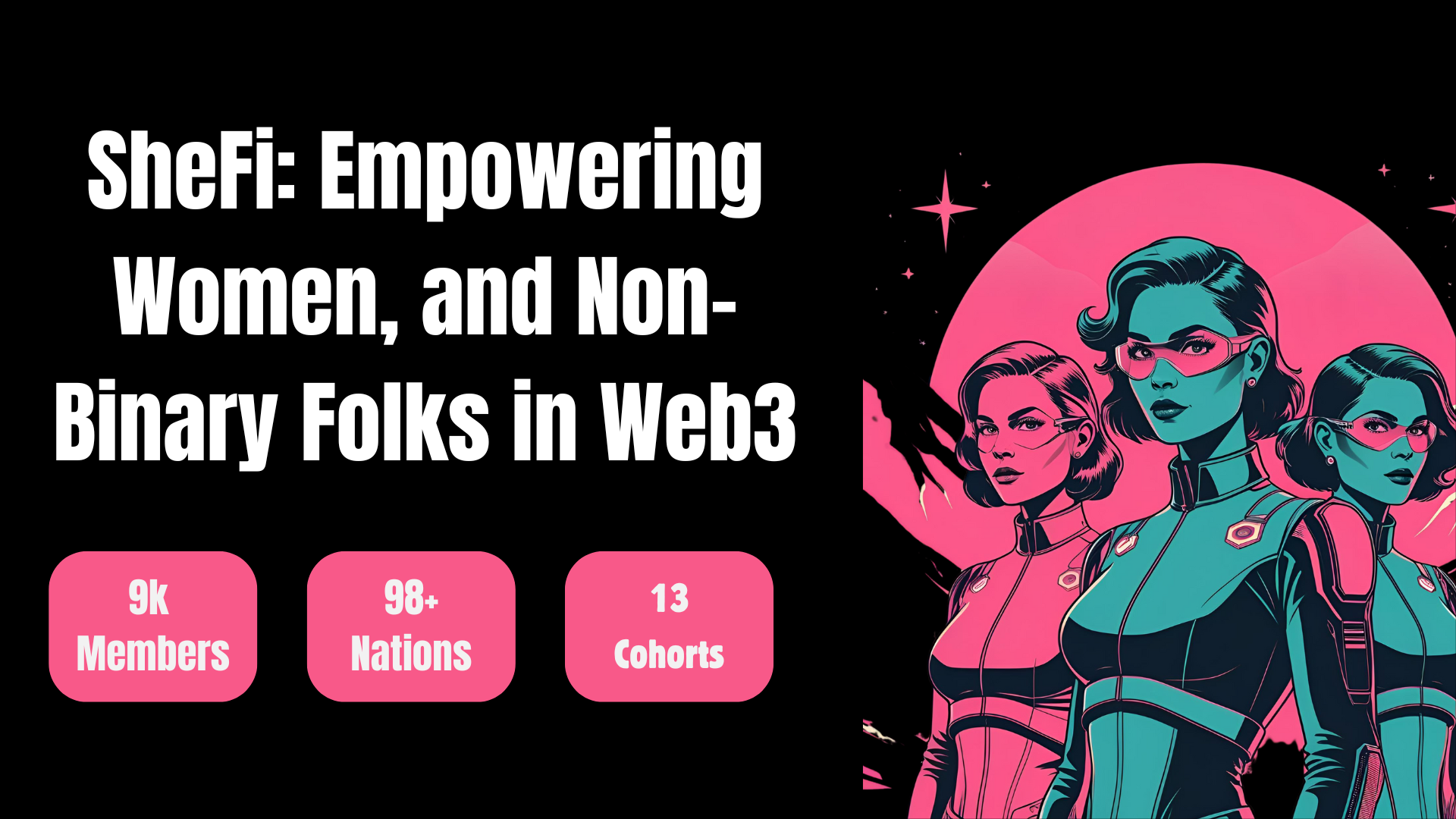
    What really makes SheFi different is its amazing global community. With over 9000 members in 98+ countries, SheFi has built something incredible: a worldwide network of women helping each other succeed in new technologies.

    The results speak for themselves. Since 2020, SheFi has:

    1. Finished 13 groups of students with the 14th happening now
    2. Taught over 9000 people from 98+ nations
    3. Built a social media following of 29,000+ people
    4. Created over 70 hours of content with 21 local chapter leaders

    Members don’t just learn alone. They connect through community chat groups, join virtual events, attend monthly career workshops, and meet up at events around the world.
    Big Web3 companies like Lens Protocol, Zerion, Aave, and Pyth have sponsored the program, showing that the industry recognizes how important SheFi’s work is.

    Real Practice and Recognition

    SheFi goes beyond just theory with fun blockchain activities. Students earn “Planets” (class certificates as NFTs) and “Astral Achievements” (quest certificates as NFTs) as they learn, making Web3 concepts feel real and fun.

    The program has earned respect from big institutions. Maggie has taught SheFi courses at Google, United Talent Agency, and Oxford Business School, proving that this woman-led program is changing how professionals learn about Web3.

    Building Confidence with Positive Thinking

    Maybe most uniquely, every SheFi class starts with positive statements designed to build self-confidence. This isn’t just feel-good talk; it’s based on science showing that saying positive things about yourself regularly can actually change your brain to focus on your strengths, boost confidence, and help you keep growing.

    “You Can Do It!” isn’t just SheFi’s saying; it’s built into every part of learning through three main ideas:

    Belief: Building curiosity, self-belief, clear goals, and positive self-talk
    Commitment: Creating commitment, practice, bounce-back ability, never giving up, and determination
    Engagement: Encouraging active participation, asking good questions, taking on challenges, asking for help, and teaching others

    The SheFi Summit Experience

    The community goes beyond online classrooms through SheFi Summits, women-focused events held in major cities worldwide. These aren’t typical tech conferences; they’re immersive experiences where women connect, learn, and celebrate their wins together.

    Recent events have drawn big crowds: 300+ people in Paris (90% women) and 400+ people in Denver (90% women). The next summit in Brooklyn, New York will continue bringing together diverse women excited about Web3’s potential.

    Making It Affordable for Everyone

    Even though SheFi offers high-quality education, it stays committed to being affordable. The full program costs $799, but scholarships are available to make sure money problems don’t stop motivated women from joining. This commitment to including everyone reflects SheFi’s main mission: making sure Web3’s future gets built by diverse voices.

    Join the Movement: What You Can Do

    Are you ready to gain financial freedom, change your career, and help shape the future of Web3? SheFi offers an amazing chance to learn Web3 in just 8 weeks, with the support of a global community. Whether you want to understand the ideas, get hands-on experience, or build a strong network, SheFi gives you the learning, practice, and community you need to do well. Money help (scholarships) is available to make sure everyone can join. Don’t miss your chance to be part of the next group and help create a fairer and more open Web3.

    Visit shefi.org to learn more and apply now for the next SheFi cohort and step into the frontier, because it’s feminine.