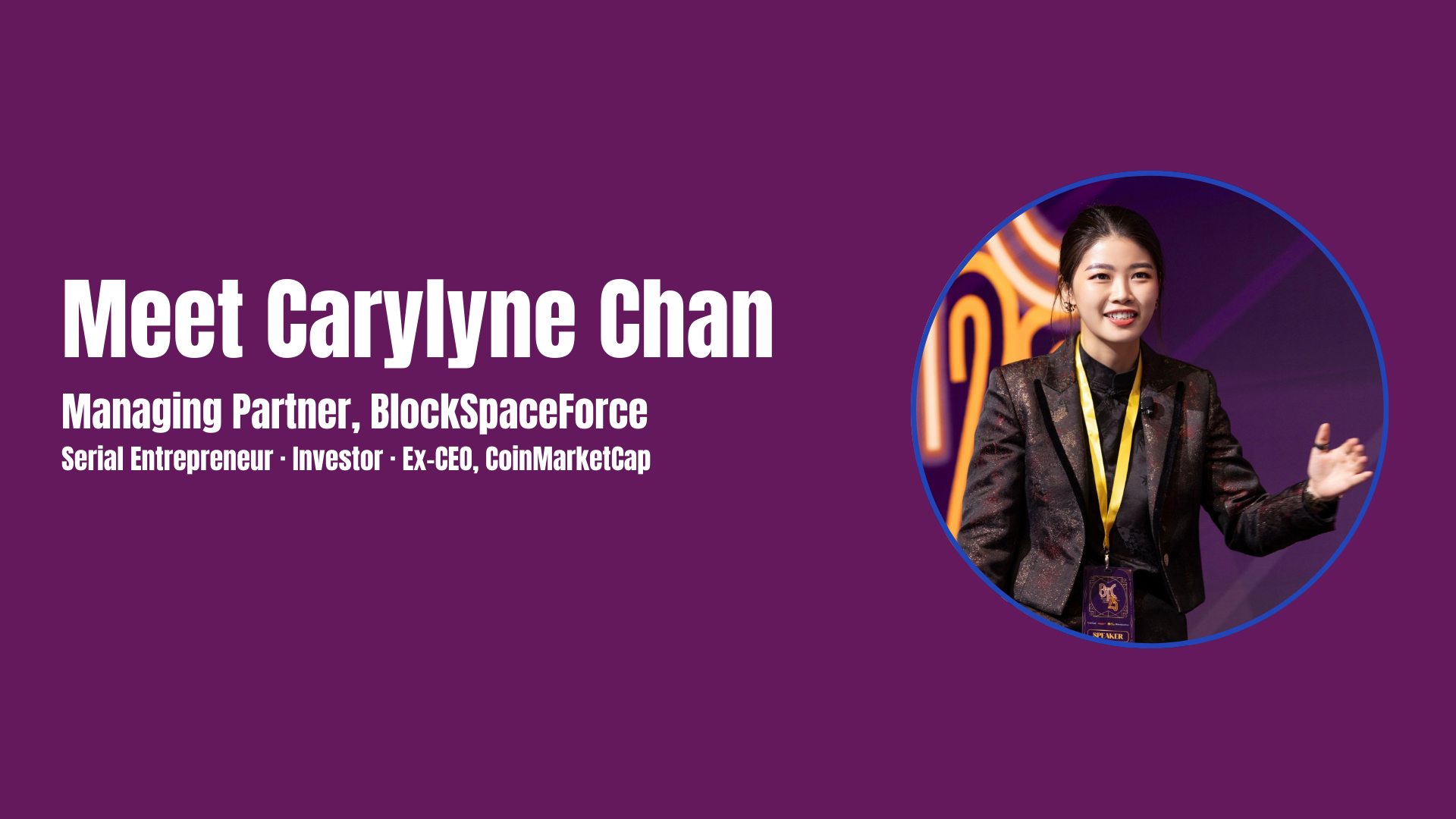
From a young age, she learned how to stand on her own feet, trust her instincts, and turn small beginnings into big opportunities. She didn’t wait for the “perfect moment.” She learned by doing, by experimenting, and by believing that underdogs can rise if they keep showing up with clarity and courage.
Today, Carylyne helps founders dream bigger, move faster, and build companies that matter. She has worked across different worlds including tech, crypto, consumer and more, always with the same mindset: stay curious and keep creating.
In this conversation, she shares the lessons, beliefs, and values that shaped her journey. Her story is a reminder that you don’t need a perfect background to build something meaningful; you just need the willingness to grow and the courage to take the first step.
The Interview: Carylyne Chan on Exits, Building & Investing Across AI, Crypto & Consumer
1) Tell us a bit about yourself – who is Carylyne Chan, where are you from, and what are you working on currently?
I’m someone who loves taking sharp ideas from small, scrappy teams and scaling them into global contenders. That instinct started early — I grew up in Singapore, took my first internship at 14 at a government agency talking to strangers about environmental issues, and spent my teens building social enterprises and learning how to operate before I even knew what a startup was.
A turbulent home life pushed me to become independent quickly, and it shaped two things that still define me today: a strong bias toward self-determination, and a deep soft spot for underdogs with outsized potential.
My career since has moved across AI/ML, crypto, and multiple exits — including helping scale CoinMarketCap from a one-person idea into a global team and a nine-figure acquisition. I’ve lived across multiple cities in the US and China, and recently moved back to San Francisco to be closer to the center of tech’s momentum and idealism.
Today, I run BlockSpaceForce, where we invest, operate, and incubate frontier, category-defining companies — and increasingly those at the inevitable convergence of crypto and the broader capital markets. Across everything I do, the throughline is the same: partnering early with exceptional founders and helping them punch far above their weight.
2) You had a successful AI/ML career – AngelPad, Fortune 500 companies. Then you joined CoinMarketCap in 2018 when it didn’t even have a logo. What made you see potential others missed?
I’ve always been drawn to categories where the macro trend is already unmistakable, but the supporting products are still early, underbuilt, or not meeting the moment. Those inflection points create room for small teams to have an outsized impact if they move quickly and build with clarity.
CoinMarketCap is one example. Crypto was becoming a global phenomenon, and there’s a very human instinct to rank, compare, and make sense of new markets — so the need for reliable data was obvious. At the same time, relative to the importance of the category, there was still a huge amount of room to grow the products and companies inside it. That combination — an inevitable trend paired with a product that already had strong natural pull — made the opportunity clear.
That’s generally how I choose the environments I step into: I look at where the world is already heading, and then ask whether the product or team at the center of it has the raw ingredients to grow into the role the category will eventually demand.
3) You’ve invested in Babylon, SatLayer, Alkimiya, and others. What pattern do you see in Bitcoin infrastructure that excites you most right now?
What excites me most is that Bitcoin is finally moving from being primarily a trillion-dollar asset to becoming a real economic platform. The asset itself is enormous, yet the economic value built on top of it is still only a tiny fraction of that — far smaller than you’d expect for something so globally held and trusted.
The next decade is about closing that gap. We’re seeing teams build the primitives that make Bitcoin not just a store of value, but a productive base layer for the broader cryptoeconomy: secure and trustless staking and restaking, blockspace markets and optimizations, more expressive settlement layers, bridges into traditional capital markets, and more.
Across the founders I believe in and back, the pattern is consistent: they expand what’s possible on Bitcoin without compromising its principles; they create new economic surface area instead of repackaging old ideas; and they ship with the speed and clarity that only small, deeply technical teams can bring.
To sum it up, I find that the opportunity in Bitcoin infrastructure is enormous — not just because of where the asset is today, but because of how much value still hasn’t been activated around it.
4) You describe yourself as turning “the underdog to top-dog.” What’s a specific strategy you’ve used multiple times to help companies dominate their category?
What I’ve seen repeatedly is that small, sharp teams often already have the right instincts — they’re close to the problem, they move fast, and they see things others miss. What they usually need is someone to help pull all those instincts into a coherent center, so they’re not fighting their own momentum.
The way I do that is by surfacing the team’s real point of view — the thing they believe but haven’t fully articulated yet — and then helping them build the product, messaging, and operating cadence around it. Once that spine is clear, execution becomes dramatically easier: priorities align, decisions get cleaner, and the team can finally move as one organism instead of scattered parts.
A big part of my work is also in the day-to-day with founders: being a sounding board, a confidante, the person who can absorb complexity with them and help translate it into action. Early-stage companies rise and fall on the founder’s clarity and energy, so creating that steadiness is just as important as any strategy.
From there, it’s about ongoing execution — building systems, tightening loops, and running focused pushes that compound over time. When a small team gains that combination of clarity, support, and operational rhythm, they start to feel much larger than they are. That’s how an underdog grows into a category leader: not through theatrics or one-offs, but through coherence and consistent, high-quality execution.
5) You’ve navigated AI acquisition, crypto acquisition, and now building consumer brands. What’s one principle that’s remained constant across all these transitions?
The principle that’s stayed constant for me is simple: play my own game all-in. Every chapter — AI, crypto, consumer — has come from following where my curiosity is strongest, where the learning curve is steepest, and where I feel I can genuinely change the status quo.
My personal credo has always guided that: stay open-minded, take risks, aim for world-class execution, create rather than imitate, and keep growing toward your fullest potential. I’ve never believed in choosing paths because they’re popular or predictable; I choose the places where the work feels alive and where I can contribute something real.
Across every transition, the same principle keeps proving itself: move toward the arenas that stretch you, that demand creativity and conviction, and that offer the chance to build something that didn’t exist before. When I make decisions from that place — not from fear, comparison, or chasing optics — the outcomes tend to compound.
Believing you’re lucky and acting like it also helps. It keeps you bold, forward-looking, and willing to take the kinds of swings that make the journey meaningful — especially when you get to take that journey with the right people!
6) What’s the biggest misconception founders have about exits that you’ve seen proven wrong? Based on your experience, what actually makes a company attractive to acquirers?
One of the biggest misconceptions is that acquirers are chasing “traction” or generic growth metrics. In reality, buyers don’t acquire momentum — they acquire strategic leverage. An exit usually happens when your company gives someone else something that’s hard, slow, or expensive for them to build on their own.
But the part founders overlook is that it’s not just a rational business decision. It’s also an emotional one. Acquirers are betting on people — on whether your team can mesh with theirs, whether there’s trust, and whether the combined company will be stronger than either side on its own. Cultural fit, continuity, and the ability to actually use and scale what you’ve built matter much more than most founders realize.
What makes a company attractive often looks like a mix of the following:
- you solve a problem the buyer urgently needs addressed,
- you built something they can’t easily replicate,
- you give them meaningful time-to-market advantage,
- your team brings talent or insight they lack, and
- the combined story makes sense internally and externally.
That last part is underrated: leaders need to justify the acquisition to their board, their employees, and the market. If your product and team help them tell a clear, forward-looking narrative, you become exponentially more attractive.
Founders often imagine exits as a reward for “success.” They’re not. They’re a strategic decision layered with human judgment. Only when both dimensions line up does the process become much clearer and far more predictable.
7) The “Build to Exit” Debate: Some say building with an exit in mind compromises the product. Others say it’s just smart business. Where do you stand, and why?
The debate is often framed in a way that misses the real issue. Building “for an exit” isn’t what compromises a product — getting distracted, chasing the wrong incentives, or making reactive decisions does. You can care about strategic outcomes without losing sight of what you’re building.
My view is that great companies are built the same way whether you eventually exit or not: you solve a real problem, you build with conviction, and you create something that users genuinely value. At the same time, it’s helpful — not harmful — to understand how acquirers think, what they look for, and how timing and competitive pressures shape their decisions. That context keeps you from unintentionally closing off future paths.
So my stance is: Build to endure, keep your standards high, and stay aware enough that if an exit becomes the right outcome, you’re already prepared for it.
You don’t have to optimize for an acquisition, but you also don’t need to pretend it doesn’t exist. The healthiest companies keep their options open while staying fully committed to making the product exceptional.
8) Post-acquisition, how did you navigate ‘what’s next?’, and what led you from tech to building consumer brands? Did you plan this shift, or did it unfold naturally?
After the acquisition, I finally had the freedom to choose my next chapter with intention. Instead of jumping into the next obvious thing, I gave myself space to explore what I was genuinely curious about — the kinds of problems I wanted to solve, the experiences I wanted to design, and the worlds I wanted to help shape.
With that autonomy, I found myself gravitating toward more tactile and culturally expressive ideas. I started noticing things that felt overlooked or unnecessarily complicated and became interested in redesigning them. That exploration led me to writing a sunscreen applicator patent and creating a sunscreen brand, and later to building a portable multi-brew tea ceremony. Each one began the same way: seeing something people had accepted as “just how it is,” and reimagining it from scratch.
What surprised me was how familiar the process felt compared to tech. You’re still solving a real problem, still thinking deeply about narrative, distribution, user behavior, and product–market fit — just expressed through physical experiences rather than software.
I never stopped working on and investing in crypto or tech; consumer simply became another place where I could apply the same way of building. It expanded my creative range, strengthened my operator instincts, and gave me a different lens for designing products people love.
9) With AI commoditizing tech, distribution has become the real moat. “Build it and they will come” product led growth can still be a moat. Any advice for early stage founders with limited resources on how to balance product, speed, and distribution?
AI changes how fast you can build, but it doesn’t change why great products win. It makes prototyping easier, lowers technical barriers, and shortens the distance between idea and execution. But it still can’t replace clarity about your users, good judgment, or the ability to create something people immediately care about.
For early-stage founders with limited resources, the most important thing is knowing exactly who you’re building for. AI lets anyone ship a product — it doesn’t tell you if you’re solving the right problem. Teams who understand the users who feel the pain most intensely still move faster and with far less waste.
The second piece is learning speed. AI helps you ship quickly, but the real advantage comes from staying in a tight feedback loop. Early companies succeed by getting sharper with every iteration, not by chasing perfection on day one.
AI also highlights something that’s always mattered: discernment. When everyone can build, what stands out are the choices you make — the narrative, the moments where users instantly “get it,” the things that feel intentional. These become natural points of distribution and travel much further than broad marketing campaigns.
And finally, even in an AI world, small teams win by choosing a few distribution channels they can execute consistently. A clean connection between product, user insight, and the right channels still beats trying to be everywhere at once.
So while AI automates pieces of the stack, it amplifies the advantage of teams with clarity, taste, and momentum. Those fundamentals don’t change — and they’re exactly what allow small teams to create outsized impact.
10) How do you sustain energy across so many different projects?
I’ve found that the key to working across different projects is choosing things that naturally hold my attention. When I’m building or advising in areas I find meaningful — whether it’s Bitcoin infrastructure or redesigning a physical experience — I don’t have to force myself into motivation. Curiosity creates its own momentum.
I’m also intentional about how I structure my time. I keep long blocks for deep work, build weeks with a rhythm that fits how I think best, and avoid spreading myself thin across constant context switches. Matching my schedule to my natural cadence has made a huge difference.
Another part of it is staying close to founders and teams I genuinely enjoy working with. Being in real collaboration — where the thinking is sharp and the conversations are honest — is sustaining in its own way. Progress feels faster and more meaningful when it’s shared.
And finally, I’m clear about my personal capacity. I know what I can hold, what should be handed off, and what no longer fits. When the work aligns with my curiosity, the people are strong, and the structure supports good decision-making, it becomes surprisingly manageable to contribute across multiple domains.
11) After two successful exits, you chose to continue building diversified ventures, angel investing, advising. What’s your “why”? What keeps you in the arena?
At this point, I build because I genuinely enjoy it. I like working with sharp founders, I like shaping new categories, and I like taking ideas that feel small or overlooked and helping them grow into something meaningful. It’s both intellectually challenging and creatively satisfying — a combination that’s hard to walk away from.
I also have a soft spot for underdogs. I know what it feels like to start with very little and still want to change the status quo. Helping founders who have the insight and the will, but not necessarily the resources, is something I find both energizing and grounding.
Working across different ventures — investing, advising, and building — lets me choose areas where I can contribute uniquely and stay in a steep learning curve. I’ve never had the desire to “retire.” I’d rather keep growing and keep building alongside people I respect.
And finally, I stay in the arena because it continues to feel meaningful. The problems are bigger, the tools are better, the founders are more global, and the opportunities are more open-ended than ever. If anything, this is the most interesting moment to be building — and I want to be part of shaping what comes next.
12) Any final insights for web3 founders? Or anything else you’d like to share that we didn’t discuss?
Focus on what’s real. Web3 moves fast, narratives change, and hype comes and goes — but solving a real problem never stops compounding.
Have a sharp point of view, build with discipline, and stay close to the users who feel the pain the most. Everything else becomes noise.
And remember: you don’t need a big team to make a big dent. A small, aligned group with conviction can reshape an entire category.
If you see something inevitable and underbuilt, go build it. No one is waiting to give you permission. When you spot the thing that won’t leave your mind, commit. And remember to play your own game, all-in!
Carylyne’s story shows that the most powerful growth doesn’t happen all at once. It happens when you stay curious, stay open, and keep moving forward even when the road feels uncertain. She reminds us that the people who make the biggest impact are not always the ones who start with the most, but the ones who stay committed to what feels real and important.
Stay connected with Carylyne and her deep thinking:
- X: @carylyne
- LinkedIn: Carylyne Chan
- Blog: carylyne.com
Join the BlockchainHQ community where builders share knowledge, collaborate on projects, and support each other’s growth. Sign up from here: https://blockchainhq.xyz/auth and follow us on X https://x.com/blockchainhqxyz to become part of our invite-only Telegram community where the real conversations happen.
Leave a Reply