Category: learn

  • From First Principles to First dApp: Learn Blockchain Dev in 2025

    From First Principles to First dApp: Learn Blockchain Dev in 2025

    Have you ever used an app and thought… “Why am I giving away all my data just to use this?”

    Or maybe you’ve wondered:

    Why can banks freeze your money without warning? Why are the games you buy online not really yours? Why do the same tech companies control everything we do?

    The answer lies in one word: trust.

    Or rather, the lack of it.

    That’s where blockchain steps in.

    In 2025, blockchain isn’t just about Bitcoin or NFTs anymore. It’s becoming the foundation for a new kind of internet, one that doesn’t ask you to trust companies, platforms, or middlemen blindly.

    But here’s the problem: most people are stuck on the sidelines.

    They hear the buzzwords. They see the headlines.

    But they don’t know where to start.

    This guide fixes that.

    Whether you’re a student, a curious developer, or someone who just wants to build something real, this is your step-by-step path.

    Real skills. Real tools. A mindset that helps you keep going.

    Let’s start with what really matters, and  the why behind it all.

    We’re still early.

    Ethereum co-founder Vitalik Buterin recently said:

    “There are still many unsolved problems in scalability, privacy, user experience… We need more developers focused on these layers.”

    The reality is this: the blockchain ecosystem is not “done.”

    It’s still being built, and it needs builders.

    Whether it’s making DeFi safer, improving wallets, exploring zero-knowledge proofs, or helping people own their digital identity, there is a real, growing need for smart developers who can understand and ship in this space.

    Why Blockchain? Start With First Principles

    Before we talk about coding, let’s talk about why blockchain exists at all. Because if you don’t understand the “why,” you’ll struggle with the “how.”

    Imagine you want to send money to your friend in another country. Right now, you need banks, clearinghouses, and payment processors. Each one takes a cut. Each one adds delay. Each one becomes a potential point of failure.

    What if you could send that money directly? No middlemen. No extra fees. No waiting three business days for “processing.”

    That’s blockchain’s core promise: removing intermediaries from systems that have always needed them.

    But money is just the beginning. What about voting systems where everyone can verify results? Supply chains where you can track products from farm to table? Digital identities that you actually own?

    Public vs Private Blockchain:

    You’ll come across different types of blockchains. They are not all the same.

    Public Blockchains

    These are open to everyone. Anyone can read, write, and build.

    Examples: Ethereum, Solana, Bitcoin

    Private Blockchains

    These are permissioned. Only selected people can participate.

    Examples: Hyperledger, Fabric

    Many people assume private blockchains are more secure because they offer control. But as Sandy Kaul rightly said:

    “The fewer nodes and simpler security models in private chains make them more vulnerable than public chains.”

    Serge from Chainlink added:

    “All private blockchains will eventually have to connect to public blockchains. Their liquidity and relevance will shrink.”

    That’s why most developers today are building on public chains,  it’s where the action is, and where the opportunities are

    Choosing Your Lane: Types of Chains

    Not all blockchains are created equal. Each has different strengths, different communities, and different opportunities.

    • Ethereum is the most widely used and secure. It’s great for learning and building, but can be slow and expensive during high traffic.
    • Solana is super fast and cheap, best for real-time apps and games. It uses a different coding language (Rust) and has fewer validators.
    • Polygon is a faster, cheaper version of Ethereum. It uses the same tools and is ideal for testing or scaling Ethereum apps.
    • Avalanche offers high speed and flexibility, letting you even create your own custom blockchains.
    • Arbitrum and Optimism are “Layer 2” networks built on top of Ethereum to make it faster and cheaper, using the same code.

    Each has strengths. Start with Ethereum to learn the basics, then explore others as you grow.

    Pick a Niche and Stick (For Now)

    You don’t need to learn every chain.

    Pick one and go deep.

    Examples:

    • Ethereum → Use Solidity + Foundry or Hardhat
    • Solana → Use Rust or JavaScript with Anchor
    • Aptos/Sui → Learn Move language
    • Starknet/Polygon zkEVM → Explore ZK circuits

    Choose one based on what excites you.

    DeFi, NFTs, ZK proofs, gaming, DAOs,  pick your playground

    Core Concepts Before Coding

    Before you write your first smart contract, make sure you understand these fundamental concepts:

    Cryptographic Hashing is how blockchain ensures data integrity. Every block contains a hash of the previous block, creating an unbreakable chain.

    Digital Signatures prove that transactions are authorized by the rightful owner of an address.

    Consensus Mechanisms are how the network agrees on what’s true. Proof of Work, Proof of Stake, and other algorithms each have different trade-offs.

    Gas is the fuel that powers blockchain operations. Every computation costs gas, and understanding this is crucial for writing efficient code.

    Smart Contracts are programs that run on the blockchain. They execute automatically when conditions are met.

    These aren’t just academic concepts. They affect every line of code you’ll write. A smart contract that doesn’t consider gas costs might be too expensive to use. A DeFi protocol that doesn’t understand consensus mechanisms might have security vulnerabilities.

    Smart Contract Security Essentials

    Here’s something that might surprise you: smart contract security is still a mess.

    Samczsun, one of the most respected security researchers in the space, noted that “almost every ticket that we got was a smart contract hack.” This isn’t ancient history. This is happening right now.

    What does this mean for you as a developer? Opportunity. The ecosystem desperately needs developers who understand security.

    Learn about common vulnerabilities like reentrancy attacks, integer overflow, and access control issues. Understand how to use tools like OpenZeppelin’s secure contract libraries. Practice writing tests that try to break your code.

    Security isn’t something you add at the end. It’s something you build in from the beginning.

    Gas Optimisation: Write Efficient Code

    Every operation on the blockchain costs gas. Users pay these costs. Write inefficient code, and nobody will want to use your application.

    Learn how to:

    • Pack storage variables
    • Minimize external calls
    • Use view and pure functions

    This isn’t premature optimization. This is fundamental to blockchain development. A function that costs $50 in gas fees won’t get used, no matter how clever the code is.

    And so on.

    Take a course on this and start learning these techniques

    Don’t Just Learn. Ship.

    This is the most important point.

    You will learn more by building one simple dApp than by reading 50 articles.

    Even if it’s small,  a todo list on-chain, a voting contract, or a basic NFT mint page just ship something.

    Break things. Fix them. Ask questions. Improve.

    Where Are the Opportunities? Jobs, Hackathons, Communities

    Blockchain is not just a tech stack. It’s a community.

    To grow fast:

    • Join hackathons: ETHGlobal, DoraHacks, Encode, Devfolio
    • Explore job boards: Web3.career, CryptoJobsList, Remote3
    • Hang out in Discords and Telegrams of your favorite protocols
    • Learn from:: Cyfrin Updraft, Alchemy University, Speedrun Ethereum and more

    The earlier you show up and ship, the faster you’ll stand out.

    Stay in the Game: Learn in Public

    Building in public is a superpower in the blockchain space. Share your learning journey. Tweet about the bugs you’re fixing. Write about the concepts you’re understanding. Stream your coding sessions.

    This isn’t just about personal branding. It’s about accountability. When you commit to learning in public, you’re more likely to stick with it. You get feedback from the community. You build relationships with other developers.

    Balaji Srinivasan, former CTO of Coinbase, talks about blockchain as the infrastructure for future digital societies. He’s working on projects that use blockchain to create new forms of governance and community. This vision shows blockchain development is evolving beyond financial apps into building tools for entire digital civilizations.

    Checklist: What You Should Have Built After 30 Days

    By the end of your first month, aim to have:

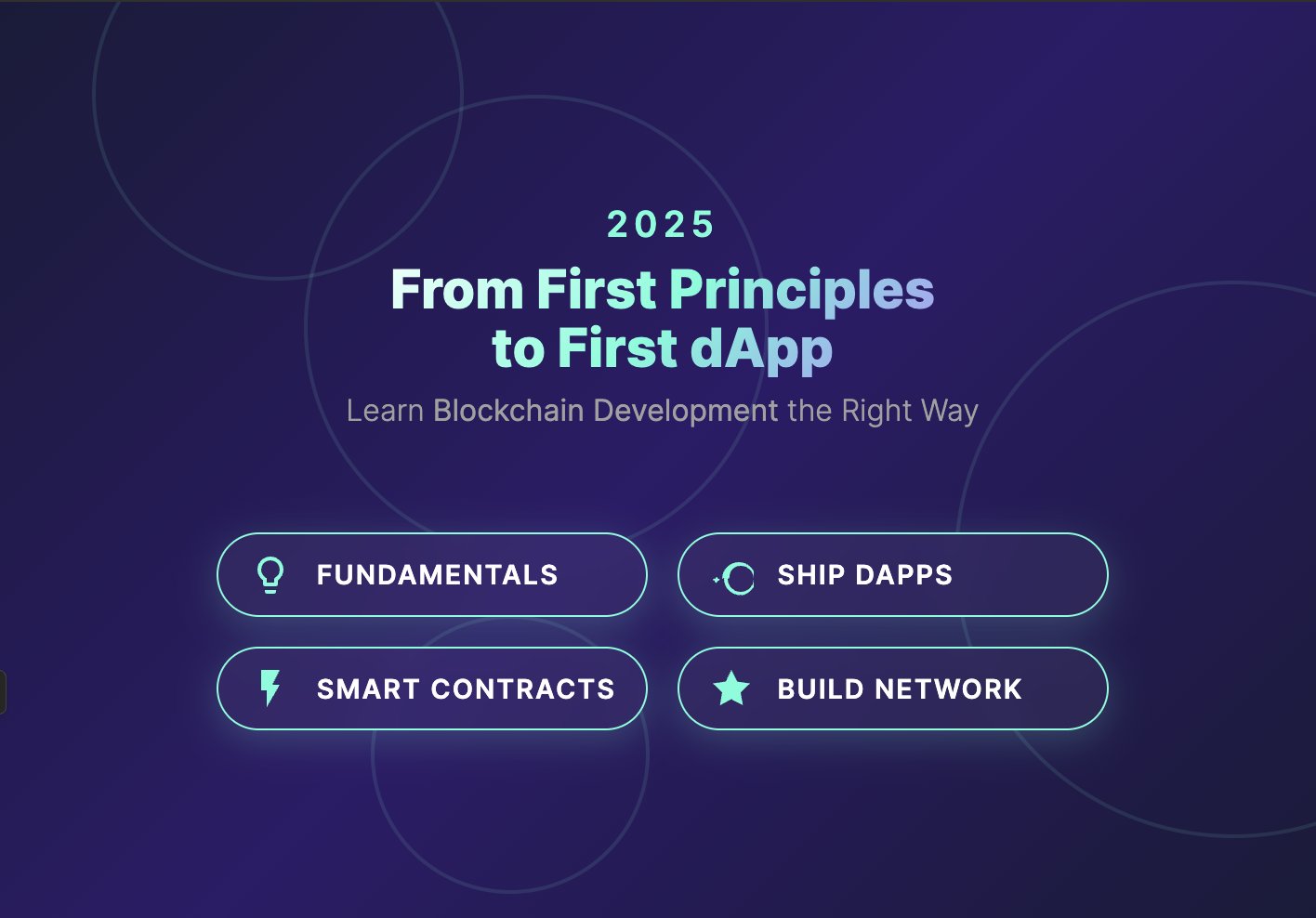
    • Fundamentals of Blockchains
    • A wallet setup (Metamask or others)
    • At least one deployed smart contract
    • A frontend that interacts with your contract
    • A GitHub repo or site link to share your project
    • A basic understanding of gas and security

    A note of 5 things you’d do differently next time

    Blockchain Learning Loop: (Read → Code → Break → Fix → Share → Repeat)

    Learning blockchain development isn’t linear. It’s cyclical. Here’s the loop that works:

    Read documentation, tutorials, and other people’s code. Don’t just skim. Really understand what’s happening.

    Code your own version. Start with copy-paste if you need to, but make sure you understand every line.

    Break things on purpose. What happens if you change this parameter? What if you remove this check? Breaking things teaches you how they work.

    Fix the problems you created. This is where real learning happens. When you fix a bug, you understand the system better.

    Share what you learned. Write about it. Talk about it. Teach someone else.

    Repeat with something more complex.

    This loop works because it combines multiple learning styles. You’re reading, writing, experimenting, and teaching. Each reinforces the others.

    Staying Current and Continuous Learning

    Blockchain evolves fast. Stay up to date by:

    • Subscribing to developer newsletters (Week in Ethereum, Starknet Weekly)
    • Watching talks from ETHGlobal, Devconnect, ZK Summit
    • Reading protocol docs regularly
    • Following devs who ship: Austin Griffith, Patrick Collins, 0xfoobar, and others

    Keep your learning tight. Build in the open. And don’t stop.

    Final Thoughts

    You don’t need to be a genius to become a blockchain developer.

    You just need a clear roadmap, a community, and the courage to start.

    There’s never been a better time to build.

    The tools are better. The community is bigger. The problems are real.

    Blockchain isn’t just about finance anymore.

    It’s about rewriting how the internet works,  and you can be part of it.

    Ready to start your journey?

    Check out our Resource Page( https://blockchainhq.xyz/resources ) to find everything from beginner tutorials to advanced guides

    The blockchain ecosystem is waiting for what you’ll build next🫡

  • Para: Go Beyond Web3 Onboarding with Universal Embedded Wallets

    Para: Go Beyond Web3 Onboarding with Universal Embedded Wallets

    The Problem: Crypto is Too Hard for Normal People

    If using crypto was as easy as checking your email, would more people use it? That’s the question Para asked themselves when they realized that most people would rather avoid crypto entirely than deal with 12 word recovery phrases that could lose them everything.

    When Para started as Capsule in 2022, their mission was simple: make blockchains work for everyone, not just tech experts. The gap between crypto’s promise and reality was massive. Crypto promised freedom and control, but delivered complexity and fear.

    The barrier wasn’t the technology itself, it was everything surrounding it. Seed phrases that couldn’t be recovered. Multiple confusing networks. Fees that made no sense. One wrong click could cost you everything.

    Most people took one look and walked away.

    What Para Actually Does

    Para stands for making crypto as easy as logging into any normal app. They built what they call “universal embedded wallets”,: which is a fancy way of saying “crypto wallets that work like everything else you’re used to.”

    Here’s what that means for regular people:

    No More Seed Phrases: Users can log in with their email, Google account, or even just their face or fingerprint (using something called passkeys). If they forget their password, they can recover their wallet just like they would recover their Instagram account.

    Works Everywhere: Para wallets work across different blockchains (like Ethereum, Solana, and others) so users only need one wallet instead of juggling multiple apps.

    Actually Secure: Unlike many “easy” solutions that compromise on security, Para uses advanced encryption called MPC (Multi-Party Computation) that splits your private key into pieces stored in different places, so no one, not even Para, can access your money.

    The Tech Behind the Magic: Distributed Multi-Party Computation (MPC)

    Para’s secret sauce is something called Distributed Multi-Party Computation (MPC). In simple terms:

    • Your wallet’s “master key” is split into multiple pieces
    • These pieces are stored in different secure locations
    • When you want to make a transaction, these pieces work together to sign it without ever being in the same place
    • This means there’s no single point of failure, if one piece gets compromised, your money is still safe

    Para also uses passkeys, which leverage secure chips in your phone or computer to add an extra layer of protection. It’s like having a vault that requires multiple keys, but one of those keys is literally built into your device.

    Real Impact: Making Web3 Identity Accessible

    Take ENS (Ethereum Name Service), which lets people get human readable names like “yourname.eth” instead of confusing wallet addresses. ENS partnered with Para to power their official ENS Manager App, and the results show why this approach works.

    Before Para, getting an ENS name required:

    • Having an existing crypto wallet
    • Understanding how to connect it to websites
    • Knowing how to manage transactions and gas fees

    Now with Para embedded in the ENS app, users can:

    • Create a wallet instantly and buy an ENS name with just email or social login
    • Use their ENS name immediately across all crypto apps without downloads or seed phrases
    • Connect existing ENS names universally across apps

    As ENS put it: Para makes crypto identity “just as accessible to crypto newcomers” as it is to crypto experts. For many people, ENS becomes their entry point into crypto, and Para makes that possible.

    Para’s Evolution: From Capsule to Something Bigger

    Para recently rebranded from “Capsule” to reflect their broader mission. The name change isn’t just cosmetic, it represents their evolution from a simple wallet tool to a complete platform for bringing crypto to everyone.

    As they put it: “Our evolution to Para is foundationally a step towards embracing the core of what we do, we help developers and their users get the best of what’s onchain”.

    The New Developer Portal: Making It Easy to Build

    Para just launched a completely redesigned Developer Portal that makes it easier for companies to integrate crypto features. Think of it as the control center where businesses can:

    • Set up wallets for their users in minutes, not days
    • Track how people are using their crypto features with detailed analytics
    • Control security settings, payment options, and branding
    • Manage teams with different permission levels

    The new portal is “built for every kind of team, from solo developers to ecosystem foundations” and focuses on helping businesses grow without compromising on security.

    Breaking Down Barriers Across Ecosystems

    One of Para’s biggest innovations is solving the “ecosystem problem” in crypto. Currently, if you use an app built on Ethereum, you need one wallet. If you use a Solana app, you might need a different wallet. Para changes this.

    With Para’s “ecosystem approach,” users get “one universal identity that travels with them wherever they go”. They partnered with networks like Camp to create “a universal embedded wallet that unifies IP, reputation, and identity across every application”.

    Major Partnerships Prove It Works

    Para isn’t just a theory, major players in crypto are betting on their approach:

    ENS (Ethereum Name Service): “The universality of Para’s embedded wallets makes them an ideal partner in our mission to make ENS names available to anyone”

    MetaMask: Para is one of the first companies selected for MetaMask’s new Account Snaps program, bringing their embedded wallets directly into the world’s most popular crypto wallet

    Vana Network: “Para empowered 1 million users to take control of their data on r/datadao”

    Enterprise Grade Security (That Actually Matters)

    Para recently completed SOC 2 compliance certification, with their Type I Audit completed in 2024 and Type II Audit completed in January 2025. This isn’t just a fancy certificate, it means Para meets the same security standards that banks and major corporations require.

    They also support multiple blockchains natively, meaning developers can build applications that work across Ethereum, Solana, and other networks without users needing to understand the differences.

    What This Means for the Future

    Para represents a fundamental shift in how we think about crypto adoption. Instead of expecting people to learn crypto’s complex rules, Para makes crypto work within the rules people already understand.

    Their vision is “a world where the internet is built around people, not corporate walled gardens. Where we are in control of our identities, data, and value and can bring ourselves across the digital world”.

    The early numbers suggest this approach works. Over the last two years, they’ve supported “hundreds of developers and their millions of users across nearly every major ecosystem”.

    The Bottom Line

    Para is solving crypto’s biggest problem: it’s too hard to use. By making crypto wallets function like everything else people use online, while keeping them more secure than traditional alternatives, Para is building the infrastructure that could finally bring cryptocurrency to mainstream adoption.

    For developers, Para provides tools to add crypto features without making their users feel like they need a PhD in blockchain technology. For users, it means being able to benefit from crypto’s advantages (true ownership, global payments, new types of applications) without crypto’s traditional headaches.

    As Para puts it, “Para’s mission is to simplify interacting with blockchains,” and judging by their growth and partnerships, they’re succeeding.

    Ready to start integrating Para in your apps? Click here to Get started with Para’s documentation and see how easy it is to add universal embedded wallets to your application.

    Want to build, learn, and grow in the Web3 space alongside like-minded developers? Join the BlockchainHQ community where builders share knowledge, collaborate on projects, and support each other’s growth. Sign up from here: https://blockchainhq.xyz/auth and follow us on X https://x.com/blockchainhqxyz to become part of our invite-only Telegram community where the real conversations happen.

  • SheFi: Empowering Women and Non-Binary Folks in Web3

    SheFi: Empowering Women and Non-Binary Folks in Web3

    The digital money revolution was happening with or without women. But one woman refused to let it happen without them. Meet Maggie Love, the founder of SheFi, who turned a concerning gap into a global movement that’s empowering thousands of women to claim their place in Web3.

    How It All Started

    Back in 2019, Maggie Love noticed something wrong.

    Maggie had been working in Web3 since 2017,

    She saw how fast decentralized finance (DeFi) was growing, but she also saw a big gap: very few women were part of it.

    Maggie realized that for Web3 to truly be fair and open to everyone, women had to be involved. If not, there was a real chance that the money world of Web3 would end up just like the old one, where women often faced financial disadvantages

    This worry led her to start SheFi in 2020, based on one strong belief: the future belongs to everyone.

    What Makes SheFi Special

    SheFi isn’t like other crypto schools. It’s a complete learning system made just for women and non-binary people who want to understand Web3. The program mixes three important things that most tech education misses: learning, trying things out, and real community support.

    The main program is an 8-week course that turns complete beginners into confident Web3 users. But unlike scary technical courses that assume you already know stuff, SheFi breaks down hard concepts into simple, practical lessons that anyone can understand.

    Students learn about everything from basic building blocks like blockchains, exchanges, and wallets, to more advanced topics like stablecoins, lending, NFTs, DAOs and Web3 social media. Every topic gets taught through live classes, hands-on practice, and real experiments that build true confidence. 

    Through this full program, SheFi makes sure its members learn both the ideas and how to actually use Web3 technology. This helps them become confident and knowledgeable users of the Web3 world, ready for new career paths and opportunities in this growing field.

    More Than Learning: A Worldwide Family

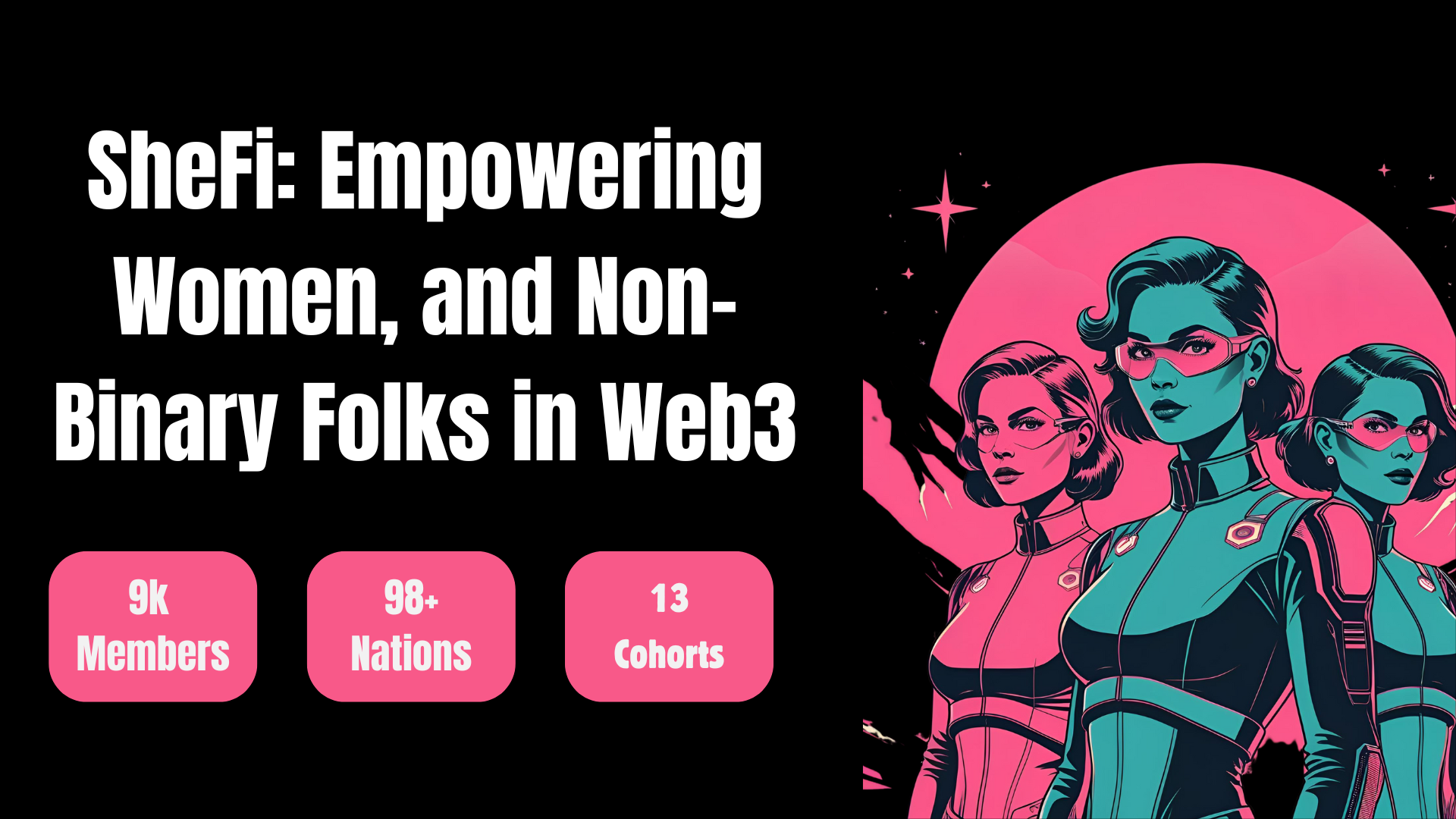
    What really makes SheFi different is its amazing global community. With over 9000 members in 98+ countries, SheFi has built something incredible: a worldwide network of women helping each other succeed in new technologies.

    The results speak for themselves. Since 2020, SheFi has:

    1. Finished 13 groups of students with the 14th happening now
    2. Taught over 9000 people from 98+ nations
    3. Built a social media following of 29,000+ people
    4. Created over 70 hours of content with 21 local chapter leaders

    Members don’t just learn alone. They connect through community chat groups, join virtual events, attend monthly career workshops, and meet up at events around the world.
    Big Web3 companies like Lens Protocol, Zerion, Aave, and Pyth have sponsored the program, showing that the industry recognizes how important SheFi’s work is.

    Real Practice and Recognition

    SheFi goes beyond just theory with fun blockchain activities. Students earn “Planets” (class certificates as NFTs) and “Astral Achievements” (quest certificates as NFTs) as they learn, making Web3 concepts feel real and fun.

    The program has earned respect from big institutions. Maggie has taught SheFi courses at Google, United Talent Agency, and Oxford Business School, proving that this woman-led program is changing how professionals learn about Web3.

    Building Confidence with Positive Thinking

    Maybe most uniquely, every SheFi class starts with positive statements designed to build self-confidence. This isn’t just feel-good talk; it’s based on science showing that saying positive things about yourself regularly can actually change your brain to focus on your strengths, boost confidence, and help you keep growing.

    “You Can Do It!” isn’t just SheFi’s saying; it’s built into every part of learning through three main ideas:

    Belief: Building curiosity, self-belief, clear goals, and positive self-talk
    Commitment: Creating commitment, practice, bounce-back ability, never giving up, and determination
    Engagement: Encouraging active participation, asking good questions, taking on challenges, asking for help, and teaching others

    The SheFi Summit Experience

    The community goes beyond online classrooms through SheFi Summits, women-focused events held in major cities worldwide. These aren’t typical tech conferences; they’re immersive experiences where women connect, learn, and celebrate their wins together.

    Recent events have drawn big crowds: 300+ people in Paris (90% women) and 400+ people in Denver (90% women). The next summit in Brooklyn, New York will continue bringing together diverse women excited about Web3’s potential.

    Making It Affordable for Everyone

    Even though SheFi offers high-quality education, it stays committed to being affordable. The full program costs $799, but scholarships are available to make sure money problems don’t stop motivated women from joining. This commitment to including everyone reflects SheFi’s main mission: making sure Web3’s future gets built by diverse voices.

    Join the Movement: What You Can Do

    Are you ready to gain financial freedom, change your career, and help shape the future of Web3? SheFi offers an amazing chance to learn Web3 in just 8 weeks, with the support of a global community. Whether you want to understand the ideas, get hands-on experience, or build a strong network, SheFi gives you the learning, practice, and community you need to do well. Money help (scholarships) is available to make sure everyone can join. Don’t miss your chance to be part of the next group and help create a fairer and more open Web3.

    Visit shefi.org to learn more and apply now for the next SheFi cohort and step into the frontier, because it’s feminine.

  • Push Chain: The Universal EVM Layer 1 Explained

    Push Chain: The Universal EVM Layer 1 Explained

    Every blockchain developer knows the pain. You spend months building the perfect app on Ethereum, only to realize you’re locked out of millions of users on Solana, Polygon, and dozens of other chains. Want to reach them? Start over. Build again. Audit again. Deploy again. It’s madness.

    What if there was a better way?

    Meet Push Chain: the world’s first truly universal blockchain where you build once and reach users everywhere.

    One Contract. Every Chain.

    If you’ve ever built on Ethereum, you know the drill:

    1. Write your smart contract.
    2. Audit it.
    3. Deploy it.

    Now… do it all again for every other chain.

    Solana? Different stack.
    Polygon? Needs bridging.
    New L2? Another deployment, more audits.

    With Push Chain, that pain disappears.

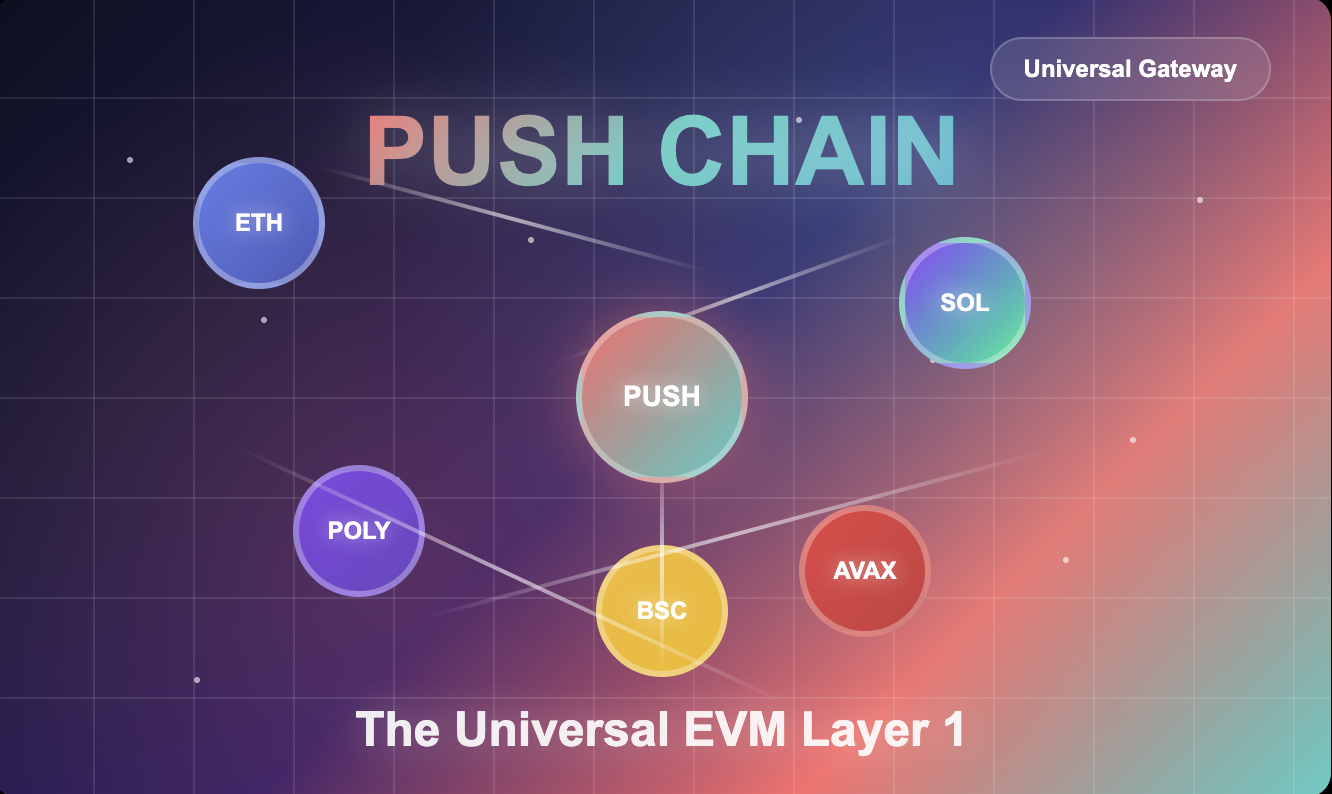
    You write your Solidity smart contract once, deploy it on Push Chain, and instantly your app becomes available to users on Ethereum, Solana, and other major chains, so there are no code changes, no forks, no bridges, and no re-audits.

    Why It Matters

    Build Once, Deploy Everywhere

    You write your smart contract exactly as you always have. Same Solidity code, same tools, same process. Deploy it on Push Chain, and suddenly, users from every major blockchain can use it. No rewrites, no translations, no compromises.

    Every Wallet Welcome

    Your users don’t need to change anything. MetaMask users stay with MetaMask. Phantom users keep using Phantom. Even people who prefer signing in with Google or email can jump right in. Push Chain handles the complexity so your users don’t have to.

    Pay With What You Have

    Here’s where it gets really good: users pay gas fees with whatever tokens they already own. Ethereum users pay with ETH, Solana users pay with SOL. No need to buy some random new token or figure out complicated bridges, even no need to hold $PC (Push Chain’s Native token) 

    Smart Cross-Chain Recognition

    Push Chain’s contracts are brilliant. They automatically know where each transaction came from and handle everything correctly. It’s like having a universal translator that not only speaks every language but understands cultural context too

    Why Developers Love Push Chain

    Instant 10x User Growth

    Deploy your existing app on Push Chain without changing anything, and you immediately reach users across multiple blockchains. It’s like going from a local TV station to worldwide broadcasting overnight.

    Skip the Audit Hell

    Since you’re not changing your code, you don’t need expensive re-audits. Just deploy and go. This saves months of waiting and thousands in audit costs.

    One App, Zero Friction

    Your users get the smoothest experience possible. They use their favourite wallet, pay with their preferred tokens, and never worry about switching networks or bridging funds.

    Future-Ready Technology

    Push Chain is building toward even more powerful features. Soon, your apps will be able to read and write across multiple blockchains simultaneously, orchestrating complex workflows that were impossible before.

    The Secret Sauce

    Universal Gateway (UG) Contracts:

    When someone sends a transaction from Ethereum, Solana, or any other chain to Push Chain, the Universal Gateway Contract is the smart contract that:

    • Receives the transaction on the source chain (like Ethereum)
    • Understands what to do with it
    • Securely passes it to Push Chain, so the right action happens there

    You don’t need bridges, custom scripts, or special tools. UG Contracts automates all the routing behind the scenes.

    Advanced Account Types

    Push Chain creates special account types that make cross-chain interaction seamless:

    Universal Executor Accounts (UEAs): 

    Universal Executor Accounts (UEAs) are special accounts on Push Chain that represent wallets from other blockchains, such as Ethereum or Solana, without requiring users to create a separate Push Chain wallet.

    When someone connects their existing wallet (e.g. MetaMask, Phantom) to a dApp built on Push Chain, a UEA is automatically created to act on behalf of that external wallet.

    Universal Origin Accounts (UOAs):

    This keeps track of where each user originally came from, like Ethereum, Solana, wherever, so the app behaves accordingly.

    Universal Account System:

    Push Chain creates a single format for representing wallet addresses that works across all blockchains. Whether you’re using an Ethereum wallet, Solana wallet, or any other type, Push Chain can understand and work with your address. It’s like having a passport that’s valid everywhere, making cross-chain interactions as simple as local transactions

    The Developer Experience Stays the Same

    Push Chain doesn’t force you to learn new tools. Use the same SDKs, the same APIs, the same development process you’re already comfortable with. Whether you prefer Viem, ethers, or any other library, everything works exactly as expected

    What’s Coming Next

    Push Chain is developing shared state technology and programmable solvers. These will let your apps read from and write to multiple blockchains simultaneously, creating possibilities that don’t exist today.

    Join Push Chain Testnet Early Access

    Doc + SDK Contest has started!

    Explore dev docs, build with the SDK, experiment with the UIKit and grab rewards in the process:

    • Prizes: 1st : $200, 2nd : $100, 3rd–6th: $50 each
    • Onchain perks, including early dev airdrops and XP
    • Core team support

    What You Can Do Now:

    1. Start with the documentation: https://pushchain.github.io/push-chain-website/pr-preview/pr-1067/docs/chain/ 
    2. Drop feedback and discuss with the community: https://zv9atndluia.typeform.com/to/ne3qEzZu 
    3. Deploy your app on Donut testnet using the SDK

    To connect with core developers and other builders, join the community channel from here – https://t.co/qhO94w1joG

    The Bottom Line

    Blockchain development doesn’t have to be complicated. You shouldn’t need separate teams for separate chains. Users shouldn’t need multiple wallets and tokens. Push Chain fixes all of this.

    The future isn’t about choosing Ethereum or Solana or any other chain. It’s about building applications that work everywhere, for everyone, without compromise. Push Chain makes that future available today.

    Stop building walls between blockchains. Start building bridges. Start building on Push Chain.

    Want to build, learn, and grow in the Web3 space alongside like-minded developers? Join the BlockchainHQ community where builders share knowledge, collaborate on projects, and support each other’s growth. Sign up from here: https://blockchainhq.xyz/auth and follow us on X https://x.com/blockchainhqxyz to become part of our invite-only Telegram community where the real conversations happen.