Blog

  • Push Chain: The Universal EVM Layer 1 Explained

    Push Chain: The Universal EVM Layer 1 Explained

    Every blockchain developer knows the pain. You spend months building the perfect app on Ethereum, only to realize you’re locked out of millions of users on Solana, Polygon, and dozens of other chains. Want to reach them? Start over. Build again. Audit again. Deploy again. It’s madness.

    What if there was a better way?

    Meet Push Chain: the world’s first truly universal blockchain where you build once and reach users everywhere.

    One Contract. Every Chain.

    If you’ve ever built on Ethereum, you know the drill:

    1. Write your smart contract.
    2. Audit it.
    3. Deploy it.

    Now… do it all again for every other chain.

    Solana? Different stack.
    Polygon? Needs bridging.
    New L2? Another deployment, more audits.

    With Push Chain, that pain disappears.

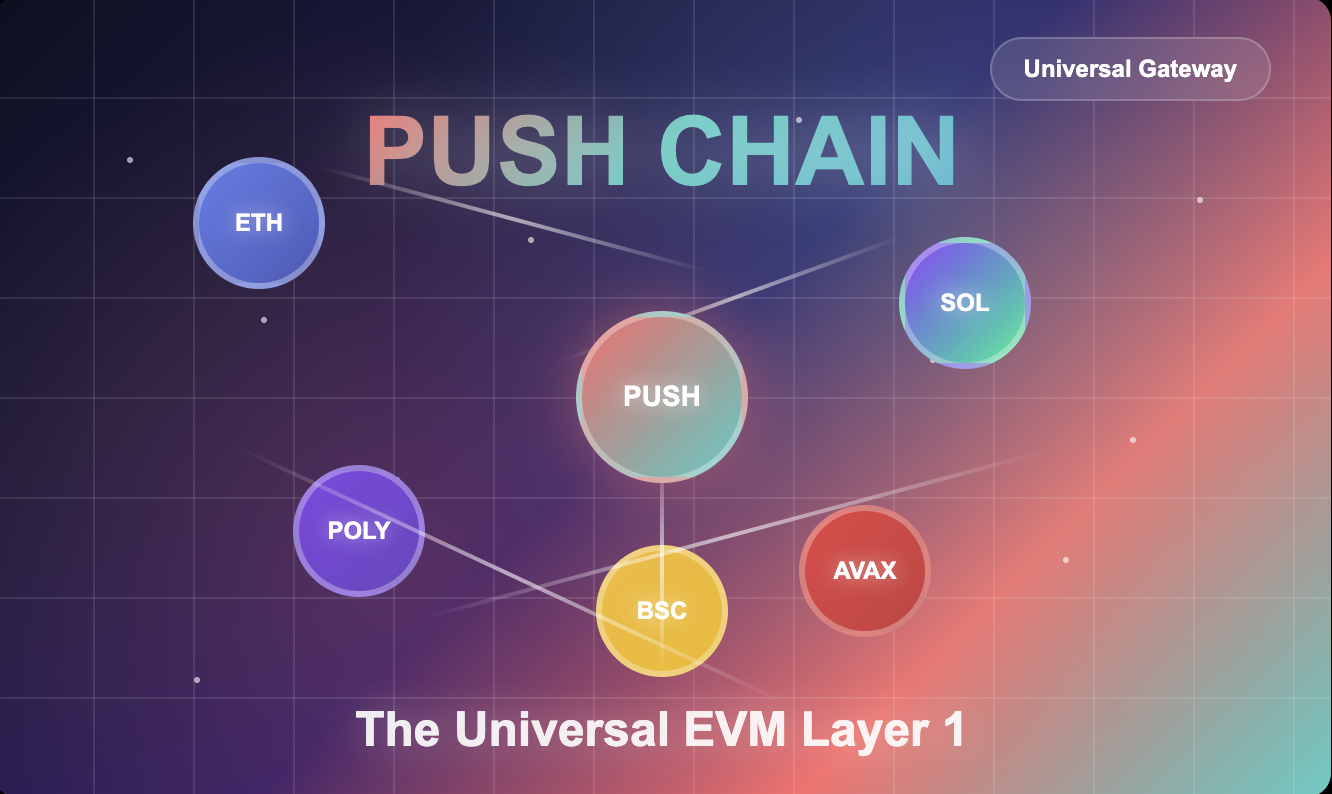
    You write your Solidity smart contract once, deploy it on Push Chain, and instantly your app becomes available to users on Ethereum, Solana, and other major chains, so there are no code changes, no forks, no bridges, and no re-audits.

    Why It Matters

    Build Once, Deploy Everywhere

    You write your smart contract exactly as you always have. Same Solidity code, same tools, same process. Deploy it on Push Chain, and suddenly, users from every major blockchain can use it. No rewrites, no translations, no compromises.

    Every Wallet Welcome

    Your users don’t need to change anything. MetaMask users stay with MetaMask. Phantom users keep using Phantom. Even people who prefer signing in with Google or email can jump right in. Push Chain handles the complexity so your users don’t have to.

    Pay With What You Have

    Here’s where it gets really good: users pay gas fees with whatever tokens they already own. Ethereum users pay with ETH, Solana users pay with SOL. No need to buy some random new token or figure out complicated bridges, even no need to hold $PC (Push Chain’s Native token) 

    Smart Cross-Chain Recognition

    Push Chain’s contracts are brilliant. They automatically know where each transaction came from and handle everything correctly. It’s like having a universal translator that not only speaks every language but understands cultural context too

    Why Developers Love Push Chain

    Instant 10x User Growth

    Deploy your existing app on Push Chain without changing anything, and you immediately reach users across multiple blockchains. It’s like going from a local TV station to worldwide broadcasting overnight.

    Skip the Audit Hell

    Since you’re not changing your code, you don’t need expensive re-audits. Just deploy and go. This saves months of waiting and thousands in audit costs.

    One App, Zero Friction

    Your users get the smoothest experience possible. They use their favourite wallet, pay with their preferred tokens, and never worry about switching networks or bridging funds.

    Future-Ready Technology

    Push Chain is building toward even more powerful features. Soon, your apps will be able to read and write across multiple blockchains simultaneously, orchestrating complex workflows that were impossible before.

    The Secret Sauce

    Universal Gateway (UG) Contracts:

    When someone sends a transaction from Ethereum, Solana, or any other chain to Push Chain, the Universal Gateway Contract is the smart contract that:

    • Receives the transaction on the source chain (like Ethereum)
    • Understands what to do with it
    • Securely passes it to Push Chain, so the right action happens there

    You don’t need bridges, custom scripts, or special tools. UG Contracts automates all the routing behind the scenes.

    Advanced Account Types

    Push Chain creates special account types that make cross-chain interaction seamless:

    Universal Executor Accounts (UEAs): 

    Universal Executor Accounts (UEAs) are special accounts on Push Chain that represent wallets from other blockchains, such as Ethereum or Solana, without requiring users to create a separate Push Chain wallet.

    When someone connects their existing wallet (e.g. MetaMask, Phantom) to a dApp built on Push Chain, a UEA is automatically created to act on behalf of that external wallet.

    Universal Origin Accounts (UOAs):

    This keeps track of where each user originally came from, like Ethereum, Solana, wherever, so the app behaves accordingly.

    Universal Account System:

    Push Chain creates a single format for representing wallet addresses that works across all blockchains. Whether you’re using an Ethereum wallet, Solana wallet, or any other type, Push Chain can understand and work with your address. It’s like having a passport that’s valid everywhere, making cross-chain interactions as simple as local transactions

    The Developer Experience Stays the Same

    Push Chain doesn’t force you to learn new tools. Use the same SDKs, the same APIs, the same development process you’re already comfortable with. Whether you prefer Viem, ethers, or any other library, everything works exactly as expected

    What’s Coming Next

    Push Chain is developing shared state technology and programmable solvers. These will let your apps read from and write to multiple blockchains simultaneously, creating possibilities that don’t exist today.

    Join Push Chain Testnet Early Access

    Doc + SDK Contest has started!

    Explore dev docs, build with the SDK, experiment with the UIKit and grab rewards in the process:

    • Prizes: 1st : $200, 2nd : $100, 3rd–6th: $50 each
    • Onchain perks, including early dev airdrops and XP
    • Core team support

    What You Can Do Now:

    1. Start with the documentation: https://pushchain.github.io/push-chain-website/pr-preview/pr-1067/docs/chain/ 
    2. Drop feedback and discuss with the community: https://zv9atndluia.typeform.com/to/ne3qEzZu 
    3. Deploy your app on Donut testnet using the SDK

    To connect with core developers and other builders, join the community channel from here – https://t.co/qhO94w1joG

    The Bottom Line

    Blockchain development doesn’t have to be complicated. You shouldn’t need separate teams for separate chains. Users shouldn’t need multiple wallets and tokens. Push Chain fixes all of this.

    The future isn’t about choosing Ethereum or Solana or any other chain. It’s about building applications that work everywhere, for everyone, without compromise. Push Chain makes that future available today.

    Stop building walls between blockchains. Start building bridges. Start building on Push Chain.

    Want to build, learn, and grow in the Web3 space alongside like-minded developers? Join the BlockchainHQ community where builders share knowledge, collaborate on projects, and support each other’s growth. Sign up from here: https://blockchainhq.xyz/auth and follow us on X https://x.com/blockchainhqxyz to become part of our invite-only Telegram community where the real conversations happen.
  • Rishikesh Kale: The Web3 Native Who Never Looked Back

    Rishikesh Kale: The Web3 Native Who Never Looked Back

    While his college friends were chasing traditional job placements with attractive packages, Rishikesh Kale made a decision that would define his entire career. He chose to stay in Web3, even when the path seemed uncertain and the resources were scarce. Today, as a Developer Advocate at FIL-B, his story proves that sometimes not going all in on a technology you believe in is the bigger risk, a risk that could mean missing out on the opportunity to shape an emerging field.

    Unlike many who transitioned into Web3 from other careers, Rishikesh Kale took a different path. He started with blockchain right after college, making Web3 not just a career choice but his only industry focus. From winning coding competitions with creative dApps to learning at a time when resources were scarce, his journey reflects what it truly means to grow alongside an emerging technology.

    Based in Nagpur, India, Rishikesh has seen Web3 change from a space where people had to learn coding through games like CryptoZombies to today’s world full of tools and chances. His experience gives a special view of building a career in blockchain from scratch, especially for those who choose to go deep instead of just trying it out.

    This talk with Rishikesh shows the mindset needed to do well in Web3’s early days, why patience matters in a space often linked with quick wins, and real advice for newcomers finding their way through today’s opportunities. His story proves the power of not giving up and the rewards that come to those who truly believe in the future of decentralized technology.

    Rishikesh Kale: The Web3 Native Who Never Looked Back

    The Interview: Rishikesh Kale on His Web3 Journey

    1. Tell us a bit about yourself.

    Rishikesh Kale: I’m Rishikesh Kale, and I’m based in Nagpur, India. Currently, I’m working as a Developer Advocate at FIL-B.

    2. What were you doing before Web3?

    Rishikesh Kale: My journey into Web3 began right out of college; it was my first love and has remained so ever since. I didn’t have a prior career outside of this space.

    3. How did you first hear about Web3?

    Rishikesh Kale: I first heard about Blockchain through my brother. After his introduction, I delved deeper by reading various articles and documentation online.

    4. What was your first step into the space?

    Rishikesh Kale: My real entry point was a hackathon during my college days. My friends and I developed a dApp called Vidhira, a social media platform designed for creators and artists. We ended up winning the hackathon and taking first place!

    5. What was one big challenge you faced early on?

    Rishikesh Kale: One of the biggest challenges I faced early on was the limited availability of educational resources. This was back when Ganache and Remix IDE were still relatively new, and there weren’t many videos or beginner-friendly materials. I largely learned Solidity by playing the CryptoZombies game and then continued my learning from there.

    6. What helped you push through?

    Rishikesh Kale: What kept me going was the desire to implement what I was learning and find opportunities. While waiting for internship opportunities, which felt like a long tunnel, I kept building and participating in more hackathons, knowing that the efforts would pay off eventually.

    7. What are you most proud of so far in your journey?

    Rishikesh Kale: I’m most proud of showing up and not turning back. It was tempting to choose a traditional job when my friends were getting attractive campus placements. However, I chose to stick with blockchain and remained patient, and I’m proud of that decision.

    8. Any major failure or learning moment?

    Rishikesh Kale: Every hackathon has been a significant learning moment for me. Instead of just “bounty hunting,” I always tried to build on new protocols. This approach, while challenging in terms of ideation and execution, taught me a tremendous amount and was a great learning process.

    9. What advice would you give to someone just starting out in Web3?

    Rishikesh Kale: If you’re just starting in Web3, patience is key. It’s rare to hit a jackpot early on. There’s a misconception that Web3 is a space where you can earn a lot of money quickly. While it will definitely pay off one day, it’s not necessarily from day one. Focus on having a solid learning and building journey, and opportunities will follow.

    10. Where can people find or follow your work?

    Rishikesh Kale: You can find or follow my work on Twitter/telegram/linkedIn: @callMeRishhh

    Rishikesh Kale’s story reminds us that Web3 isn’t just about quick financial gains or following the latest trends. It’s about building something meaningful, staying patient during uncertain times, and believing in the long-term vision of decentralized technology. His journey from a college student learning Solidity through games to a Developer Advocate at FIL-B shows that consistent effort and genuine curiosity can lead to remarkable opportunities.

    For those considering a similar path, Rishikesh’s experience offers a valuable lesson: the space rewards those who show up consistently, keep building, and resist the temptation to chase shortcuts. In a world where everyone is looking for the next big opportunity, sometimes the biggest opportunity is the one you’re already working on.

    Ready to start your own Web3 journey? Follow Rishikesh’s approach: start building, participate in hackathons, and focus on learning rather than immediate returns. Connect with him on Twitter @callMeRishhh to learn more about his work and get insights into the developer advocate role in Web3.

    Want to build, learn, and grow in the Web3 space alongside like-minded developers? Join the BlockchainHQ community where builders share knowledge, collaborate on projects, and support each other’s growth. Sign up from here: https://blockchainhq.xyz/auth and follow us on X https://x.com/blockchainhqxyz to become part of our invite only Telegram community where the real conversations happen

  • Meet Patrick Collins: Securing Web3, Educating and Onboarding Builders

    Meet Patrick Collins: Securing Web3, Educating and Onboarding Builders

    In the fast-changing world of Web3, some people really stand out. They bring clear ideas, deep knowledge, and a true passion for building a better digital future. Patrick Collins is definitely one of these important people. As a top smart contract engineer, a dedicated teacher, and a key leader at Cyfrin, he’s not just watching new digital technologies grow, he’s actively helping to shape them.

    Patrick’s path into Web3 shows how important it is to be curious, keep going when things are tough, and truly want to make this new area safer and easier for everyone to use. From his early days figuring out how to put information onto the blockchain to his current work leading the way in blockchain security and teaching, his journey offers valuable lessons for both experienced people and those just starting out.

    At Cyfrin, Patrick and his team are working on some of the biggest challenges in Web3 today. They make sure smart contracts are strong and reliable, and they help train the next group of skilled developers and security experts. Their work not only protects big companies in the industry but also helps individuals through thorough, often free, learning programs like Cyfrin Updraft.

    This interview is a special chance to hear directly from Patrick Collins. We’ll talk about his personal story, the important moments that shaped his career, and his honest advice for navigating the exciting but sometimes difficult world of Web3. Get ready to learn from someone who truly believes in the power of decentralized technology and is working hard to make it all happen.

    Meet Patrick Collins: Securing Web3, Educating and Onboarding Builders

    The Interview: Patrick Collins on His Web3 Journey

    1. Tell us a bit about yourself.

    Patrick Collins: I’m Patrick Collins. I’m from MA in the United States. I’m working on making Web3 more secure with security and educational initiatives as a part of Cyfrin.

    2. What were you doing before Web3?

    Patrick Collins: Before Web3, I worked as a software support engineer at an asset manager, and as a Devrel at a stock data company.

    3. How did you first hear about Web3?

    Patrick Collins: I heard about Web3 first when I had heard about Chainlink and how they wanted to “get financial data on chain” which sounded bizarre to me. At the time, crypto was just like “bitcoin” and it didn’t make sense to me to “put data into bitcoin.”

    4. What was your first step into the space?

    Patrick Collins: I went to the ETH Denver hackathon and spent the hackathon learning Solidity.

    5. What was one big challenge you faced early on?

    Patrick Collins: Getting started in general was confusing. I didn’t know who to trust, what was good vs bad Web3, there were so many competing narratives. One in particular was if using “send”, “transfer”, or “call” on moving ETH. Why are there 3 functions?

    6. What helped you push through?

    Patrick Collins: My curiosity more or less. I thought the tech was sooooo cool and I just wanted to learn more.

    7. What are you most proud of so far in your journey?

    Patrick Collins: Cyfrin. Everything we’ve done so far, and everything we are going to do. We not only secure some of the largest companies in the industry, but we onboard some of the best people through our security education, and make the whole industry better in safer ways.

    8. Any major failure or learning moment?

    Patrick Collins: I fail all the time. Get better and move on. One of my favorite learnings was, I had some feedback that my videos were obnoxious and ruining the brand of the product I was promoting. That I needed to be more boring ‘cuz “devs like boring.” So I made two videos of the same content, one “boring” and one ridiculous. To this day, the ridiculous one has performed over 20x better than the boring one.

    9. What advice would you give to someone just starting out in Web3?

    Patrick Collins: Go to Cyfrin Updraft, compete on CodeHawks, and you’ll be set up for success.

    10. Where can people find or follow your work?

    Patrick Collins: X – @PatrickAlphaC and @patrickalphac on YouTube.

    11. Any advice would you like to share with builders and learners?

    Patrick Collins: Understand why you want to do what you do. Write it down. So that when things get hard, you can remember why you’re doing it and push through.

    It’s truly inspiring to see how Patrick Collins started his journey in Web3. His dedication to sharing knowledge through educational resources has helped thousands of individuals kickstart their careers in Web3. Furthermore, his ongoing efforts are adding immense value to the Web3 space by assisting companies in making their products secure and, as always, helping many across the globe with Cyfrin Updraft’s educational initiatives.