Table of Contents
A few years ago, if you wanted to buy or sell crypto, you had to go through a central exchange. You’d sign up, verify your identity, and trust the platform to keep your money safe.
Then came Decentralized Exchanges (DEXs), a new way to trade crypto without giving up control.
No sign-ups. No middlemen. No waiting for someone on the other side.
Just you, a wallet, and a smart contract.
This is the revolutionary promise of Decentralized Finance (DeFi), where smart contracts handle everything automatically. Today, we’ll explore the foundation of DeFi: Decentralized Exchanges (DEXs) and the magic behind them
What is a Decentralized Exchange (DEX)?
A Decentralized Exchange (DEX) lets you trade one token for another, directly from your wallet. There’s no company holding your money. Instead, smart contracts handle everything.
You connect your wallet. You choose what you want to swap. And the trade happens instantly.
How Does a DEX Actually Work?
Let’s break down the key components that make DEXs possible:
1. Liquidity Pools
A liquidity pool is like a jar filled with two tokens. For example:
- 50 ETH and
- 10,000 DAI
People add their tokens to these pools. These people are called liquidity providers, and they earn small fees from every trade that happens.
2. Swapping
You want to swap your DAI for ETH?
The smart contract pulls ETH from the pool and adds your DAI to it.
The price changes based on how much you take and how much you give.
3. Automated Market Maker (AMM): The Price Calculator
Here’s where it gets interesting. Instead of matching you with another trader (like in traditional markets), an AMM uses a mathematical formula to determine prices instantly. It’s like having a calculator that always knows the fair price based on how much of each token is in the pool.
4. Small Fees, Big Rewards
Every trade pays a small fee (typically 0.3%). This fee gets distributed among all the people who provided liquidity to that pool. It’s like getting a cut of every transaction just for helping keep the marketplace running.
Understanding Liquidity and Why It Matters
What is Liquidity? Liquidity is simply having enough tokens in a pool to make trading smooth and efficient. Think of it like having enough cash in your wallet to buy coffee without needing to break a $100 bill.
Why Do We Need It? Without enough liquidity, strange things happen:
- Trades become slow and expensive
- Prices swing wildly with small purchases
- Large trades become nearly impossible
Who Benefits?
- Traders get fast, reliable swaps
- Liquidity providers earn passive income from fees
- The entire ecosystem stays healthy and functional
Examples of Popular DEXs
- PancakeSwap – Built on Binance Smart Chain. Fast and great for beginners.
- SushiSwap – Available on many chains. It rewards people who add liquidity.
There are many more. Each one has its own pools, tokens, and features.
DEX vs CEX: Choose Your Adventure
Centralized Exchange (CEX):
- Requires account creation and identity verification
- Company holds your funds
- Easy to use with familiar interfaces
- Customer support available
Decentralized Exchange (DEX):
- No signup required
- You always control your funds
- More privacy and anonymity
- Full responsibility for your own security
The Bottom Line: Want complete control and privacy? Go with a DEX. Prefer simplicity and support? Choose a CEX.
How Automated Market Makers Work
An Automated Market Maker (AMM) is a smart contract that lets you swap tokens without needing someone else on the other side.
Let’s Break Down the Formula
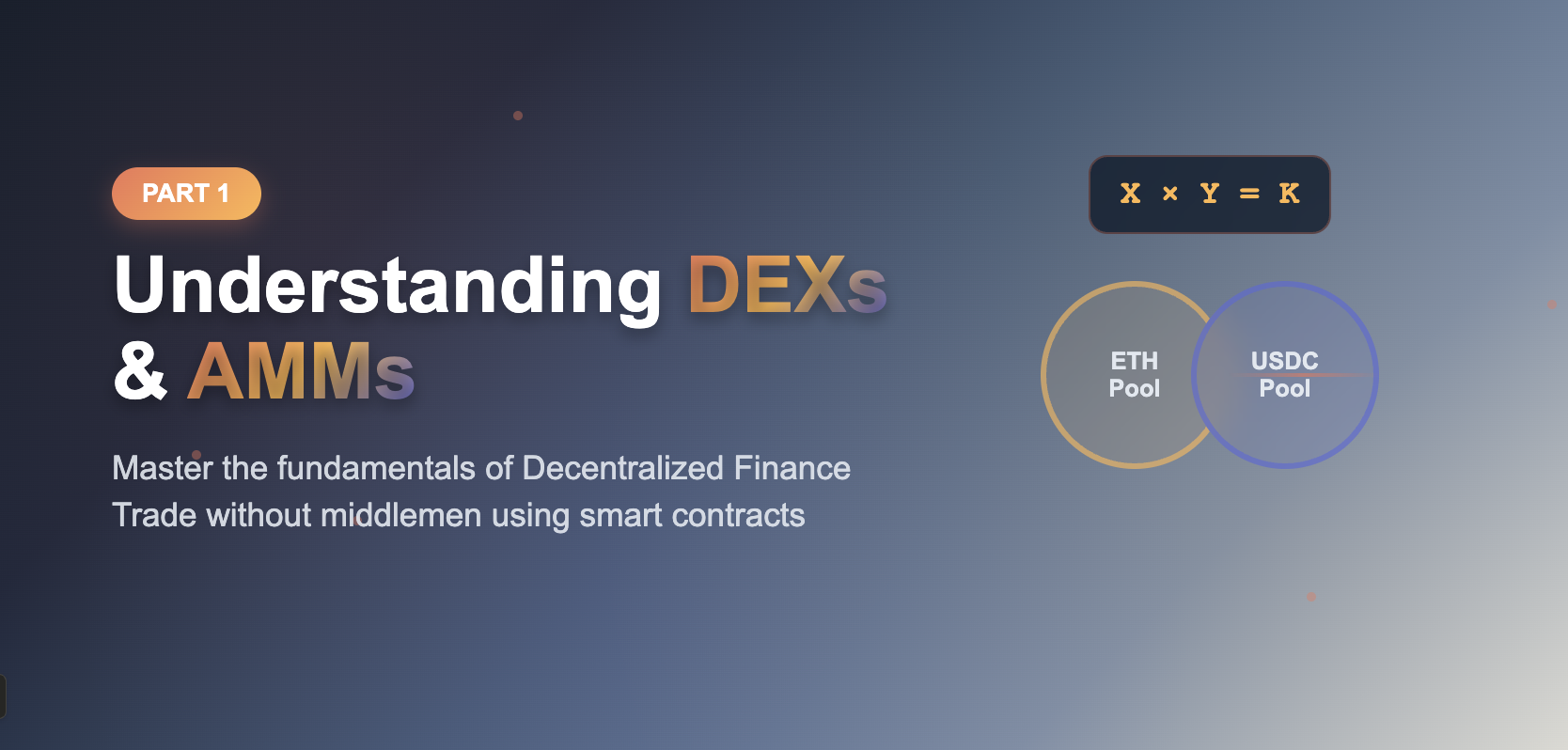
X × Y = K
- X = Amount of Token 1 in the pool
- Y = Amount of Token 2 in the pool
- K = A constant number that never changes
Think of K as the pool’s “balance point.” No matter how much trading happens, the formula ensures X × Y always equals K.
A Real-World Example
Let’s say we have a pool with:
- 50 ETH (Token 1)
- 10,000 DAI (Token 2)
- K = 50 × 10,000 = 500,000
Now imagine you want to buy 1 ETH using DAI.
After your trade:
- ETH remaining = 49 (you took 1 ETH out)
- To keep K = 500,000, we need: 49 × Y = 500,000
- Y = 500,000 ÷ 49 = 10,204.08 DAI
Since the pool started with 10,000 DAI and needs 10,204.08 DAI after your trade, you must add 204.08 DAI to buy 1 ETH.
The price was calculated automatically by the formula, not by a person!
Why Prices Change as You Trade
Here’s where it gets interesting. The more ETH you try to buy, the more DAI you need to add to keep K constant. This makes each additional ETH more expensive.
Example:
- Buying 1 ETH costs ~204 DAI
- Buying 2 ETH would cost even more per ETH
- Buying 10 ETH would be extremely expensive per ETH
This price increase is called “slippage,” and it’s completely normal in AMMs. It prevents any single person from draining the entire pool
This price jump is called slippage, the more you buy, the more you pay.
AMM vs Order Book
- Order Book (used by CEX): Buyers and sellers agree on a price
- AMM (used by DEX): The price is decided by a formula
In AMMs, you don’t wait for someone to match your trade.
The pool is always ready, the formula handles everything.
Key Takeaways
- DEXs eliminate middlemen – You trade directly through smart contracts
- Liquidity pools are the foundation – They provide the tokens needed for smooth trading
- AMMs use simple math – The X × Y = K formula determines all prices
- Everyone benefits – Traders get instant swaps, providers earn fees
- You stay in control – Your funds never leave your wallet
In Part 2, we’ll explore money markets