Tag: DevRel

  • Meet Nidhi Singh: DevRel at Pyth Network

    Meet Nidhi Singh: DevRel at Pyth Network

    A developer who worked on anti-spam technology used by billions of Indians didn’t know those billions were using her code. Seven years later, she’s breaking down complex Web3 concepts for developers worldwide and loving every minute of it.

    Nidhi Singh’s career is a masterclass in adaptation. From writing code that billions of telecom users rely on without knowing it exists, to leading Ethereum platforms at Walmart, to now making developer experiences smoother at Pyth Network, she has constantly reinvented herself.

    What makes her story compelling isn’t just the impressive resume. It’s how she discovered her true passion not in writing code, but in explaining it. After years as a core protocol engineer, she made the bold move to developer relations, choosing communication over computation.

    Her transition reveals something important about the Web3 space: technical excellence is valuable, but the ability to make complex topics accessible might be even more crucial. Through her YouTube channel and content creation, Nidhi is filling the educational gap she wished existed when she started, all while managing a demanding full-time role in crypto.

    At Pyth Network, she’s not just supporting developers, she’s actively working to bridge the knowledge gap that keeps talented people from entering Web3. Her story proves that sometimes finding what you love means stepping away from what you’re already good at.
    The Interview: Nidhi’s Web3 Journey

    1. Tell us a bit about yourself.

    Nidhi: Hey, I am Nidhi, born and brought up on different coastlines of India. I work as a developer relations engineer at Pyth Network, focusing on making the developer experience smoother. I am passionate about breaking down complex technical topics into easy-to-understand formats. This was something that I recently discovered and I started loving it, that’s the reason I transitioned from a core protocol role to a developer relations role. Apart from work, you will find me walking/running in parks and touching some grass.

    2. What were you doing before Web3?

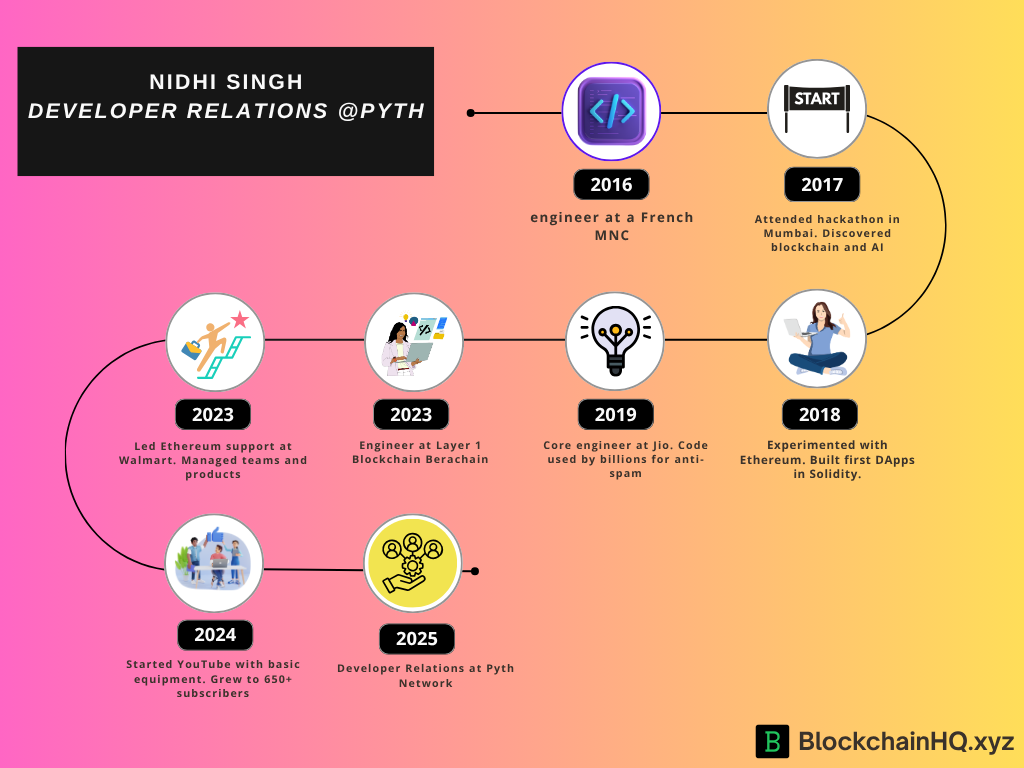
    Nidhi: I have been in the Web3 space for close to 7 years and spent close to 5 years in the enterprise blockchain space while working in big tech like Jio and Walmart for mass adoption of enterprise blockchains. I was a core engineer that contributed to the TRAI (Telecom Regulatory Authority of India) anti-spam use case, so happy to see my code being used by billions of telecom subscribers without them knowing about it. At Walmart, I led the Ethereum support for the blockchain platforms, which allowed me to think about how to design systems, manage the team, how to be a technical product manager and everything else in between. This was the period during which I had the opportunity to experiment with various engineering and product roles. If we talk about crypto specifically, my journey started as a core protocol engineer at a Layer 1 blockchain contributing on the consensus layer.

    3. How did you first hear about Web3?

    Nidhi: I heard about Web3 for the first time in 2017 when I was a participant in a hackathon in Mumbai. In the Hack, I created an interesting mobile application, there I heard about all these emerging technologies like blockchain, AI and others. At that time, blockchain had just started getting popular and my curiosity sparked from there and since then there has been no looking back.

    4. What was your first step into the space?

    Nidhi: I remember the first protocol that I experimented with was Ethereum. I created a few projects, wrote smart contracts in Solidity and made my first few DApps.

    5. What was one big challenge you faced early on?

    Nidhi: My whole professional journey has been full of twists and turns, as with every transition my tech stack has changed and it has only made me more resilient. I remain to be highly self-motivated, but there have been certain situations when things were not clear to me but I kept my hustle on. One of the challenges that I faced while entering the web3 space was the unavailability of the educational content that would have accelerated my journey so that gap has always stayed in my mind and to fill it I’ve also started my YouTube channel.

    7. What are you most proud of so far in your journey?

    Nidhi: I am proud of myself for being able to get out of my comfort zone every now and then, which is one thing that keeps me going. Last year, I started my YouTube channel and kicked off my journey of content creation, grew my channel to 650+ subscribers on YouTube and started working on my personal brand. I started with what equipment I had, I didn’t want to invest in any expensive home setup. My focus has been to create quality content. Managing your own passion along with a full-time job in crypto is tough, but I used to find time on my weekends to do it. It requires dedicated efforts, you need to keep going even when you get few views but being consistent is what matters the most.

    9. What advice would you give to someone just starting out in Web3?

    Nidhi: For someone who is new in the space, my only piece of advice is to be yourself and be authentic as it’s so easy to get lost. Don’t be afraid to experiment and fail and then experiment again until you figure out what you enjoy the most. This is applicable to any domain in general, but it is especially relevant in the blockchain space as things are changing at a fast pace, you need to be able to identify what to learn and what to experiment with and keep doing it without any distractions because the narrative is going to change every other day. I really love how this space keeps on evolving and you need to be on your toes.

    10. Where can people find or follow your work?

    Nidhi: You can find me on X, YouTube and LinkedIn. Across all three I have the same handle, @nidhisinghattri

    X: https://x.com/nidhisinghattri

    LinkedIn: http://linkedin.com/in/nidhisinghattri

    YouTube: https://youtube.com/@NidhiSinghAttri – Don’t forget to check out my Oracle series and DeFi series.

    GitHub: http://github.com/nidhi-singh02 if you are a developer.

    11. What is that thing/challenge you would like to change in Web3-Crypto industry?

    Nidhi: I would like to create more awareness about the crypto space in general, considering it is perceived not so well, folks often think of it as a means to get rich real quick. In that regard, I have taken small initiative by providing quality educational content related to web3 for free. I am trying my best to bridge that knowledge gap that folks have when it comes to understanding web3 from the general perspective as well as the technical perspective. Would love support from all of us in spreading the word about this initiative so more folks are aware of it.

    From contributing to systems used by billions to teaching the next generation of Web3 builders, Nidhi’s journey reminds us that career pivots aren’t just about changing roles. They’re about discovering where your passion truly lies. Her commitment to bridging the knowledge gap she once experienced herself shows that sometimes the best teachers are those who remember what it was like to be a student.

    Ready to start your own Web3 journey? Follow Nidhi’s work on YouTube and social media to learn from someone who’s walked the path and is now lighting the way for others.

    Want to build, learn, and grow in the Web3 space alongside like-minded developers? Join the BlockchainHQ community where builders share knowledge, collaborate on projects, and support each other’s growth. Sign up from here: https://blockchainhq.xyz/auth and follow us on X https://x.com/blockchainhqxyz to become part of our invite-only Telegram community where the real conversations happen
  • From Stanford Campus to Leading Web3 Developer Relations at Celo

    From Stanford Campus to Leading Web3 Developer Relations at Celo

    A Stanford computer science student walks into an entrepreneur event and gets asked for her Twitter handle. Her response? “What’s Twitter?” Fast forward to today, and she’s now leading developer relations at Celo, one of the most important layer two blockchains focused on real world applications.

    Sophia’s rise in Web3 breaks every normal career path you’ve heard about. While most people enter this space through technical skills or investment backgrounds, she found it through pure curiosity and a willingness to explore new communities online.

    What makes her story remarkable is how not knowing about social media became the gateway to discovering an entirely new industry. From joining her first Web3 groups as a Stanford student to now leading developer relations at a major blockchain platform, her journey shows the surprising ways success can happen in this industry.

    At Celo, Sophia isn’t just managing developer relationships. She’s actively helping one of Ethereum’s most important layer two solutions connect with developers around the world. Her work focuses on real-world adoption and building applications that actually matter to people’s daily lives.

    Her story proves that Web3 success often comes from unexpected places and that community involvement can be just as important as technical skills. Through genuine curiosity about how technology impacts society, she built the foundation for a thriving career in one of the most exciting industries today.

    sophia inforgraphics

    The Interview: Sophia’s Web3 Journey

    1. Tell us a bit about yourself.

    Sophia: I’m Sophia. I am originally from the Bay Area, born and raised here, currently living here, and I am currently the developer relations lead at Celo, which is a layer two on Ethereum, and it’s a frontier chain scaling with real-world adoption and real-world apps.

    2. What were you doing before Web3?

    Sophia: I was still in school, so I went to Stanford for my undergrad. I studied computer science and product design, but I was super into different, like, just, like, building things. So I was always tinkering on different projects and different stuff. I even left school to run a startup full-time, and I was, yeah, just really into, like, figuring out what was cutting edge, what could I build, what could I create. I just loved products and creating and building products. And so I did that a lot while I was in school.

    3. How did you first hear about Web3?

    Sophia: I first heard about Web3 a little bit on Twitter. I was at an event for student entrepreneurs and on a panel for student entrepreneurs and they were talking about there’s a lot of people there that are really into Web3 and the intersection of future of tech. And afterwards they were like, Hey, like, can we follow you on Twitter? And I was like, what’s Twitter? And so I got on Twitter. I started following all these folks and everyone is very like Web3 focused. And I just got started getting involved in communities, a few different ones.

    4. What was your first step into the space?

    Sophia: A Web3 familia I think was one of the first ones and SheFi and yeah I just started really getting involved in some of these like web3 like I think web3 ladies was an early one I I did and it was really cool I learned so much this is like 2021 2022 and I was still in school at the time but it was just so cool getting to learn about all of these programs and then the first thing that actually brought me into the space officially was I went to ETH Denver and visited like I was staying at one of the hacker houses and I was just so impressed that like as a student they would take you to conferences and pay for you to your accommodations and you could win hackathon money it was just such a new eye-opening way for me so that’s definitely what got me originally in this space is just like like paying for travel.

    5. What was one big challenge you faced early on?

    Sophia: I would say, when I first was doing all these hackathons, I was really interested in building, but then as I was getting closer to graduating, I really wanted to figure out what job I wanted to do in the space. And so I set up like all these coffee chats. I would do like three coffee chats a day with people in the industry, just kind of talking about the different opportunities. And at the time, like I knew there was something I was so excited about, but I couldn’t exactly put my finger on what it was. And at the time it was like, oh, you can either do DeFi or NFTs or gaming or payments. and I was like, I don’t know, these specific areas I’m not that interested in but there’s like this intersection between Blockchain and society and how you know how cutting-edge tech is influencing the world that I was so excited about I couldn’t put my finger and articulate what exactly it was

    6. What helped you push through?

    Sophia: Eventually I discovered a Gitcoin and Gitcoin definitely led me down a path that I was really excited about.

    7. What are you most proud of so far in your journey?

    Sophia: Something I’m most proud of so far in my journey is joining Celo and getting to lead the developer relations team at Celo. So it was just so cool getting to go a little bit from like Gitcoin, which is a smaller team, and then I then, through Gitcoin, started leading Public Goods Network, which is also a chain, a blockchain. And I was running a lot of that, and it was a lot smaller. And when I then transitioned to Celo, it was like, it was so cool because like the stakes were a lot bigger.

    8. Any major failure or learning moment?

    Sophia: Honestly leading public goods networks that was one of the first OP stack L twos and I got to lead that and I learned how difficult it is to launch a chain… but the chain did shut down so it was also technically a major failure but I’m glad that it did shut down because I think not all chains need to yeah need to exist you don’t need to launch a change just for the sake of launching a chain.

    9. What advice would you give to someone just starting out in Web3?

    Sophia: I would say join a hackathon. I think that’s one of the most tangible ways to get involved in Web3… There’s so many diverse skill sets that are so appreciated in hackathons now from like marketing to coming up with the product idea to designing the thing to communicating what you’re building. There’s so many aspects and a lot of the coding I see is getting done with AI. So it’s like I feel like there’s less of a technical focus right now in hackathons and more of like a creative focus.

    10. Where can people find or follow your work?

    Sophia: And if anyone wants to find me or follow my work, the best place would probably be on X or on Twitter. My username is @sodofi_ or you can find me on Farcaster on: @sophia

    From not knowing what Twitter was to leading developer relations at one of the most important blockchains around, Sophia’s journey shows that Web3 success can come from the most unexpected beginnings. Her focus on community involvement, hackathon participation, and staying curious about how technology and society connect offers a clear path for anyone looking to build a meaningful career in this space. Through her work at Celo, she continues to prove that understanding people and communities is just as valuable as understanding code.

    Want to build, learn, and grow in the Web3 space alongside like-minded developers? Join the BlockchainHQ community where builders share knowledge, collaborate on projects, and support each other’s growth. Sign up from here: https://blockchainhq.xyz/auth and follow us on X https://x.com/blockchainhqxyz to become part of our invite-only Telegram community where the real conversations happen.

  • Kevin’s Web3 Journey: From Cameras to Code to Community

    Kevin’s Web3 Journey: From Cameras to Code to Community

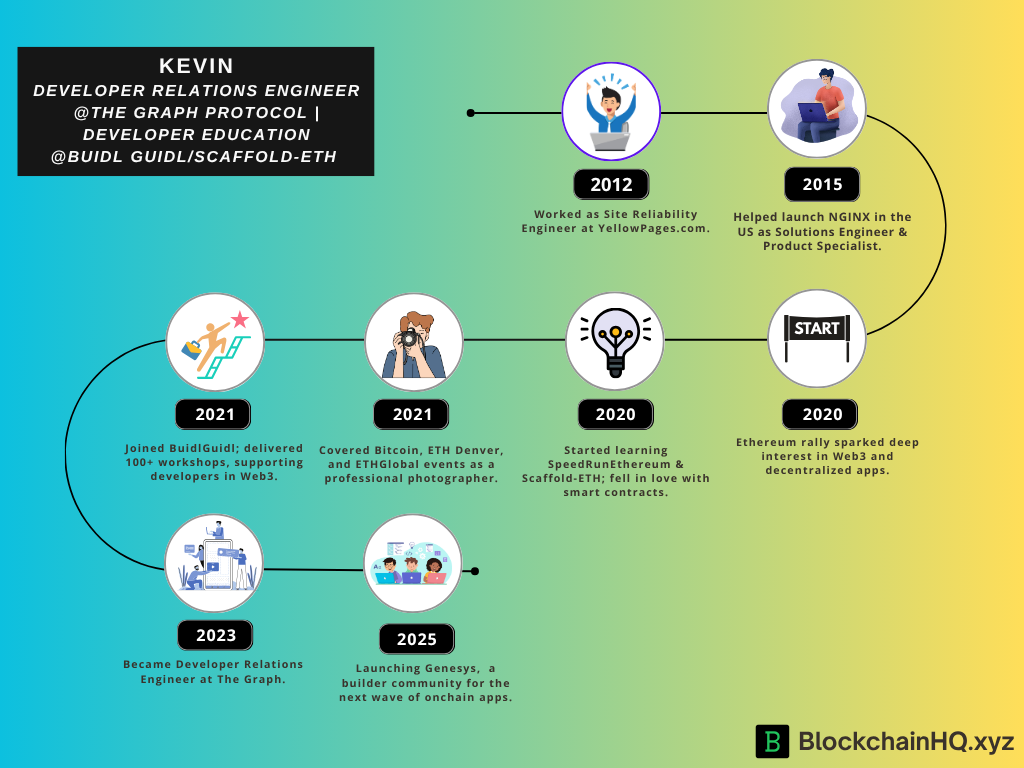
    Some people find their calling in the most unexpected places. For Kevin, it started with cameras at blockchain conferences and evolved into building communities that shape the future of decentralized technology. What began as a side hobby capturing moments at Bitcoin conferences has transformed into a mission to help developers worldwide enter the exciting world of Web3.

    Kevin’s story is one of curiosity, persistence, and genuine passion for helping others succeed. From his early days as a Site Reliability Engineer to becoming a leading voice in developer education, his journey shows how technical skills combined with community spirit can create lasting impact in the rapidly evolving blockchain space.

    Today, as a Developer Relations professional at The Graph Protocol, Kevin builds something more valuable than applications: pathways for other developers to follow. Through workshops, educational content, and his upcoming Genesys platform, he’s making Web3 accessible to newcomers.

    His approach is refreshingly practical. Rather than getting lost in complex theories, Kevin focuses on hands on learning and real world building. This philosophy has helped hundreds of developers take their first steps into Web3, turning curiosity into career changing skills.

    This conversation with Kevin reveals the human side of blockchain development. We explore his journey from traditional web applications to smart contracts, the challenges that almost made him quit, and the communities that kept him going. Most importantly, we discuss his vision for making Web3 more accessible to developers everywhere.

    The Interview: Kevin on Building Communities in Web3

    1. Tell us a bit about yourself.

    Kevin: My name is Kevin, and I was born in California, USA. I’ve been passionate about technology since I was a young child. I’m also a photographer, DJ, and father of two boys.

    2. What were you doing before Web3?

    Kevin: I worked for about three years as a Site Reliability Engineer at YellowPages.com, then helped build and launch NGINX in the US as a Solutions Engineer and Product Specialist. I also began my journey into Web3 as a professional photographer, covering events like Bitcoin Conference, ETH Denver, and ETHGlobal Hackathons around the world.

    3. How did you first hear about Web3?

    Kevin: I remember hearing about Bitcoin in its early days and shrugged it off like most of us did. However, my interest really grew when I witnessed the Ethereum rally in 2017. I was amazed to learn that you could build fully decentralized and unstoppable applications on the EVM, and I was instantly hooked!

    4. What was your first step into the space?

    Kevin: I had been doing photography in the space for a long time, and in my off time, I began learning through SpeedRunEthereum and using Scaffold-ETH. I was amazed at how enjoyable writing smart contracts was and wanted to teach others. I started creating YouTube videos and conducting workshops for my current company about Ethereum and Web3, which led me down the rabbit hole. Eventually, I was fortunate enough to meet Austin Griffith, who really helped me reach the next level and welcomed me into the BuidlGuidl to help support builders in the space. Since then, I’ve given over 100 workshops on Scaffold-ETH and SpeedRunEthereum and helped countless developers enter the space.

    5. What was one big challenge you faced early on?

    Kevin: Understanding the tooling differences between traditional web applications and blockchain-based applications was one of the biggest challenges. I found that diving into the EVM and understanding its core components really helped elevate my understanding of how smart contracts are executed under the hood.

    6. What helped you push through?

    Kevin: Excellent videos by Austin Griffith, Nader Dabit, Patrick Collins, and Smart Contract Programmer really helped me overcome the hurdle of building onchain applications. Additionally, having a starter kit like Scaffold-ETH made it much easier to get started building, as I could abstract some of the EVM nuances and return to them later when I needed to dive deeper.

    7. What are you most proud of so far in your journey?

    Kevin: I’m proud that I can help others achieve the same success I’ve experienced. I believe that building a community for builders is the best way for me to contribute to the space. This is why I’m launching Genesys, a community where developers can come together and build the next wave of onchain applications.

    8. Any major failure or learning moment?

    Kevin: I think learning is something you have to do constantly. I’ve always tried to consistently push myself to try new things and stay ahead of major setbacks. However, there have been many times when I lost energy and experienced burnout. This is the most critical point in your journey. You just have to take some time for yourself, then push through and remember why you’re here.

    9. What advice would you give to someone just starting out in Web3?

    Kevin: Don’t be afraid to try things you wouldn’t normally feel comfortable doing. There have been many times when I started working on a codebase and realized it was going to be much more difficult than I had anticipated, but going through that process taught me a lot and elevated my knowledge.

    10. Where can people find or follow your work?

    Kevin: You can find me on X at https://x.com/cryptomastery_ , on YouTube at https://www.youtube.com/@cryptomastery_ , and on Genesys at https://www.genesysapp.xyz/user/0x89480c2e67876650b48622907ff5c48a569a36c7

    Kevin’s journey reminds us that the most impactful contributions in Web3 often come from those who combine technical expertise with a genuine desire to help others. His transition from capturing blockchain events through a camera lens to actively building developer relations at The Graph Protocol and creating communities shows how diverse backgrounds can create unique value in this space.

    Through his work at The Graph Protocol, Genesys, and his educational efforts, Kevin continues to lower the barriers for developers entering Web3. His story proves that sometimes the best way to master something is to teach it to others, creating a cycle of learning and growth that benefits the entire ecosystem.

    Want to build, learn, and grow in the Web3 space alongside like-minded developers? Join the BlockchainHQ community where builders share knowledge, collaborate on projects, and support each other’s growth. Sign up from here: https://blockchainhq.xyz/auth and follow us on X https://x.com/blockchainhqxyz to become part of our invite only Telegram community where the real conversations happen
  • Meet Pandit Dhamdhere: Building Against All Odds

    Meet Pandit Dhamdhere: Building Against All Odds

    In a quiet village in Pune district, far from any startup hubs or big tech campuses, a young man decided to teach himself how to code. With no degree, no formal training, Pandit Dhamdhere entered a space where talent and persistence mattered more than certificates. Today, despite a recent setback, his journey proves that passion and persistence can overcome even the most challenging circumstances.

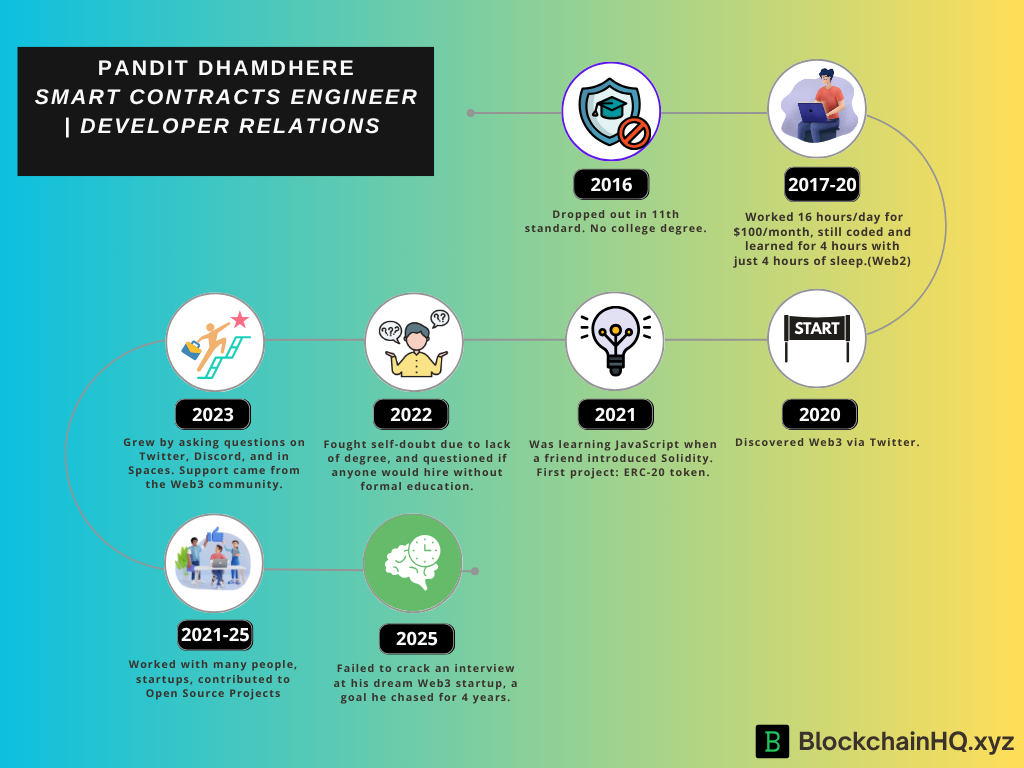
    While working 16-hour days for $100 a month, he would spend another 4 hours at night learning JavaScript and Solidity, often sleeping only 4 hours before starting over again. In 2020, a single introduction to Web3 changed the direction of his life.

    Pandit’s journey is a reminder that in Web3, you don’t need perfect conditions, you need the courage to start and the persistence to keep going.

    This conversation with Pandit reveals the mindset needed to keep building despite self-doubt, the power of community in an online-first industry, and why sometimes the biggest battles aren’t with code but with your own limiting beliefs. His story is still being written, and the recent interview rejection that crushed his four-year dream might just be the setup for something bigger.

    The Interview: Pandit Dhamdhere on His Web3 Journey

    1. Tell us a bit about yourself.

    Pandit Dhamdhere: I’m Pandit Dhamdhere, and I’m from a village in Pune district, Maharashtra. I was recently laid off from the company I was working for, so currently I’m working part-time with many startups while building my own stuff.

    2. What were you doing before Web3?

    Pandit Dhamdhere: I’m a college dropout from 11th standard, and I come from a farming background. That was pretty much my reality before I discovered this space.

    3. How did you first hear about Web3?

    Pandit Dhamdhere: I first heard about Web3 on Twitter back in 2020. That’s where it all started for me.

    4. What was your first step into the space?

    Pandit Dhamdhere: While I was doing JavaScript and frontend stuff, a friend introduced me to Solidity. I loved it immediately and started with the basics. My first project was creating an ERC-20 token after doing the usual Hello World programs.

    5. What was one big challenge you faced early on?

    Pandit Dhamdhere: The challenge wasn’t really technical. It was a battle with myself. It was hard to believe in myself because I don’t have a degree. I used to think, “You’re learning and building, but who’s going to hire you when you don’t have a degree?” That self-doubt was the biggest obstacle.

    6. What helped you push through?

    Pandit Dhamdhere: The Twitter community and some of my friends who helped me throughout my journey. I used to ask questions by DMing people on Twitter and Discord. I would ask questions to people in Twitter Spaces. That helped me a lot. It’s really the community that kept me going.

    7. What are you most proud of so far in your journey?

    Pandit Dhamdhere: I’m proud of the skills I learned despite unfavorable conditions. Once upon a time, there was a period in my life where I had to work 16 hours for $100 a month, and I used to learn and code for 4 hours and sleep for 4 hours. I’m proud that I didn’t give up during that time.

    8. Any major failure or learning moment?

    Pandit Dhamdhere: Recently, I failed to crack an interview at one of the biggest Web3 startups, which I’ve been dreaming to work with for the last 4 years. That was a major setback, but it’s also a learning moment about persistence and not giving up on your dreams.

    9. Where can people find or follow your work?

    Pandit Dhamdhere: You can find me @panditdhamdhere on X and LinkedIn.

    What makes Pandit’s story special isn’t just the skills he learned or the projects he built. It’s proof that in this space, hard work matters more than having the right degree. When he messaged strangers on Twitter asking for help, he found something powerful: people who were willing to teach and guide him.

    The numbers tell his story best. Four hours of sleep, four hours of learning, sixteen hours of working just to survive. Most people would have given up. Pandit kept going, choosing to grow even when it was the harder path.

    This space needs more people like Pandit, who know what struggle feels like and still choose to build. His story is far from over.

    Read to start your own journey no matter where you come from? Do what Pandit did: start building, ask questions, and don’t let doubt stop you.

    Want to build, learn, and grow in the Web3 space alongside like-minded developers? Join the BlockchainHQ community where builders share knowledge, collaborate on projects, and support each other’s growth. Sign up from here: https://blockchainhq.xyz/auth and follow us on X https://x.com/blockchainhqxyz to become part of our invite-only Telegram community where the real conversations happen.