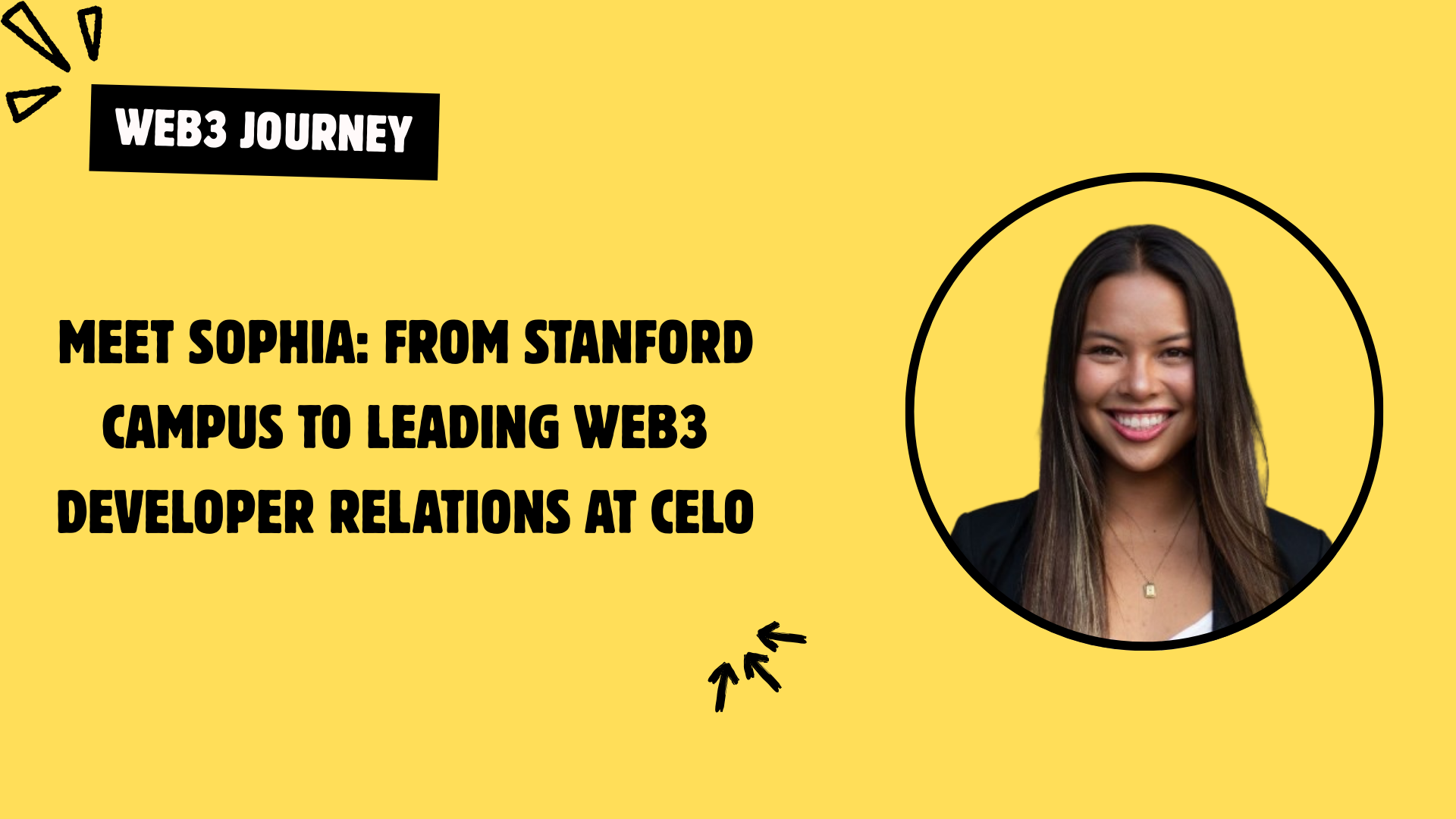
A Stanford computer science student walks into an entrepreneur event and gets asked for her Twitter handle. Her response? “What’s Twitter?” Fast forward to today, and she’s now leading developer relations at Celo, one of the most important layer two blockchains focused on real world applications.
Sophia’s rise in Web3 breaks every normal career path you’ve heard about. While most people enter this space through technical skills or investment backgrounds, she found it through pure curiosity and a willingness to explore new communities online.
What makes her story remarkable is how not knowing about social media became the gateway to discovering an entirely new industry. From joining her first Web3 groups as a Stanford student to now leading developer relations at a major blockchain platform, her journey shows the surprising ways success can happen in this industry.
At Celo, Sophia isn’t just managing developer relationships. She’s actively helping one of Ethereum’s most important layer two solutions connect with developers around the world. Her work focuses on real-world adoption and building applications that actually matter to people’s daily lives.
Her story proves that Web3 success often comes from unexpected places and that community involvement can be just as important as technical skills. Through genuine curiosity about how technology impacts society, she built the foundation for a thriving career in one of the most exciting industries today.

The Interview: Sophia’s Web3 Journey
1. Tell us a bit about yourself.
Sophia: I’m Sophia. I am originally from the Bay Area, born and raised here, currently living here, and I am currently the developer relations lead at Celo, which is a layer two on Ethereum, and it’s a frontier chain scaling with real-world adoption and real-world apps.
2. What were you doing before Web3?
Sophia: I was still in school, so I went to Stanford for my undergrad. I studied computer science and product design, but I was super into different, like, just, like, building things. So I was always tinkering on different projects and different stuff. I even left school to run a startup full-time, and I was, yeah, just really into, like, figuring out what was cutting edge, what could I build, what could I create. I just loved products and creating and building products. And so I did that a lot while I was in school.
3. How did you first hear about Web3?
Sophia: I first heard about Web3 a little bit on Twitter. I was at an event for student entrepreneurs and on a panel for student entrepreneurs and they were talking about there’s a lot of people there that are really into Web3 and the intersection of future of tech. And afterwards they were like, Hey, like, can we follow you on Twitter? And I was like, what’s Twitter? And so I got on Twitter. I started following all these folks and everyone is very like Web3 focused. And I just got started getting involved in communities, a few different ones.
4. What was your first step into the space?
Sophia: A Web3 familia I think was one of the first ones and SheFi and yeah I just started really getting involved in some of these like web3 like I think web3 ladies was an early one I I did and it was really cool I learned so much this is like 2021 2022 and I was still in school at the time but it was just so cool getting to learn about all of these programs and then the first thing that actually brought me into the space officially was I went to ETH Denver and visited like I was staying at one of the hacker houses and I was just so impressed that like as a student they would take you to conferences and pay for you to your accommodations and you could win hackathon money it was just such a new eye-opening way for me so that’s definitely what got me originally in this space is just like like paying for travel.
5. What was one big challenge you faced early on?
Sophia: I would say, when I first was doing all these hackathons, I was really interested in building, but then as I was getting closer to graduating, I really wanted to figure out what job I wanted to do in the space. And so I set up like all these coffee chats. I would do like three coffee chats a day with people in the industry, just kind of talking about the different opportunities. And at the time, like I knew there was something I was so excited about, but I couldn’t exactly put my finger on what it was. And at the time it was like, oh, you can either do DeFi or NFTs or gaming or payments. and I was like, I don’t know, these specific areas I’m not that interested in but there’s like this intersection between Blockchain and society and how you know how cutting-edge tech is influencing the world that I was so excited about I couldn’t put my finger and articulate what exactly it was
6. What helped you push through?
Sophia: Eventually I discovered a Gitcoin and Gitcoin definitely led me down a path that I was really excited about.
7. What are you most proud of so far in your journey?
Sophia: Something I’m most proud of so far in my journey is joining Celo and getting to lead the developer relations team at Celo. So it was just so cool getting to go a little bit from like Gitcoin, which is a smaller team, and then I then, through Gitcoin, started leading Public Goods Network, which is also a chain, a blockchain. And I was running a lot of that, and it was a lot smaller. And when I then transitioned to Celo, it was like, it was so cool because like the stakes were a lot bigger.
8. Any major failure or learning moment?
Sophia: Honestly leading public goods networks that was one of the first OP stack L twos and I got to lead that and I learned how difficult it is to launch a chain… but the chain did shut down so it was also technically a major failure but I’m glad that it did shut down because I think not all chains need to yeah need to exist you don’t need to launch a change just for the sake of launching a chain.
9. What advice would you give to someone just starting out in Web3?
Sophia: I would say join a hackathon. I think that’s one of the most tangible ways to get involved in Web3… There’s so many diverse skill sets that are so appreciated in hackathons now from like marketing to coming up with the product idea to designing the thing to communicating what you’re building. There’s so many aspects and a lot of the coding I see is getting done with AI. So it’s like I feel like there’s less of a technical focus right now in hackathons and more of like a creative focus.
10. Where can people find or follow your work?
Sophia: And if anyone wants to find me or follow my work, the best place would probably be on X or on Twitter. My username is @sodofi_ or you can find me on Farcaster on: @sophia
From not knowing what Twitter was to leading developer relations at one of the most important blockchains around, Sophia’s journey shows that Web3 success can come from the most unexpected beginnings. Her focus on community involvement, hackathon participation, and staying curious about how technology and society connect offers a clear path for anyone looking to build a meaningful career in this space. Through her work at Celo, she continues to prove that understanding people and communities is just as valuable as understanding code.
Want to build, learn, and grow in the Web3 space alongside like-minded developers? Join the BlockchainHQ community where builders share knowledge, collaborate on projects, and support each other’s growth. Sign up from here: https://blockchainhq.xyz/auth and follow us on X https://x.com/blockchainhqxyz to become part of our invite-only Telegram community where the real conversations happen.
Leave a Reply