Author: blockchainwebdir@gmail.com

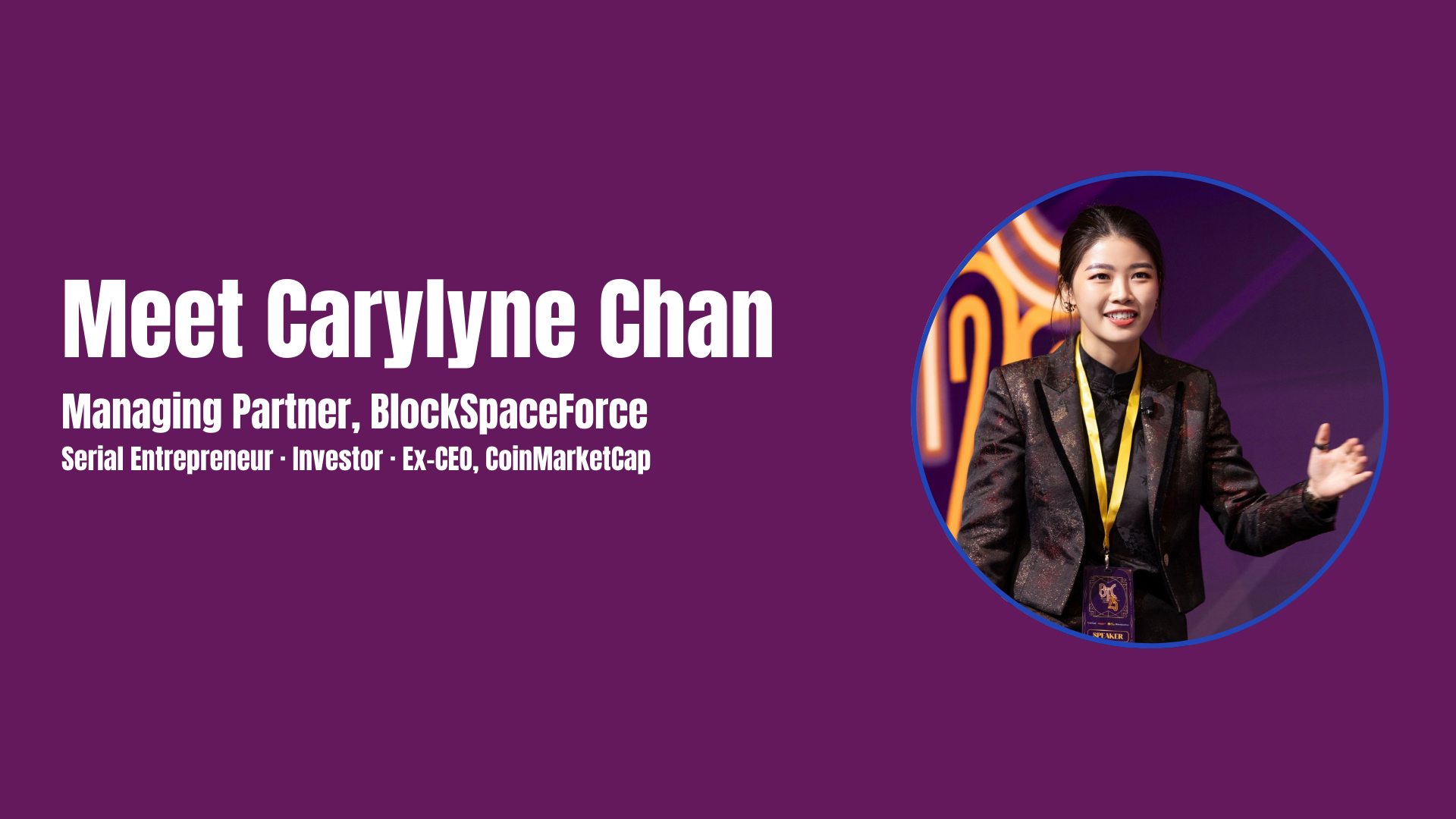
  • Play Your Own Game, All-In: Carylyne Chan on Exits, AI, Crypto & Consumer

    Play Your Own Game, All-In: Carylyne Chan on Exits, AI, Crypto & Consumer

    From a young age, she learned how to stand on her own feet, trust her instincts, and turn small beginnings into big opportunities. She didn’t wait for the “perfect moment.” She learned by doing, by experimenting, and by believing that underdogs can rise if they keep showing up with clarity and courage.

    Today, Carylyne helps founders dream bigger, move faster, and build companies that matter. She has worked across different worlds including tech, crypto, consumer and more, always with the same mindset: stay curious and keep creating.

    In this conversation, she shares the lessons, beliefs, and values that shaped her journey. Her story is a reminder that you don’t need a perfect background to build something meaningful; you just need the willingness to grow and the courage to take the first step.

    The Interview: Carylyne Chan on Exits, Building & Investing Across AI, Crypto & Consumer

    1) Tell us a bit about yourself – who is Carylyne Chan, where are you from, and what are you working on currently?

    I’m someone who loves taking sharp ideas from small, scrappy teams and scaling them into global contenders. That instinct started early — I grew up in Singapore, took my first internship at 14 at a government agency talking to strangers about environmental issues, and spent my teens building social enterprises and learning how to operate before I even knew what a startup was.


    A turbulent home life pushed me to become independent quickly, and it shaped two things that still define me today: a strong bias toward self-determination, and a deep soft spot for underdogs with outsized potential.


    My career since has moved across AI/ML, crypto, and multiple exits — including helping scale CoinMarketCap from a one-person idea into a global team and a nine-figure acquisition. I’ve lived across multiple cities in the US and China, and recently moved back to San Francisco to be closer to the center of tech’s momentum and idealism.


    Today, I run BlockSpaceForce, where we invest, operate, and incubate frontier, category-defining companies — and increasingly those at the inevitable convergence of crypto and the broader capital markets. Across everything I do, the throughline is the same: partnering early with exceptional founders and helping them punch far above their weight.

    2) You had a successful AI/ML career – AngelPad, Fortune 500 companies. Then you joined CoinMarketCap in 2018 when it didn’t even have a logo. What made you see potential others missed?

    I’ve always been drawn to categories where the macro trend is already unmistakable, but the supporting products are still early, underbuilt, or not meeting the moment. Those inflection points create room for small teams to have an outsized impact if they move quickly and build with clarity.


    CoinMarketCap is one example. Crypto was becoming a global phenomenon, and there’s a very human instinct to rank, compare, and make sense of new markets — so the need for reliable data was obvious. At the same time, relative to the importance of the category, there was still a huge amount of room to grow the products and companies inside it. That combination — an inevitable trend paired with a product that already had strong natural pull — made the opportunity clear.


    That’s generally how I choose the environments I step into: I look at where the world is already heading, and then ask whether the product or team at the center of it has the raw ingredients to grow into the role the category will eventually demand.

    3) You’ve invested in Babylon, SatLayer, Alkimiya, and others. What pattern do you see in Bitcoin infrastructure that excites you most right now?

    What excites me most is that Bitcoin is finally moving from being primarily a trillion-dollar asset to becoming a real economic platform. The asset itself is enormous, yet the economic value built on top of it is still only a tiny fraction of that — far smaller than you’d expect for something so globally held and trusted.


    The next decade is about closing that gap. We’re seeing teams build the primitives that make Bitcoin not just a store of value, but a productive base layer for the broader cryptoeconomy: secure and trustless staking and restaking, blockspace markets and optimizations, more expressive settlement layers, bridges into traditional capital markets, and more.


    Across the founders I believe in and back, the pattern is consistent: they expand what’s possible on Bitcoin without compromising its principles; they create new economic surface area instead of repackaging old ideas; and they ship with the speed and clarity that only small, deeply technical teams can bring.


    To sum it up, I find that the opportunity in Bitcoin infrastructure is enormous — not just because of where the asset is today, but because of how much value still hasn’t been activated around it.

    4) You describe yourself as turning “the underdog to top-dog.” What’s a specific strategy you’ve used multiple times to help companies dominate their category?

    What I’ve seen repeatedly is that small, sharp teams often already have the right instincts — they’re close to the problem, they move fast, and they see things others miss. What they usually need is someone to help pull all those instincts into a coherent center, so they’re not fighting their own momentum.


    The way I do that is by surfacing the team’s real point of view — the thing they believe but haven’t fully articulated yet — and then helping them build the product, messaging, and operating cadence around it. Once that spine is clear, execution becomes dramatically easier: priorities align, decisions get cleaner, and the team can finally move as one organism instead of scattered parts.
    A big part of my work is also in the day-to-day with founders: being a sounding board, a confidante, the person who can absorb complexity with them and help translate it into action. Early-stage companies rise and fall on the founder’s clarity and energy, so creating that steadiness is just as important as any strategy.
    From there, it’s about ongoing execution — building systems, tightening loops, and running focused pushes that compound over time. When a small team gains that combination of clarity, support, and operational rhythm, they start to feel much larger than they are. That’s how an underdog grows into a category leader: not through theatrics or one-offs, but through coherence and consistent, high-quality execution.

    5) You’ve navigated AI acquisition, crypto acquisition, and now building consumer brands. What’s one principle that’s remained constant across all these transitions?

    The principle that’s stayed constant for me is simple: play my own game all-in. Every chapter — AI, crypto, consumer — has come from following where my curiosity is strongest, where the learning curve is steepest, and where I feel I can genuinely change the status quo.


    My personal credo has always guided that: stay open-minded, take risks, aim for world-class execution, create rather than imitate, and keep growing toward your fullest potential. I’ve never believed in choosing paths because they’re popular or predictable; I choose the places where the work feels alive and where I can contribute something real.


    Across every transition, the same principle keeps proving itself: move toward the arenas that stretch you, that demand creativity and conviction, and that offer the chance to build something that didn’t exist before. When I make decisions from that place — not from fear, comparison, or chasing optics — the outcomes tend to compound.


    Believing you’re lucky and acting like it also helps. It keeps you bold, forward-looking, and willing to take the kinds of swings that make the journey meaningful — especially when you get to take that journey with the right people!

    6) What’s the biggest misconception founders have about exits that you’ve seen proven wrong? Based on your experience, what actually makes a company attractive to acquirers?


    One of the biggest misconceptions is that acquirers are chasing “traction” or generic growth metrics. In reality, buyers don’t acquire momentum — they acquire strategic leverage. An exit usually happens when your company gives someone else something that’s hard, slow, or expensive for them to build on their own.


    But the part founders overlook is that it’s not just a rational business decision. It’s also an emotional one. Acquirers are betting on people — on whether your team can mesh with theirs, whether there’s trust, and whether the combined company will be stronger than either side on its own. Cultural fit, continuity, and the ability to actually use and scale what you’ve built matter much more than most founders realize.


    What makes a company attractive often looks like a mix of the following:

    • you solve a problem the buyer urgently needs addressed,
    • you built something they can’t easily replicate,
    • you give them meaningful time-to-market advantage,
    • your team brings talent or insight they lack, and
    • the combined story makes sense internally and externally.


    That last part is underrated: leaders need to justify the acquisition to their board, their employees, and the market. If your product and team help them tell a clear, forward-looking narrative, you become exponentially more attractive.


    Founders often imagine exits as a reward for “success.” They’re not. They’re a strategic decision layered with human judgment. Only when both dimensions line up does the process become much clearer and far more predictable.

    7) The “Build to Exit” Debate: Some say building with an exit in mind compromises the product. Others say it’s just smart business. Where do you stand, and why?

    The debate is often framed in a way that misses the real issue. Building “for an exit” isn’t what compromises a product — getting distracted, chasing the wrong incentives, or making reactive decisions does. You can care about strategic outcomes without losing sight of what you’re building.


    My view is that great companies are built the same way whether you eventually exit or not: you solve a real problem, you build with conviction, and you create something that users genuinely value. At the same time, it’s helpful — not harmful — to understand how acquirers think, what they look for, and how timing and competitive pressures shape their decisions. That context keeps you from unintentionally closing off future paths.


    So my stance is: Build to endure, keep your standards high, and stay aware enough that if an exit becomes the right outcome, you’re already prepared for it.


    You don’t have to optimize for an acquisition, but you also don’t need to pretend it doesn’t exist. The healthiest companies keep their options open while staying fully committed to making the product exceptional.

    8) Post-acquisition, how did you navigate ‘what’s next?’, and what led you from tech to building consumer brands? Did you plan this shift, or did it unfold naturally?

    After the acquisition, I finally had the freedom to choose my next chapter with intention. Instead of jumping into the next obvious thing, I gave myself space to explore what I was genuinely curious about — the kinds of problems I wanted to solve, the experiences I wanted to design, and the worlds I wanted to help shape.
    With that autonomy, I found myself gravitating toward more tactile and culturally expressive ideas. I started noticing things that felt overlooked or unnecessarily complicated and became interested in redesigning them. That exploration led me to writing a sunscreen applicator patent and creating a sunscreen brand, and later to building a portable multi-brew tea ceremony. Each one began the same way: seeing something people had accepted as “just how it is,” and reimagining it from scratch.


    What surprised me was how familiar the process felt compared to tech. You’re still solving a real problem, still thinking deeply about narrative, distribution, user behavior, and product–market fit — just expressed through physical experiences rather than software.


    I never stopped working on and investing in crypto or tech; consumer simply became another place where I could apply the same way of building. It expanded my creative range, strengthened my operator instincts, and gave me a different lens for designing products people love.

    9) With AI commoditizing tech, distribution has become the real moat. “Build it and they will come” product led growth can still be a moat. Any advice for early stage founders with limited resources on how to balance product, speed, and distribution?

    AI changes how fast you can build, but it doesn’t change why great products win. It makes prototyping easier, lowers technical barriers, and shortens the distance between idea and execution. But it still can’t replace clarity about your users, good judgment, or the ability to create something people immediately care about.
    For early-stage founders with limited resources, the most important thing is knowing exactly who you’re building for. AI lets anyone ship a product — it doesn’t tell you if you’re solving the right problem. Teams who understand the users who feel the pain most intensely still move faster and with far less waste.


    The second piece is learning speed. AI helps you ship quickly, but the real advantage comes from staying in a tight feedback loop. Early companies succeed by getting sharper with every iteration, not by chasing perfection on day one.


    AI also highlights something that’s always mattered: discernment. When everyone can build, what stands out are the choices you make — the narrative, the moments where users instantly “get it,” the things that feel intentional. These become natural points of distribution and travel much further than broad marketing campaigns.


    And finally, even in an AI world, small teams win by choosing a few distribution channels they can execute consistently. A clean connection between product, user insight, and the right channels still beats trying to be everywhere at once.


    So while AI automates pieces of the stack, it amplifies the advantage of teams with clarity, taste, and momentum. Those fundamentals don’t change — and they’re exactly what allow small teams to create outsized impact.

    10) How do you sustain energy across so many different projects?

    I’ve found that the key to working across different projects is choosing things that naturally hold my attention. When I’m building or advising in areas I find meaningful — whether it’s Bitcoin infrastructure or redesigning a physical experience — I don’t have to force myself into motivation. Curiosity creates its own momentum.


    I’m also intentional about how I structure my time. I keep long blocks for deep work, build weeks with a rhythm that fits how I think best, and avoid spreading myself thin across constant context switches. Matching my schedule to my natural cadence has made a huge difference.


    Another part of it is staying close to founders and teams I genuinely enjoy working with. Being in real collaboration — where the thinking is sharp and the conversations are honest — is sustaining in its own way. Progress feels faster and more meaningful when it’s shared.


    And finally, I’m clear about my personal capacity. I know what I can hold, what should be handed off, and what no longer fits. When the work aligns with my curiosity, the people are strong, and the structure supports good decision-making, it becomes surprisingly manageable to contribute across multiple domains.

    11) After two successful exits, you chose to continue building diversified ventures, angel investing, advising. What’s your “why”? What keeps you in the arena?

    At this point, I build because I genuinely enjoy it. I like working with sharp founders, I like shaping new categories, and I like taking ideas that feel small or overlooked and helping them grow into something meaningful. It’s both intellectually challenging and creatively satisfying — a combination that’s hard to walk away from.


    I also have a soft spot for underdogs. I know what it feels like to start with very little and still want to change the status quo. Helping founders who have the insight and the will, but not necessarily the resources, is something I find both energizing and grounding.


    Working across different ventures — investing, advising, and building — lets me choose areas where I can contribute uniquely and stay in a steep learning curve. I’ve never had the desire to “retire.” I’d rather keep growing and keep building alongside people I respect.


    And finally, I stay in the arena because it continues to feel meaningful. The problems are bigger, the tools are better, the founders are more global, and the opportunities are more open-ended than ever. If anything, this is the most interesting moment to be building — and I want to be part of shaping what comes next.

    12) Any final insights for web3 founders? Or anything else you’d like to share that we didn’t discuss?


    Focus on what’s real. Web3 moves fast, narratives change, and hype comes and goes — but solving a real problem never stops compounding.


    Have a sharp point of view, build with discipline, and stay close to the users who feel the pain the most. Everything else becomes noise.


    And remember: you don’t need a big team to make a big dent. A small, aligned group with conviction can reshape an entire category.


    If you see something inevitable and underbuilt, go build it. No one is waiting to give you permission. When you spot the thing that won’t leave your mind, commit. And remember to play your own game, all-in!


    Carylyne’s story shows that the most powerful growth doesn’t happen all at once. It happens when you stay curious, stay open, and keep moving forward even when the road feels uncertain. She reminds us that the people who make the biggest impact are not always the ones who start with the most, but the ones who stay committed to what feels real and important.

    Stay connected with Carylyne and her deep thinking:

    Join the BlockchainHQ community where builders share knowledge, collaborate on projects, and support each other’s growth. Sign up from here: https://blockchainhq.xyz/auth and follow us on X https://x.com/blockchainhqxyz to become part of our invite-only Telegram community where the real conversations happen.

  • Meet Ishita Pandey: From Dogecoin FOMO to Building career as a Web3 Marketer

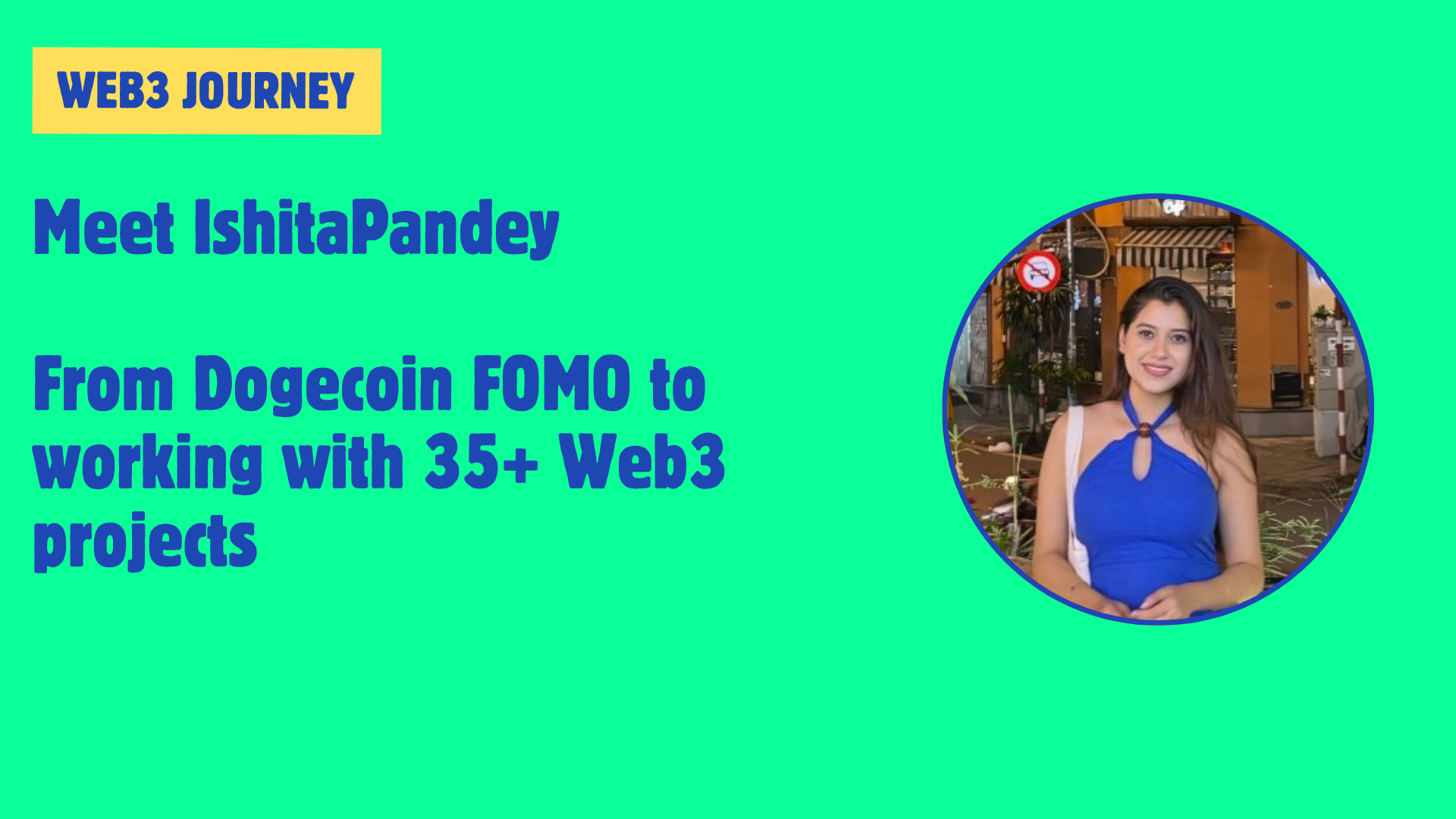
    Meet Ishita Pandey: From Dogecoin FOMO to Building career as a Web3 Marketer

    Some stories begin with a dream.
    Ishita’s began with… Dogecoin.

    What looked like a random FOMO purchase at the peak quickly became the spark that pulled her into a world of memes, builders, and unstoppable creativity. What started as curiosity on Twitter in 2021 turned into a career that reshaped her life long before she graduated college.

    Today, Ishita is one of the rising voices in Web3 content and community storytelling, shaping narratives, humanizing projects, and helping brands show up in ways that actually feel real.
    Her journey is proof that you don’t need a technical background to leave your mark in crypto; you just need the courage to show up, experiment, and stay when most people quit.

    This conversation with Ishita reveals the human side of Web3 marketing, the instability, the chaos, the creativity and how one creator turned her curiosity into a career impacting 35+ projects across the ecosystem.

    Meet Ishita Pandey: From Dogecoin FOMO to Building career as a Web3 Marketer

    The Interview: Ishita’s Web3 Journey

    1. Tell us a bit about yourself. 


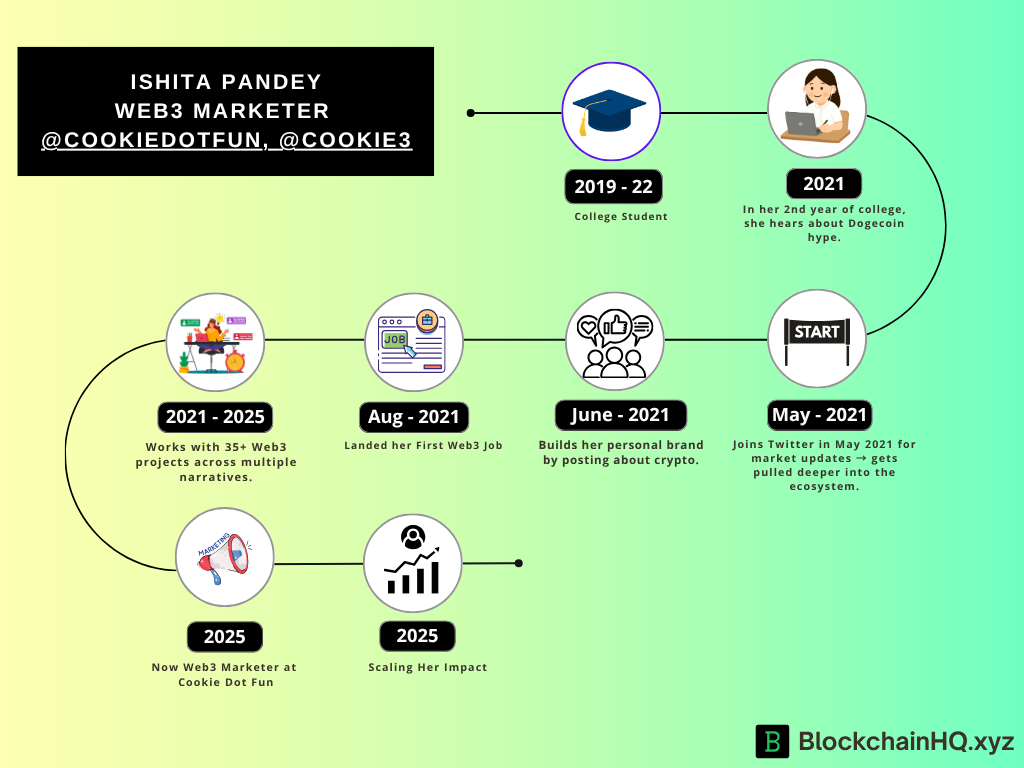
    I’m Ishita, I’m from India. I’ve been working in crypto since 2021, started out in my 2nd year of college as a social media manager and since then, I’ve worked with 35+ projects, helping them grow through marketing and community strategies

    2. What were you doing before Web3? 


    Honestly, I was just a college student before Web3 took over my life.

    3. How did you first hear about Web3? 


    It all started with Dogecoin. I jumped in at its ATH purely out of FOMO. I joined Twitter to stay updated with the market, but ended up getting deeper into the space. Over time, I started building my personal brand around crypto, and that’s what eventually helped me land my first job as a social media manager in Web3.

    4. What kind of content or marketing work do you focus on in Web3?


    I mostly focus on content and shitposting, blending storytelling, memes, and community-driven posts to make projects feel more human and relatable. I believe good shitposting is a form of marketing when done right,  it builds authenticity and connection without feeling forced.

    5. What inspired you to start creating in this space?

    I never aimed for a corporate life but always wanted a space where I could show my creativity and crypto was exactly what I was looking for. Everyone was building, memeing, experimenting, and I wanted in. I started creating just to be part of the conversation, and somewhere along the way, it turned into my thing

    6. What’s the biggest challenge you’ve faced as a creator/marketer in Web3?

    Honestly, the hardest part has been keeping up. Things change overnight: algorithms, narratives, trends, even platforms. One day, your content does great, the next it flops for no reason and the same goes for the narrative one day a specific narrative is trending and a few days later no one is talking about it. It gets exhausting trying to stay consistent and updated without burning out.

    7. What are you most proud of so far in your journey?


    I’m really proud of the journey I’ve had so far. Working with over 35 projects across so many different narratives has taught me a ton about the space. At the same time, I’ve been building my own personal brand from scratch, which has been its own challenge and reward. Juggling both has pushed me to grow faster than I ever expected, and it’s exciting to see the impact of the work I’ve put out there

    8. What’s one piece of advice you’d give to someone starting as a Web3 creator or marketer?

    My biggest tip for anyone starting in Web3 is just: show up. Be consistent, post, engage, experiment and keep an eye on what’s trending. This space moves so fast; if you’re not there, you’re missing the wave. It’s not about being the smartest; it’s about being everywhere at the right time.

    9. Who are some creators or marketers in Web3 you admire or take inspiration from?


    I really like what Zac is doing with Kast, previously with Phantom and Alex’s shitposting skills at Coinbase

    10. Where can people find or follow your work? 

    You can find me shitposting on Twitter/X: https://x.com/IshitaaPandey

    11. What is that thing/challenge you would like to change in Web3-Crypto industry?

    If I could change one thing in the Web3/Crypto space, it would be the instability. Right now, the market moves so unpredictably that it becomes a huge hurdle for mainstream adoption. I’d love to see more stability, because that’s what will let projects and communities grow sustainably and attract people who are still hesitant to enter the space.

    From buying Dogecoin at the top to working with 35+ Web3 projects, Ishita’s story shows that you don’t need the perfect plan to start, you just need to show up.
    Her journey proves one thing: consistency is a superpower in a space where trends flip overnight.

    She didn’t wait to become an expert.
    She built, posted, engaged, experimented and the industry noticed.

    If you want to see real, unfiltered Web3 storytelling in action, follow Ishita on X (@IshitaaPandey).

    Join the BlockchainHQ community where builders share knowledge, collaborate on projects, and support each other’s growth. Sign up and follow us on X to become part of our invite-only Telegram community where the real conversations happen.


  • Meet Aditi Polkam: Building, Breaking, and Shipping in Web3

    Meet Aditi Polkam: Building, Breaking, and Shipping in Web3

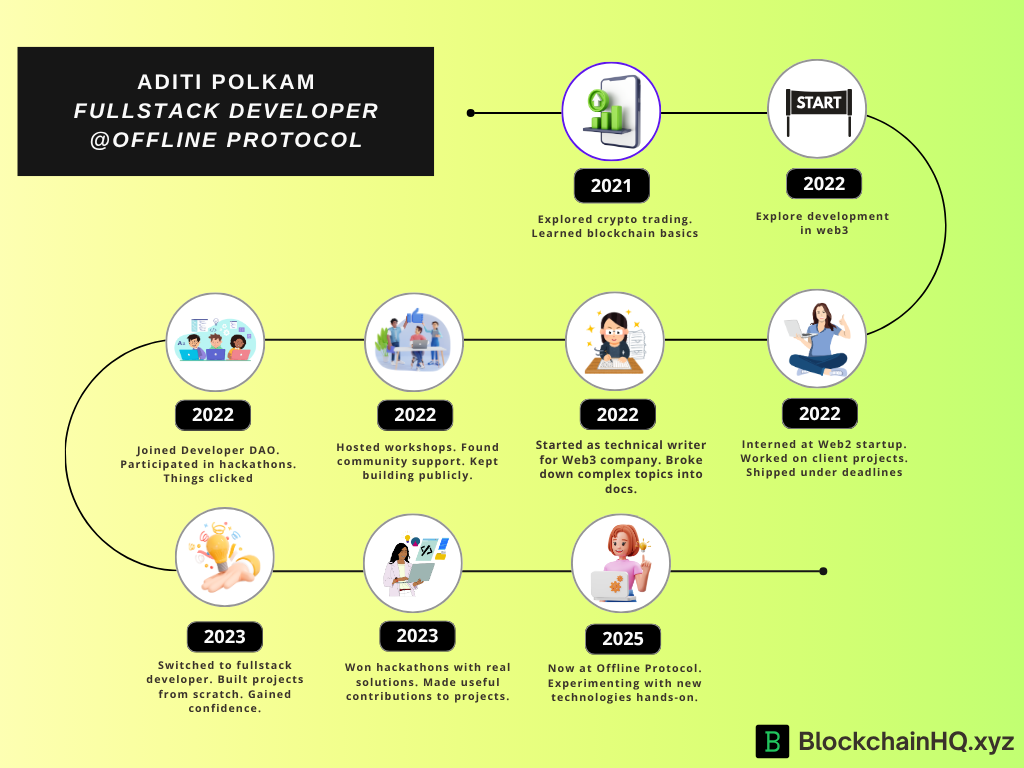
    A Web2 intern who dabbled in crypto trading during lockdown is now building across the Web3 ecosystem. Her secret? Stop waiting to be ready and start experimenting.

    Aditi Polkam’s entry into Web3 wasn’t through a grand epiphany or a prestigious program. It started with lockdown curiosity about crypto trading and evolved into writing technical content for a Web3 company. What followed was a journey of constant experimentation, countless failures, and the realization that building in public is more valuable than waiting for perfection.

    Her path from technical writer to fullstack developer to hackathon winner shows something important about Web3: there’s no single right way in. While others might obsess over learning every acronym and tool, Aditi focused on one thing at a time, built projects that broke, fixed them, and shipped anyway.

    What sets her apart isn’t just her technical skills. It’s her honest acknowledgment that feeling lost is normal in Web3, and that the overwhelming information overload everyone talks about is real. Instead of pretending otherwise, she leaned into fundamentals, found her community, and kept building even when projects failed.

    At Offline Protocol, she continues to explore new technologies hands-on, but her real contribution might be her philosophy: experimentation is underrated. Most growth doesn’t come from following a perfect roadmap. It comes from trying things, breaking things, and iterating until something works.

    Meet Aditi Polkam: Building, Breaking, and Shipping in Web3

    The Interview: Aditi’s Web3 Journey

    1. Tell us a bit about yourself.

    Aditi: Hey, I’m Aditi. I’m from India and currently working with Offline Protocol while also experimenting with projects across the Web3 space. Most of what I do is about exploring new technologies, trying them hands-on, and figuring out how they can be applied in real-world scenarios. I enjoy building things, contributing to projects, and constantly learning along the way.

    2. What were you doing before Web3?

    Aditi: Before Web3, I was interning at a Web2 startup where I got to work on multiple client projects. It gave me a lot of exposure to how software is built in the real world and what it means to ship things under deadlines. Around that time, I also got the opportunity to write technical content for a Web3 company. That felt like an interesting entry point, so I took it — and that’s how I slowly transitioned from just “observing Web3 from the outside” to actively contributing to it.

    3. How did you first hear about Web3?

    Aditi: I already had some idea about crypto during the lockdown – I was experimenting with trading and exploring the basics of how blockchains worked. But my actual journey into Web3 development started a year later, around 2022. That’s when I realized there’s a huge difference between knowing crypto as a user and actually building things that power this ecosystem.

    4. What was your first step into the space?

    Aditi: My very first step was as a technical writer for a Web3 company. I learned a lot while breaking down complex topics into articles and docs. Later, I switched into a more hands-on role as a fullstack developer at a startup, which gave me the confidence to actually build projects from scratch. And eventually, I started participating in hackathons, contributing to DAOs, and joining communities like Developer DAO – that’s where things really clicked for me.

    5. What was one big challenge you faced early on?

    Aditi: The biggest challenge was honestly the overwhelming amount of information. Everyone in Web3 talks in acronyms, there are hundreds of tools, and things evolve at lightning speed. It was easy to feel lost or feel like I didn’t belong because there was always someone who seemed to know more. There were moments where I wondered if I was even cut out for it.

    6. What helped you push through?

    Aditi: Two things really helped: a strong desire to learn the basics and community support. I knew I couldn’t skip fundamentals, so I made it a point to dig deeper even if it took extra time. At the same time, being part of communities, hosting workshops, and interacting with like-minded builders encouraged me to keep going. The combination of curiosity and peer support kept me motivated.

    7. What are you most proud of so far in your journey?

    Aditi: A few things stand out:

    • Winning hackathons with projects that actually solved problems.
    • The contributions I’ve made to projects that people found useful.
    • Transitioning from being “just curious” to someone who can actually build and ship.

    Those moments of recognition, whether through a prize or just a “this is cool” from someone, are what I look back on with pride.

    8. Any major failure or learning moment?

    Aditi: Plenty. I’ve had projects that didn’t ship on time, experiments that completely broke, and even ideas that never really took off. But every one of those experiences taught me something – whether it was how to plan better, how to debug smarter, or just how to be okay with things not working out the first time. I think failures in Web3 are just learning curves disguised in fancy clothes.

    9. What advice would you give to someone just starting out in Web3?

    Aditi: Don’t aim to “learn everything” at once – it’s impossible. Pick one area that excites you, whether it’s smart contracts, DAOs, or frontends for dApps, and start there. The rest will fall into place as you go. Also, don’t be afraid to build in public and ask questions. Three months from now, you’ll thank yourself for starting small instead of waiting to be “ready.”

    10. Where can people find or follow your work?

    Aditi: I’m most active on Twitter/X (@aditipolkam) and I share my projects and experiments on GitHub. That’s where you’ll see my latest updates, thoughts, and work.

    11. What is that thing/challenge you would like to change in Web3-Crypto industry?

    Aditi: A lot of companies are building technically sound and fancy products, but not something an average internet user would actually want to use. We need to bridge that gap – simplify UX, focus on real-world use cases, and make Web3 products less intimidating for non-crypto people. Until then, mainstream adoption will remain a buzzword.

    12. Do you want us to cover anything that we missed?

    Aditi: Maybe just this: experimentation is underrated. Most of what I’ve learned came from trying things, breaking things, and iterating — not from following a strict path. If you’re in Web3, don’t wait for perfect conditions. Start experimenting – that’s where the real growth happens.


    From lockdown crypto curiosity to building at Offline Protocol, Aditi’s story is a reminder that Web3 careers aren’t built on perfect preparation. They’re built on willingness to experiment, fail, learn, and ship anyway. Her advice to start small and build in public isn’t just motivational talk, it’s exactly how she built her own career.

    Ready to start your Web3 journey? Follow Aditi on X (@aditipolkam) and GitHub to see what happens when you stop waiting and start building.
    Want to build, learn, and grow in the Web3 space alongside like-minded developers? Join the BlockchainHQ community where builders share knowledge, collaborate on projects, and support each other’s growth. Sign up from here: https://blockchainhq.xyz/auth and follow us on X https://x.com/blockchainhqxyz to become part of our invite-only Telegram community where the real conversations happen.
  • Meet Nidhi Singh: DevRel at Pyth Network

    Meet Nidhi Singh: DevRel at Pyth Network

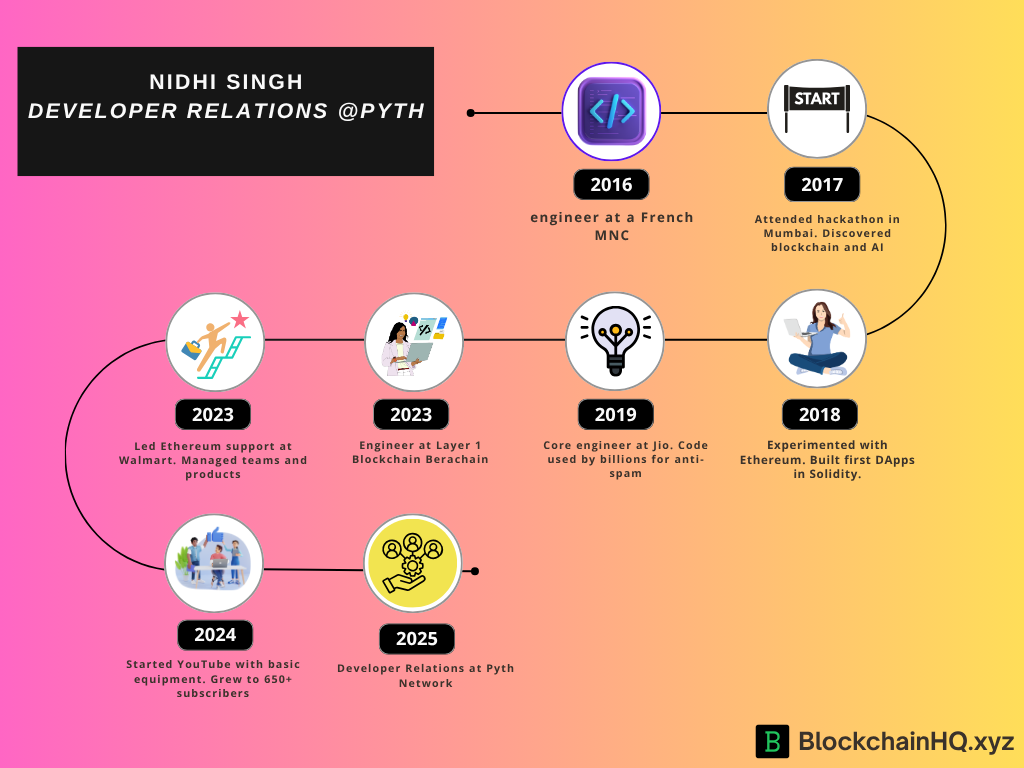
    A developer who worked on anti-spam technology used by billions of Indians didn’t know those billions were using her code. Seven years later, she’s breaking down complex Web3 concepts for developers worldwide and loving every minute of it.

    Nidhi Singh’s career is a masterclass in adaptation. From writing code that billions of telecom users rely on without knowing it exists, to leading Ethereum platforms at Walmart, to now making developer experiences smoother at Pyth Network, she has constantly reinvented herself.

    What makes her story compelling isn’t just the impressive resume. It’s how she discovered her true passion not in writing code, but in explaining it. After years as a core protocol engineer, she made the bold move to developer relations, choosing communication over computation.

    Her transition reveals something important about the Web3 space: technical excellence is valuable, but the ability to make complex topics accessible might be even more crucial. Through her YouTube channel and content creation, Nidhi is filling the educational gap she wished existed when she started, all while managing a demanding full-time role in crypto.

    At Pyth Network, she’s not just supporting developers, she’s actively working to bridge the knowledge gap that keeps talented people from entering Web3. Her story proves that sometimes finding what you love means stepping away from what you’re already good at.

    The Interview: Nidhi’s Web3 Journey

    1. Tell us a bit about yourself.

    Nidhi: Hey, I am Nidhi, born and brought up on different coastlines of India. I work as a developer relations engineer at Pyth Network, focusing on making the developer experience smoother. I am passionate about breaking down complex technical topics into easy-to-understand formats. This was something that I recently discovered and I started loving it, that’s the reason I transitioned from a core protocol role to a developer relations role. Apart from work, you will find me walking/running in parks and touching some grass.

    2. What were you doing before Web3?

    Nidhi: I have been in the Web3 space for close to 7 years and spent close to 5 years in the enterprise blockchain space while working in big tech like Jio and Walmart for mass adoption of enterprise blockchains. I was a core engineer that contributed to the TRAI (Telecom Regulatory Authority of India) anti-spam use case, so happy to see my code being used by billions of telecom subscribers without them knowing about it. At Walmart, I led the Ethereum support for the blockchain platforms, which allowed me to think about how to design systems, manage the team, how to be a technical product manager and everything else in between. This was the period during which I had the opportunity to experiment with various engineering and product roles. If we talk about crypto specifically, my journey started as a core protocol engineer at a Layer 1 blockchain contributing on the consensus layer.

    3. How did you first hear about Web3?

    Nidhi: I heard about Web3 for the first time in 2017 when I was a participant in a hackathon in Mumbai. In the Hack, I created an interesting mobile application, there I heard about all these emerging technologies like blockchain, AI and others. At that time, blockchain had just started getting popular and my curiosity sparked from there and since then there has been no looking back.

    4. What was your first step into the space?

    Nidhi: I remember the first protocol that I experimented with was Ethereum. I created a few projects, wrote smart contracts in Solidity and made my first few DApps.

    5. What was one big challenge you faced early on?

    Nidhi: My whole professional journey has been full of twists and turns, as with every transition my tech stack has changed and it has only made me more resilient. I remain to be highly self-motivated, but there have been certain situations when things were not clear to me but I kept my hustle on. One of the challenges that I faced while entering the web3 space was the unavailability of the educational content that would have accelerated my journey so that gap has always stayed in my mind and to fill it I’ve also started my YouTube channel.

    7. What are you most proud of so far in your journey?

    Nidhi: I am proud of myself for being able to get out of my comfort zone every now and then, which is one thing that keeps me going. Last year, I started my YouTube channel and kicked off my journey of content creation, grew my channel to 650+ subscribers on YouTube and started working on my personal brand. I started with what equipment I had, I didn’t want to invest in any expensive home setup. My focus has been to create quality content. Managing your own passion along with a full-time job in crypto is tough, but I used to find time on my weekends to do it. It requires dedicated efforts, you need to keep going even when you get few views but being consistent is what matters the most.

    9. What advice would you give to someone just starting out in Web3?

    Nidhi: For someone who is new in the space, my only piece of advice is to be yourself and be authentic as it’s so easy to get lost. Don’t be afraid to experiment and fail and then experiment again until you figure out what you enjoy the most. This is applicable to any domain in general, but it is especially relevant in the blockchain space as things are changing at a fast pace, you need to be able to identify what to learn and what to experiment with and keep doing it without any distractions because the narrative is going to change every other day. I really love how this space keeps on evolving and you need to be on your toes.

    10. Where can people find or follow your work?

    Nidhi: You can find me on X, YouTube and LinkedIn. Across all three I have the same handle, @nidhisinghattri

    X: https://x.com/nidhisinghattri

    LinkedIn: http://linkedin.com/in/nidhisinghattri

    YouTube: https://youtube.com/@NidhiSinghAttri – Don’t forget to check out my Oracle series and DeFi series.

    GitHub: http://github.com/nidhi-singh02 if you are a developer.

    11. What is that thing/challenge you would like to change in Web3-Crypto industry?

    Nidhi: I would like to create more awareness about the crypto space in general, considering it is perceived not so well, folks often think of it as a means to get rich real quick. In that regard, I have taken small initiative by providing quality educational content related to web3 for free. I am trying my best to bridge that knowledge gap that folks have when it comes to understanding web3 from the general perspective as well as the technical perspective. Would love support from all of us in spreading the word about this initiative so more folks are aware of it.

    From contributing to systems used by billions to teaching the next generation of Web3 builders, Nidhi’s journey reminds us that career pivots aren’t just about changing roles. They’re about discovering where your passion truly lies. Her commitment to bridging the knowledge gap she once experienced herself shows that sometimes the best teachers are those who remember what it was like to be a student.

    Ready to start your own Web3 journey? Follow Nidhi’s work on YouTube and social media to learn from someone who’s walked the path and is now lighting the way for others.

    Want to build, learn, and grow in the Web3 space alongside like-minded developers? Join the BlockchainHQ community where builders share knowledge, collaborate on projects, and support each other’s growth. Sign up from here: https://blockchainhq.xyz/auth and follow us on X https://x.com/blockchainhqxyz to become part of our invite-only Telegram community where the real conversations happen

  • From Stanford Campus to Leading Web3 Developer Relations at Celo

    From Stanford Campus to Leading Web3 Developer Relations at Celo

    A Stanford computer science student walks into an entrepreneur event and gets asked for her Twitter handle. Her response? “What’s Twitter?” Fast forward to today, and she’s now leading developer relations at Celo, one of the most important layer two blockchains focused on real world applications.

    Sophia’s rise in Web3 breaks every normal career path you’ve heard about. While most people enter this space through technical skills or investment backgrounds, she found it through pure curiosity and a willingness to explore new communities online.

    What makes her story remarkable is how not knowing about social media became the gateway to discovering an entirely new industry. From joining her first Web3 groups as a Stanford student to now leading developer relations at a major blockchain platform, her journey shows the surprising ways success can happen in this industry.

    At Celo, Sophia isn’t just managing developer relationships. She’s actively helping one of Ethereum’s most important layer two solutions connect with developers around the world. Her work focuses on real-world adoption and building applications that actually matter to people’s daily lives.

    Her story proves that Web3 success often comes from unexpected places and that community involvement can be just as important as technical skills. Through genuine curiosity about how technology impacts society, she built the foundation for a thriving career in one of the most exciting industries today.

    sophia inforgraphics

    The Interview: Sophia’s Web3 Journey

    1. Tell us a bit about yourself.

    Sophia: I’m Sophia. I am originally from the Bay Area, born and raised here, currently living here, and I am currently the developer relations lead at Celo, which is a layer two on Ethereum, and it’s a frontier chain scaling with real-world adoption and real-world apps.

    2. What were you doing before Web3?

    Sophia: I was still in school, so I went to Stanford for my undergrad. I studied computer science and product design, but I was super into different, like, just, like, building things. So I was always tinkering on different projects and different stuff. I even left school to run a startup full-time, and I was, yeah, just really into, like, figuring out what was cutting edge, what could I build, what could I create. I just loved products and creating and building products. And so I did that a lot while I was in school.

    3. How did you first hear about Web3?

    Sophia: I first heard about Web3 a little bit on Twitter. I was at an event for student entrepreneurs and on a panel for student entrepreneurs and they were talking about there’s a lot of people there that are really into Web3 and the intersection of future of tech. And afterwards they were like, Hey, like, can we follow you on Twitter? And I was like, what’s Twitter? And so I got on Twitter. I started following all these folks and everyone is very like Web3 focused. And I just got started getting involved in communities, a few different ones.

    4. What was your first step into the space?

    Sophia: A Web3 familia I think was one of the first ones and SheFi and yeah I just started really getting involved in some of these like web3 like I think web3 ladies was an early one I I did and it was really cool I learned so much this is like 2021 2022 and I was still in school at the time but it was just so cool getting to learn about all of these programs and then the first thing that actually brought me into the space officially was I went to ETH Denver and visited like I was staying at one of the hacker houses and I was just so impressed that like as a student they would take you to conferences and pay for you to your accommodations and you could win hackathon money it was just such a new eye-opening way for me so that’s definitely what got me originally in this space is just like like paying for travel.

    5. What was one big challenge you faced early on?

    Sophia: I would say, when I first was doing all these hackathons, I was really interested in building, but then as I was getting closer to graduating, I really wanted to figure out what job I wanted to do in the space. And so I set up like all these coffee chats. I would do like three coffee chats a day with people in the industry, just kind of talking about the different opportunities. And at the time, like I knew there was something I was so excited about, but I couldn’t exactly put my finger on what it was. And at the time it was like, oh, you can either do DeFi or NFTs or gaming or payments. and I was like, I don’t know, these specific areas I’m not that interested in but there’s like this intersection between Blockchain and society and how you know how cutting-edge tech is influencing the world that I was so excited about I couldn’t put my finger and articulate what exactly it was

    6. What helped you push through?

    Sophia: Eventually I discovered a Gitcoin and Gitcoin definitely led me down a path that I was really excited about.

    7. What are you most proud of so far in your journey?

    Sophia: Something I’m most proud of so far in my journey is joining Celo and getting to lead the developer relations team at Celo. So it was just so cool getting to go a little bit from like Gitcoin, which is a smaller team, and then I then, through Gitcoin, started leading Public Goods Network, which is also a chain, a blockchain. And I was running a lot of that, and it was a lot smaller. And when I then transitioned to Celo, it was like, it was so cool because like the stakes were a lot bigger.

    8. Any major failure or learning moment?

    Sophia: Honestly leading public goods networks that was one of the first OP stack L twos and I got to lead that and I learned how difficult it is to launch a chain… but the chain did shut down so it was also technically a major failure but I’m glad that it did shut down because I think not all chains need to yeah need to exist you don’t need to launch a change just for the sake of launching a chain.

    9. What advice would you give to someone just starting out in Web3?

    Sophia: I would say join a hackathon. I think that’s one of the most tangible ways to get involved in Web3… There’s so many diverse skill sets that are so appreciated in hackathons now from like marketing to coming up with the product idea to designing the thing to communicating what you’re building. There’s so many aspects and a lot of the coding I see is getting done with AI. So it’s like I feel like there’s less of a technical focus right now in hackathons and more of like a creative focus.

    10. Where can people find or follow your work?

    Sophia: And if anyone wants to find me or follow my work, the best place would probably be on X or on Twitter. My username is @sodofi_ or you can find me on Farcaster on: @sophia

    From not knowing what Twitter was to leading developer relations at one of the most important blockchains around, Sophia’s journey shows that Web3 success can come from the most unexpected beginnings. Her focus on community involvement, hackathon participation, and staying curious about how technology and society connect offers a clear path for anyone looking to build a meaningful career in this space. Through her work at Celo, she continues to prove that understanding people and communities is just as valuable as understanding code.

    Want to build, learn, and grow in the Web3 space alongside like-minded developers? Join the BlockchainHQ community where builders share knowledge, collaborate on projects, and support each other’s growth. Sign up from here: https://blockchainhq.xyz/auth and follow us on X https://x.com/blockchainhqxyz to become part of our invite-only Telegram community where the real conversations happen.

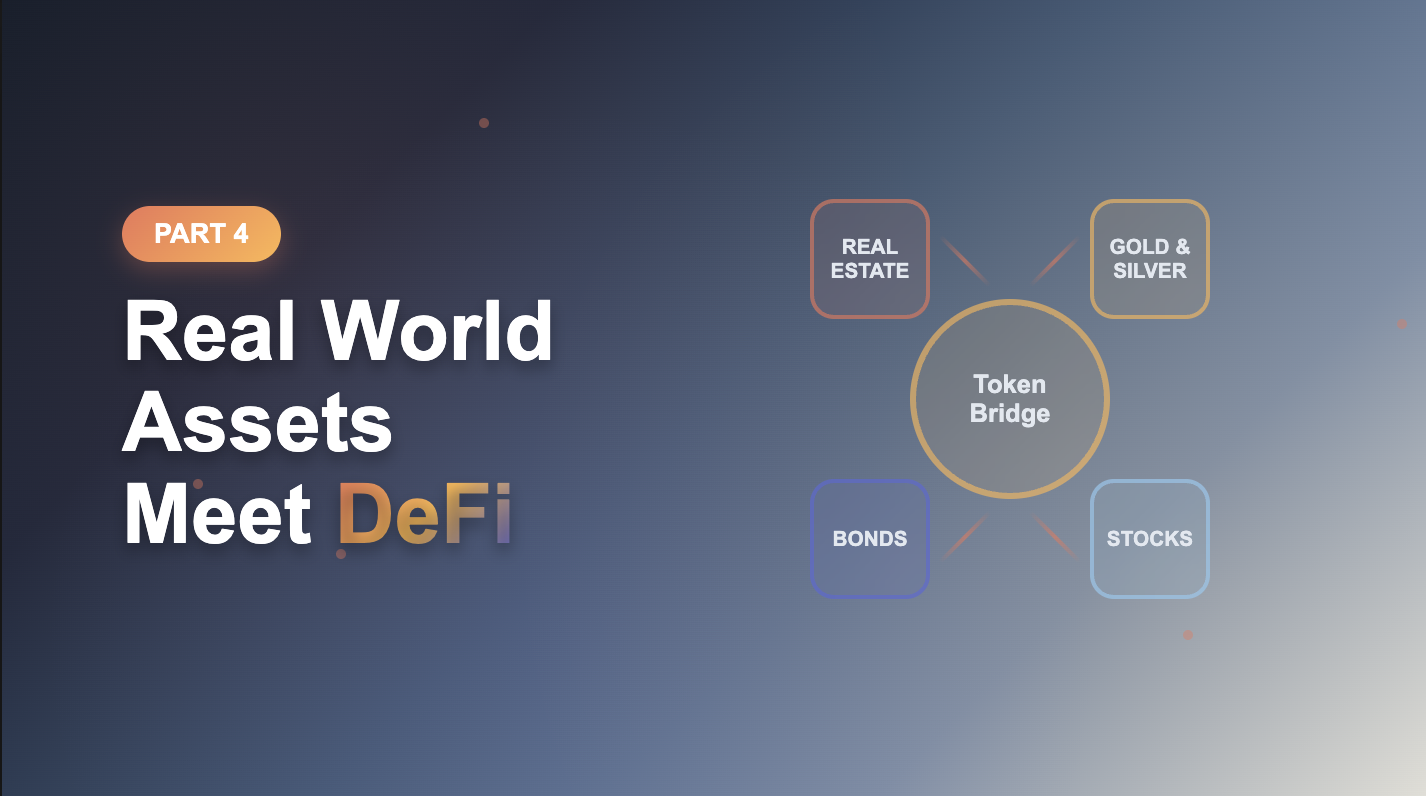
  • Decentralized Finance Part 4: Real World Assets Meet DeFi

    Decentralized Finance Part 4: Real World Assets Meet DeFi

    What if you could earn rent from a house you don’t own, in a country you’ve never been to, using an app on your phone?

    That’s the power of real-world assets in DeFi.

    What Are Real World Assets (RWA)?

    Real World Assets are things that exist outside the blockchain.

    Examples:

    • Houses
    • Company shares
    • Government bonds
    • Invoices
    • Art or collectibles

    These things are now being linked to DeFi through tokenization.

    This means creating a digital version of a real asset, which can then be traded or used inside smart contracts.

    Why Should We Care?

    Tokenized real world assets open up new investment opportunities, making high-value assets more accessible to everyone. They bring much-needed liquidity to traditionally hard-to-sell assets, allowing for quicker transactions. The transparency and security of blockchain technology reduce fraud and build trust. Plus, integrating RWAs with DeFi creates innovative financial products and services, building a more inclusive, efficient, and transparent financial system for all, and more…

    RWA Needs an On-Chain Connection

    Real world assets live outside the blockchain.

    To use them inside DeFi, we need a way to connect them to smart contracts.

    This means creating a bridge between the physical world and the digital one.

    Someone needs to verify the asset, hold it safely, and create a digital version of it on-chain.

    That digital token is what DeFi apps can then use for trading, lending, borrowing, or earning.

    Without this connection, real-world assets cannot interact with DeFi tools. The token must reflect the real thing clearly and must be backed by trust.

    You Can Make These TODAY!

    The exciting part is that tokenizing real-world assets isn’t just for big corporations or tech gurus. With the right platforms and knowledge, individuals and businesses can also participate in creating these digital representations of physical assets today. The process generally involves a few key steps. First, the real-world asset needs to be legally verified and appraised to determine its value and ownership. This is a crucial step to ensure that the digital token accurately reflects the physical asset. Once verified, the asset is then ‘tokenized’ on a blockchain.

    This means a smart contract is created that represents the asset, and digital tokens are issued. These tokens can then be bought, sold, or traded on various blockchain platforms. While it might sound complex, many platforms are emerging that simplify this process, making it more accessible for a wider audience. This means that the potential for bringing real-world value onto the blockchain is immense, and it’s happening right now, opening up new avenues for investment and ownership.

    Key Benefits of RWA + DeFi

    1. New Investment Opportunities: Tokenized real-world assets make high-value assets (like real estate, art, etc.) more accessible to everyone, lowering the barrier to entry for investments.
    1. Increased Liquidity: Traditionally illiquid assets can be bought and sold almost instantly on a global market, allowing for quicker transactions and easier access to asset value.
    1. Enhanced Transparency and Security: Blockchain technology ensures that every transaction is recorded on an immutable ledger, reducing fraud and increasing trust in asset ownership and transfer.
    1. Innovative Financial Products: The integration of RWAs with DeFi platforms enables new financial services, such as using tokenized real estate as collateral for loans or participating in decentralized exchanges with real-world backed assets.

    Popular RWA Projects in DeFi

    1. Centrifuge – Brings real-world loans (like invoices) to DeFi
    1. Goldfinch – Offers loans to real businesses in emerging markets
    1. Maple – Lets institutions borrow on-chain
    1. Ondo – Tokenizes US Treasuries for yield

    Challenges to Watch

    • Legal rules are not clear yet
    • Need for trusted middlemen to hold the real asset
    • Hard to scale across countries
    • Price feeds and real-world data must be accurate

    Final Thoughts

    Real World Assets will bring real growth to DeFi.

    They connect blockchain to the world we live in.

    And they give DeFi a chance to solve real problems, not just trade tokens.

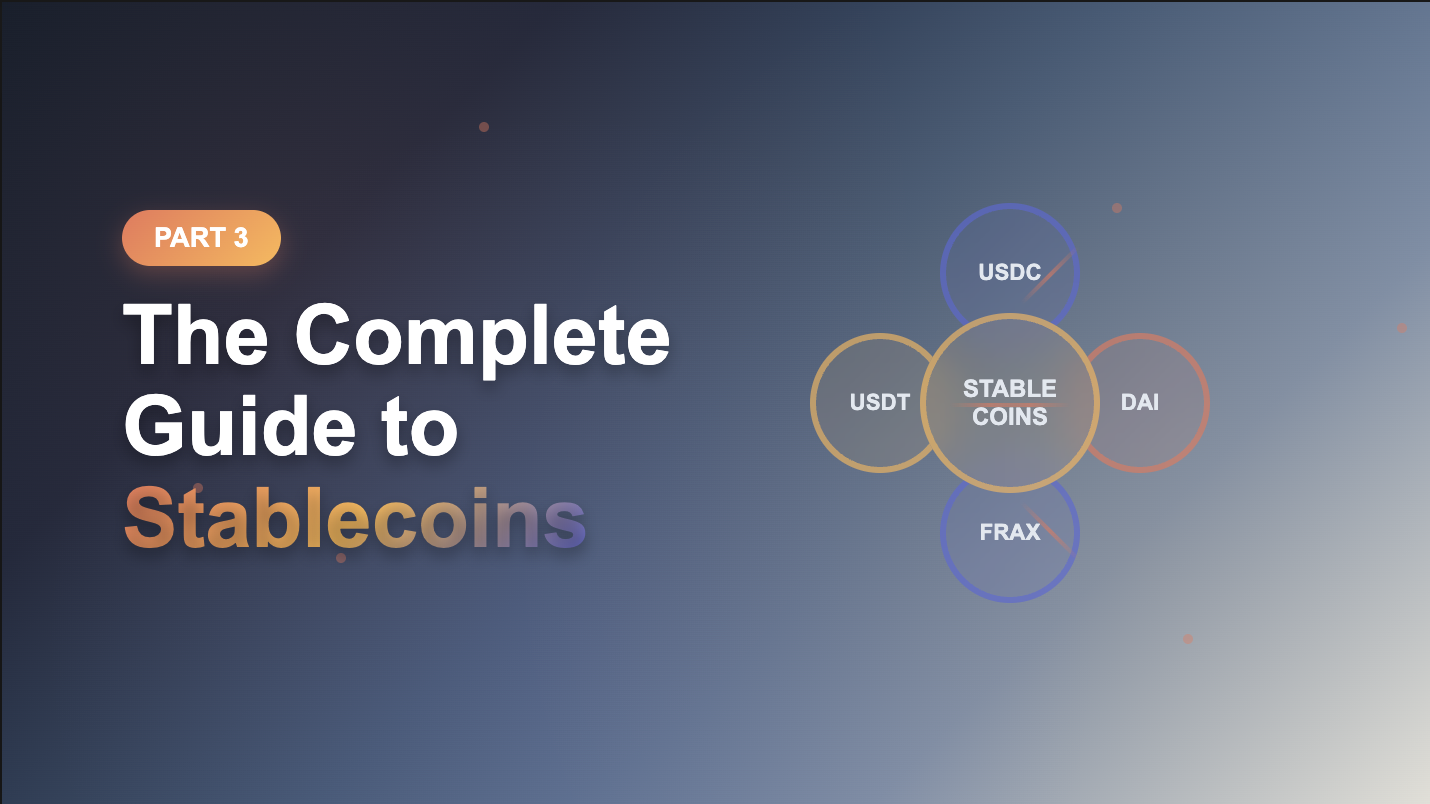
  • Decentralized Finance Part 3: The Complete Guide to Stablecoins

    Decentralized Finance Part 3: The Complete Guide to Stablecoins

    The Problem That Started It All

    Imagine you bought a cup of coffee with Bitcoin six months ago. Back then, it cost you 0.0001 BTC. Today, that same amount of Bitcoin could buy you either half a cup or three cups, depending on Bitcoin’s wild price swings. But if you paid with dollars six months ago and pay with dollars today, you’d pay roughly the same amount. This is the fundamental problem that stablecoins solve.

    What Are Stablecoins?

    Most people think stablecoins are simply “non-volatile crypto assets.” This definition is wrong.

    The correct definition: A stablecoin is a crypto asset whose buying power fluctuates very little relative to the rest of the market.

    The keyword here is “buying power.” It’s not about price stability, it’s about purchasing power stability. A stablecoin should let you buy roughly the same amount of goods today as you could yesterday, next week, or next month.

    Why Do We Care About Stablecoins?

    Money serves three critical functions, and understanding these explains why stablecoins matter:

    1. Store of Value

    Money should preserve your wealth over time. When you save money in a bank or invest in stocks, you expect it to maintain its purchasing power. Volatile assets like Bitcoin fail at this because your wealth can disappear overnight.

    2. Unit of Account

    Money should help us measure how valuable something is. We price Bitcoin in dollars, not the other way around, because Bitcoin’s constant price changes make it a poor measuring stick. Nobody wants to price their business in Bitcoin when it could be worth 50% less tomorrow.

    3. Medium of Exchange

    Money should facilitate transactions. While you can technically buy groceries with Bitcoin, most people won’t because they don’t want to spend an asset that might double in value next week.

    The Web3 Money Problem: Ethereum works great as a store of value and medium of exchange, but fails as a unit of account due to its volatile nature. We need Web3 money that can do all three functions reliably

    Categories and Properties of Stablecoins

    1. Relative Stability: Pegged/Anchored or  Floating

    Pegged  Stablecoins: These are tied to another asset’s value. Most popular stablecoins fall into this category:

    • Tether (USDT): 1 USDT = 1 USD
    • USD Coin (USDC): 1 USDC = 1 USD

    Floating Stablecoins: These maintain stable buying power without being tied to any specific asset. Think of it this way: if you could buy 10 apples with 10 dollars five years ago, but today you can only buy 5 apples with 10 dollars due to inflation, a floating stablecoin would adjust so you can still buy 10 apples with the same amount.

    Anchored Stablecoins: These are pegged to a specific reference point that moves over time. Think of it like measuring ocean levels, where the anchor point itself changes but the relationship remains stable.

    2. Stability Method: Governed vs Algorithmic

    This refers to who or what controls the minting and burning of stablecoins to maintain their peg.

    Governed Stablecoins: Humans or organizations decide when to create or destroy tokens. These are typically centralized:

    • A government entity
    • A company (like Circle for USDC)
    • A decentralized autonomous organization (DAO)

    Algorithmic Stablecoins: Smart contracts automatically mint and burn tokens based on predetermined rules. No human intervention required:

    • DAI (partially algorithmic)
    • FRAX
    • RAI
    • UST (failed example)

    3. Collateral Type: Endogenous vs Exogenous

    This describes what backs the stablecoin’s value.

    Exogenous Collateral: Backed by assets outside the stablecoin’s ecosystem:

    • USDC is backed by US dollars
    • DAI is backed by ETH, USDC, and other external assets

    If these stablecoins fail, their underlying collateral (dollars, ETH) continues to exist and function.

    Endogenous Collateral: Backed by assets within the same ecosystem:

    • UST was backed by LUNA tokens
    • If UST failed, LUNA would fail too (which actually happened)

    The relationship creates a reflexive loop where the stablecoin and its collateral depend on each other for value.

    The Endogenous Dilemma

    Endogenous collateral sounds risky, so why use it at all?

    The Answer: Capital Efficiency

    With exogenous stablecoins like USDC, you need to over-collateralize. To mint $100 worth of DAI, you might need to deposit $150 worth of ETH. This ties up a lot of capital.

    Endogenous stablecoins can theoretically operate with zero external collateral because they’re backed by their own ecosystem. This makes them highly capital efficient but also highly risky.

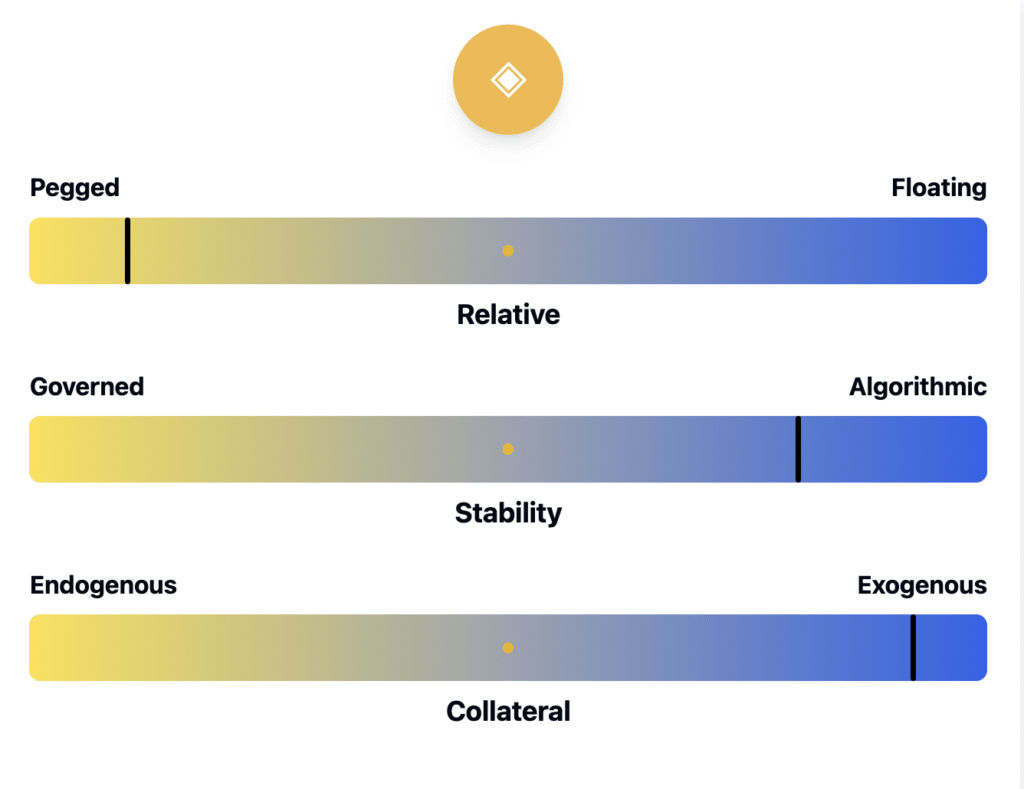
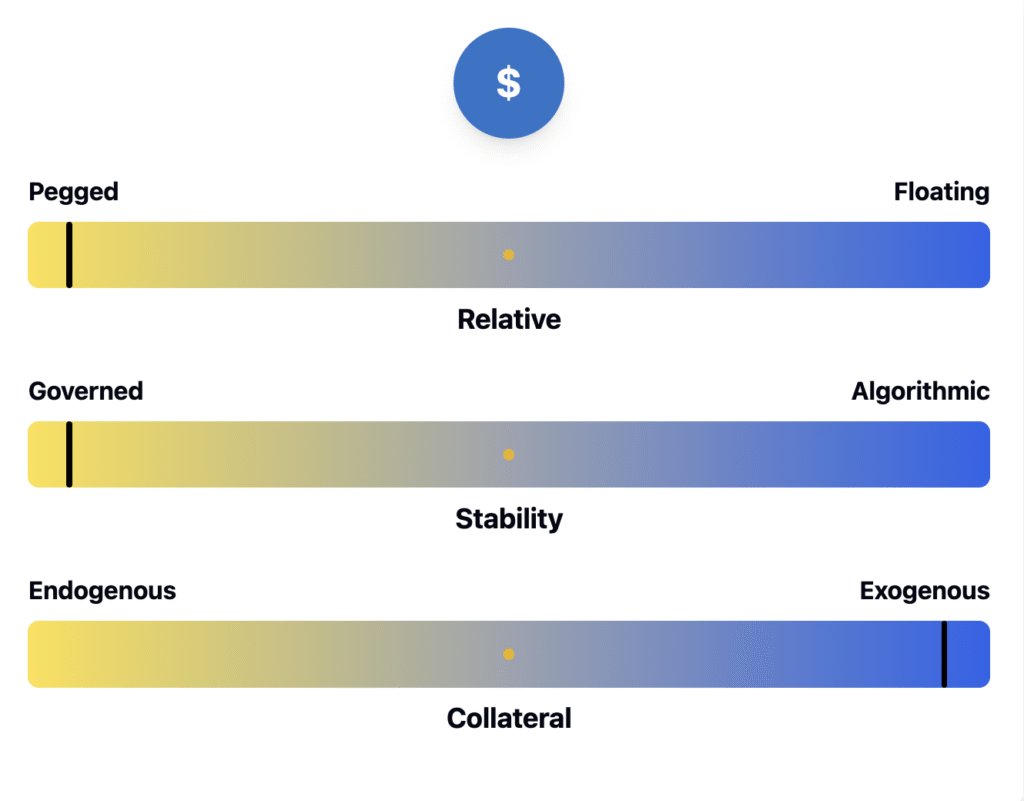
    Check out these visuals to understand how some of the most well-known stablecoins are built and how they work

    (DAI StableCoin)

    ( USDC StableCoin)

    (RAI StableCoin)

    What Stablecoins Really Do

    Beyond just maintaining stable value, stablecoins serve as:

    Financial Infrastructure: They enable DeFi protocols to function with predictable unit pricing.

    Bridge Between Traditional and Crypto: They allow seamless movement between fiat and crypto worlds.

    Yield Generation: Many stablecoins can be staked or lent to earn interest.

    Global Access: They provide dollar-equivalent access to people in countries with unstable currencies.

    Which Stablecoins Are Good?

    For Safety and Reliability:

    • USDC: Highly regulated, transparent reserves
    • DAI: Decentralized, over-collateralized, battle-tested

    For Innovation:

    • RAI: Truly algorithmic, not pegged to fiat
    • FRAX: Hybrid model balancing efficiency and stability

    Trade-offs to Consider:

    • Centralized stablecoins (USDC) offer stability but can be frozen or regulated
    • Decentralized stablecoins (DAI, RAI) offer censorship resistance but may have slight fees and complexity
    • Algorithmic stablecoins offer capital efficiency but carry higher risks

    The Future of Stablecoins

    The stablecoin landscape continues evolving as projects balance three competing priorities:

    1. Stability – Maintaining purchasing power
    2. Decentralization – Avoiding central points of failure
    3. Capital Efficiency – Maximizing utility of locked assets

    The most successful stablecoins will likely be those that find the optimal balance between these three factors while serving the core functions of money in the digital age.

    Before you use or build with stablecoins, take the time to understand how they’re designed. The more you know, the better decisions you’ll make in the Web3 world.

  • Decentralized Finance Part 2: Money Markets

    Decentralized Finance Part 2: Money Markets

    Banks have controlled lending and borrowing for centuries. They decide who gets loans, set the interest rates, and hold all the power. If your credit score isn’t perfect or you don’t have the right paperwork, you’re out of luck.

    DeFi Money Markets flip this system completely upside down.

    No credit checks. No paperwork. No waiting weeks for approval.

    Just deposit your crypto as collateral, and borrow instantly. The smart contract handles everything else.

    What Are DeFi Money Markets?

    DeFi money markets are lending platforms built on smart contracts.

    They allow users to:

    • Lend crypto and earn interest – Deposit your tokens and get paid for lending them out
    • Borrow crypto and pay interest – Put up collateral and borrow different tokens

    The most popular platforms include Aave, Compound, and others.

    But here’s the catch:

    You can’t borrow unless you first deposit something valuable.

    This is called collateral.

    Traditional Borrowing vs DeFi

    In traditional loans, you get money based on:

    • Your salary
    • Credit score
    • Personal background

    In DeFi, none of that matters.

    The only thing that matters is how much you deposit as collateral.

    How Collateral-Based Borrowing Works

    The Collateral System

    In DeFi, collateral is your security deposit. It’s like leaving your car keys with a friend when you borrow their bike. If you don’t return the bike, they keep your keys.

    Here’s a simple example:

    • You deposit 1,000 USDC as collateral
    • You can then borrow 800 DAI (or ETH worth $800)
    • You can’t borrow more than you deposited
    • Your collateral stays locked until you repay the loan

    DeFi Money Markets Glossary

    Collateral

    The crypto you deposit as security to borrow other tokens. If you deposit 1 ETH to a protocol, your collateral is 1 ETH.

    Loan-to-Value (LTV) Ratio

    LTV determines how much you can borrow compared to your collateral value. It’s expressed as a percentage.

    Example with 75% LTV:

    • You deposit 1 ETH worth $1,000 as collateral
    • You can borrow up to 0.75 ETH worth of other tokens (or $750 worth)
    • The protocol keeps 25% as a safety buffer

    Different tokens have different LTV ratios based on their stability and risk.

    The Liquidation Threshold

    Liquidation happens when your borrowed amount becomes too risky compared to your collateral. It’s the protocol’s way of protecting itself and other users.

    Common triggers:

    • Your collateral drops in value (ETH price falls)
    • Your borrowed asset rises in value (borrowed token pumps)
    • You borrow too close to your limit

    How Liquidation Works

    When you cross the liquidation threshold:

    1. Liquidators step in – These are users who “buy” your debt
    2. You pay a penalty – Usually 5-10% of your collateral value
    3. Your collateral gets sold – To cover the borrowed amount
    4. You keep the rest – Any remaining collateral after paying debt and penalty

    The warning system: Most protocols show you a “health factor” that warns you before liquidation happens.

    Annual Percentage Yield (APY)

    The yearly return on your investment, including compound interest. If you earn 10% APY, your money grows by 10% over one year with compounding.

    Annual Percentage Rate (APR)

    The yearly cost of borrowing without compound interest. If you pay 8% APR, you pay 8% interest over one year on the original loan amount.

    Receipt Token

    A special token you receive when depositing into a protocol. It’s like a receipt that proves you deposited funds. These tokens are minted when you deposit and burned when you withdraw.

    Reserve/Underlying Asset

    The actual token you deposited into the protocol. For example, if you deposit ETH into AAVE, WETH is the underlying token, and you receive aWETH receipt tokens.

    Key Benefits of DeFi Money Markets

    For Lenders:

    • Earn passive income on idle crypto
    • No minimum deposit requirements
    • Withdraw anytime (subject to liquidity)
    • Transparent interest rates

    For Borrowers:

    • No credit checks or paperwork
    • Instant loan approval
    • Keep your crypto exposure while borrowing
    • Access to leverage trading strategies

    AAVE: The largest lending protocol with innovative features like flash loans and rate switching.

    Compound: Pioneer in DeFi lending with simple, reliable mechanics.

    MakerDAO: Focused on DAI stablecoin creation through collateralized debt positions.

    Conclusion

    DeFi money markets represent a fundamental shift in how we think about lending and borrowing. They remove gatekeepers, reduce costs, and provide global access to financial services.

    The power is now in your hands. No banker can reject your loan application. No credit agency can block your access. Just you, your crypto, and the smart contract.

    But with great power comes great responsibility. Understanding collateral, liquidation, and risk management is essential before diving in.

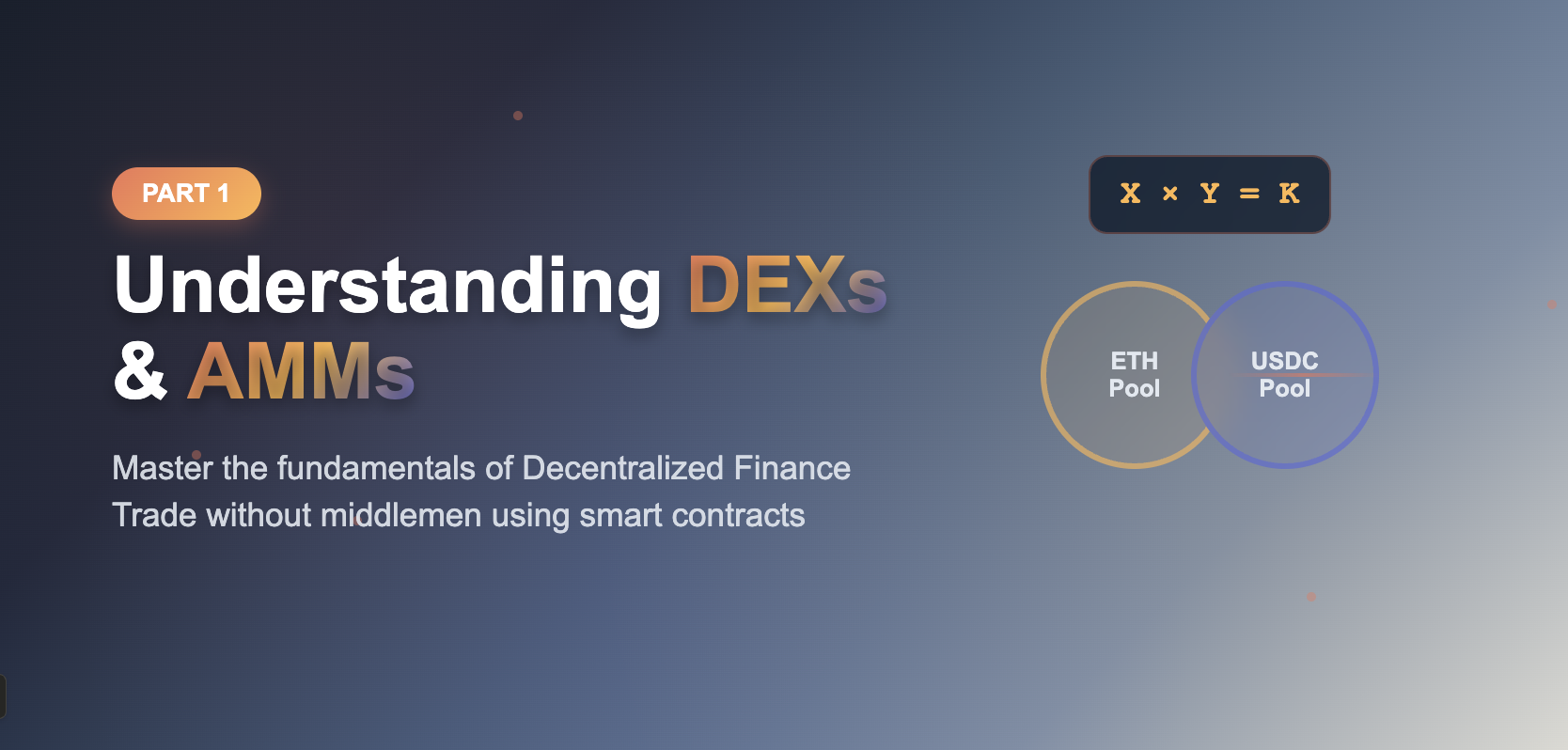
  • Decentralized Finance Part 1: Understanding DEXs and AMMs

    Decentralized Finance Part 1: Understanding DEXs and AMMs

    A few years ago, if you wanted to buy or sell crypto, you had to go through a central exchange. You’d sign up, verify your identity, and trust the platform to keep your money safe.

    Then came Decentralized Exchanges (DEXs), a new way to trade crypto without giving up control.

    No sign-ups. No middlemen. No waiting for someone on the other side.

    Just you, a wallet, and a smart contract.

    This is the revolutionary promise of Decentralized Finance (DeFi), where smart contracts handle everything automatically. Today, we’ll explore the foundation of DeFi: Decentralized Exchanges (DEXs) and the magic behind them

    What is a Decentralized Exchange (DEX)?

    A Decentralized Exchange (DEX) lets you trade one token for another, directly from your wallet. There’s no company holding your money. Instead, smart contracts handle everything.

    You connect your wallet. You choose what you want to swap. And the trade happens instantly.

    How Does a DEX Actually Work?

    Let’s break down the key components that make DEXs possible:

    1. Liquidity Pools

    A liquidity pool is like a jar filled with two tokens. For example:

    • 50 ETH and
    • 10,000 DAI

    People add their tokens to these pools. These people are called liquidity providers, and they earn small fees from every trade that happens.

    2. Swapping

    You want to swap your DAI for ETH?

    The smart contract pulls ETH from the pool and adds your DAI to it.

    The price changes based on how much you take and how much you give.

    3. Automated Market Maker (AMM): The Price Calculator

    Here’s where it gets interesting. Instead of matching you with another trader (like in traditional markets), an AMM uses a mathematical formula to determine prices instantly. It’s like having a calculator that always knows the fair price based on how much of each token is in the pool.

    4. Small Fees, Big Rewards

    Every trade pays a small fee (typically 0.3%). This fee gets distributed among all the people who provided liquidity to that pool. It’s like getting a cut of every transaction just for helping keep the marketplace running.

    Understanding Liquidity and Why It Matters

    What is Liquidity? Liquidity is simply having enough tokens in a pool to make trading smooth and efficient. Think of it like having enough cash in your wallet to buy coffee without needing to break a $100 bill.

    Why Do We Need It? Without enough liquidity, strange things happen:

    • Trades become slow and expensive
    • Prices swing wildly with small purchases
    • Large trades become nearly impossible

    Who Benefits?

    • Traders get fast, reliable swaps
    • Liquidity providers earn passive income from fees
    • The entire ecosystem stays healthy and functional
    1. PancakeSwap – Built on Binance Smart Chain. Fast and great for beginners.
    2. SushiSwap – Available on many chains. It rewards people who add liquidity.

    There are many more. Each one has its own pools, tokens, and features.

    DEX vs CEX: Choose Your Adventure

    Centralized Exchange (CEX):

    • Requires account creation and identity verification
    • Company holds your funds
    • Easy to use with familiar interfaces
    • Customer support available

    Decentralized Exchange (DEX):

    • No signup required
    • You always control your funds
    • More privacy and anonymity
    • Full responsibility for your own security

    The Bottom Line: Want complete control and privacy? Go with a DEX. Prefer simplicity and support? Choose a CEX.

    How Automated Market Makers Work

    An Automated Market Maker (AMM) is a smart contract that lets you swap tokens without needing someone else on the other side.

    Let’s Break Down the Formula

    X × Y = K

    • X = Amount of Token 1 in the pool
    • Y = Amount of Token 2 in the pool
    • K = A constant number that never changes

    Think of K as the pool’s “balance point.” No matter how much trading happens, the formula ensures X × Y always equals K.

    A Real-World Example

    Let’s say we have a pool with:

    • 50 ETH (Token 1)
    • 10,000 DAI (Token 2)
    • K = 50 × 10,000 = 500,000

    Now imagine you want to buy 1 ETH using DAI.

    After your trade:

    • ETH remaining = 49 (you took 1 ETH out)
    • To keep K = 500,000, we need: 49 × Y = 500,000
    • Y = 500,000 ÷ 49 = 10,204.08 DAI

    Since the pool started with 10,000 DAI and needs 10,204.08 DAI after your trade, you must add 204.08 DAI to buy 1 ETH.

    The price was calculated automatically by the formula, not by a person!

    Why Prices Change as You Trade

    Here’s where it gets interesting. The more ETH you try to buy, the more DAI you need to add to keep K constant. This makes each additional ETH more expensive.

    Example:

    • Buying 1 ETH costs ~204 DAI
    • Buying 2 ETH would cost even more per ETH
    • Buying 10 ETH would be extremely expensive per ETH

    This price increase is called “slippage,” and it’s completely normal in AMMs. It prevents any single person from draining the entire pool

    This price jump is called slippage, the more you buy, the more you pay.

    AMM vs Order Book

    • Order Book (used by CEX): Buyers and sellers agree on a price
    • AMM (used by DEX): The price is decided by a formula

    In AMMs, you don’t wait for someone to match your trade.

    The pool is always ready, the formula handles everything.

    Key Takeaways

    1. DEXs eliminate middlemen – You trade directly through smart contracts
    2. Liquidity pools are the foundation – They provide the tokens needed for smooth trading
    3. AMMs use simple math – The X × Y = K formula determines all prices
    4. Everyone benefits – Traders get instant swaps, providers earn fees
    5. You stay in control – Your funds never leave your wallet

    In Part 2, we’ll explore money markets

  • Kevin’s Web3 Journey: From Cameras to Code to Community

    Kevin’s Web3 Journey: From Cameras to Code to Community

    Some people find their calling in the most unexpected places. For Kevin, it started with cameras at blockchain conferences and evolved into building communities that shape the future of decentralized technology. What began as a side hobby capturing moments at Bitcoin conferences has transformed into a mission to help developers worldwide enter the exciting world of Web3.

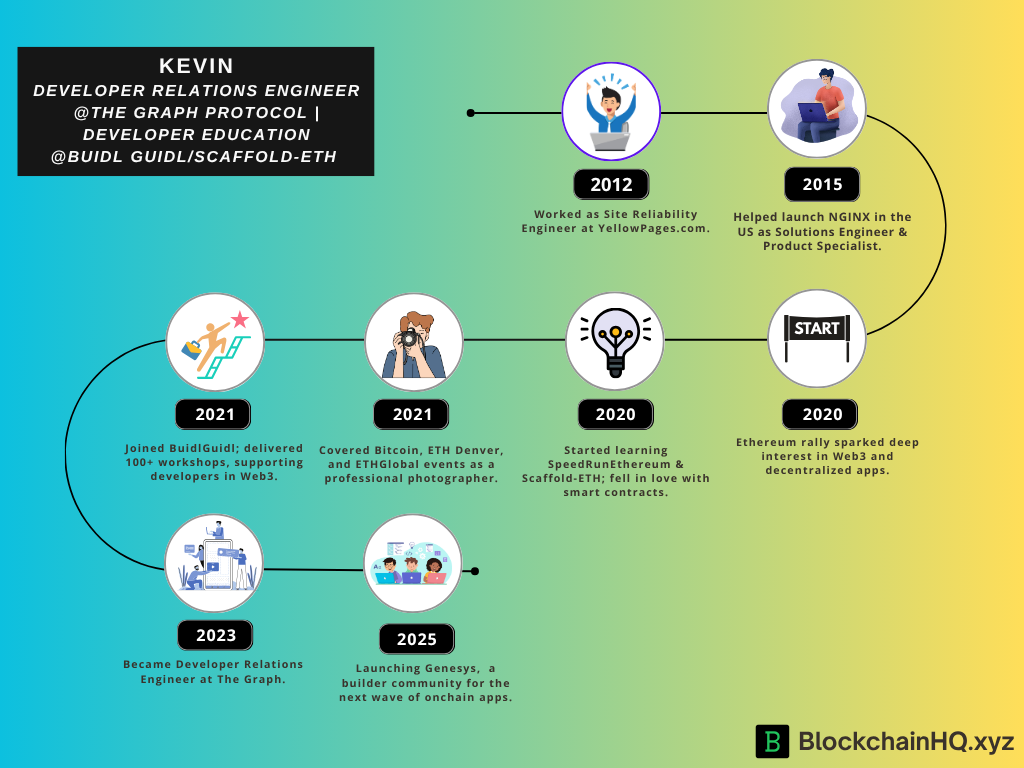
    Kevin’s story is one of curiosity, persistence, and genuine passion for helping others succeed. From his early days as a Site Reliability Engineer to becoming a leading voice in developer education, his journey shows how technical skills combined with community spirit can create lasting impact in the rapidly evolving blockchain space.

    Today, as a Developer Relations professional at The Graph Protocol, Kevin builds something more valuable than applications: pathways for other developers to follow. Through workshops, educational content, and his upcoming Genesys platform, he’s making Web3 accessible to newcomers.

    His approach is refreshingly practical. Rather than getting lost in complex theories, Kevin focuses on hands on learning and real world building. This philosophy has helped hundreds of developers take their first steps into Web3, turning curiosity into career changing skills.

    This conversation with Kevin reveals the human side of blockchain development. We explore his journey from traditional web applications to smart contracts, the challenges that almost made him quit, and the communities that kept him going. Most importantly, we discuss his vision for making Web3 more accessible to developers everywhere.

    The Interview: Kevin on Building Communities in Web3

    1. Tell us a bit about yourself.

    Kevin: My name is Kevin, and I was born in California, USA. I’ve been passionate about technology since I was a young child. I’m also a photographer, DJ, and father of two boys.

    2. What were you doing before Web3?

    Kevin: I worked for about three years as a Site Reliability Engineer at YellowPages.com, then helped build and launch NGINX in the US as a Solutions Engineer and Product Specialist. I also began my journey into Web3 as a professional photographer, covering events like Bitcoin Conference, ETH Denver, and ETHGlobal Hackathons around the world.

    3. How did you first hear about Web3?

    Kevin: I remember hearing about Bitcoin in its early days and shrugged it off like most of us did. However, my interest really grew when I witnessed the Ethereum rally in 2017. I was amazed to learn that you could build fully decentralized and unstoppable applications on the EVM, and I was instantly hooked!

    4. What was your first step into the space?

    Kevin: I had been doing photography in the space for a long time, and in my off time, I began learning through SpeedRunEthereum and using Scaffold-ETH. I was amazed at how enjoyable writing smart contracts was and wanted to teach others. I started creating YouTube videos and conducting workshops for my current company about Ethereum and Web3, which led me down the rabbit hole. Eventually, I was fortunate enough to meet Austin Griffith, who really helped me reach the next level and welcomed me into the BuidlGuidl to help support builders in the space. Since then, I’ve given over 100 workshops on Scaffold-ETH and SpeedRunEthereum and helped countless developers enter the space.

    5. What was one big challenge you faced early on?

    Kevin: Understanding the tooling differences between traditional web applications and blockchain-based applications was one of the biggest challenges. I found that diving into the EVM and understanding its core components really helped elevate my understanding of how smart contracts are executed under the hood.

    6. What helped you push through?

    Kevin: Excellent videos by Austin Griffith, Nader Dabit, Patrick Collins, and Smart Contract Programmer really helped me overcome the hurdle of building onchain applications. Additionally, having a starter kit like Scaffold-ETH made it much easier to get started building, as I could abstract some of the EVM nuances and return to them later when I needed to dive deeper.

    7. What are you most proud of so far in your journey?

    Kevin: I’m proud that I can help others achieve the same success I’ve experienced. I believe that building a community for builders is the best way for me to contribute to the space. This is why I’m launching Genesys, a community where developers can come together and build the next wave of onchain applications.

    8. Any major failure or learning moment?

    Kevin: I think learning is something you have to do constantly. I’ve always tried to consistently push myself to try new things and stay ahead of major setbacks. However, there have been many times when I lost energy and experienced burnout. This is the most critical point in your journey. You just have to take some time for yourself, then push through and remember why you’re here.

    9. What advice would you give to someone just starting out in Web3?

    Kevin: Don’t be afraid to try things you wouldn’t normally feel comfortable doing. There have been many times when I started working on a codebase and realized it was going to be much more difficult than I had anticipated, but going through that process taught me a lot and elevated my knowledge.

    10. Where can people find or follow your work?

    Kevin: You can find me on X at https://x.com/cryptomastery_ , on YouTube at https://www.youtube.com/@cryptomastery_ , and on Genesys at https://www.genesysapp.xyz/user/0x89480c2e67876650b48622907ff5c48a569a36c7

    Kevin’s journey reminds us that the most impactful contributions in Web3 often come from those who combine technical expertise with a genuine desire to help others. His transition from capturing blockchain events through a camera lens to actively building developer relations at The Graph Protocol and creating communities shows how diverse backgrounds can create unique value in this space.

    Through his work at The Graph Protocol, Genesys, and his educational efforts, Kevin continues to lower the barriers for developers entering Web3. His story proves that sometimes the best way to master something is to teach it to others, creating a cycle of learning and growth that benefits the entire ecosystem.

    Want to build, learn, and grow in the Web3 space alongside like-minded developers? Join the BlockchainHQ community where builders share knowledge, collaborate on projects, and support each other’s growth. Sign up from here: https://blockchainhq.xyz/auth and follow us on X https://x.com/blockchainhqxyz to become part of our invite only Telegram community where the real conversations happen