A Web2 intern who dabbled in crypto trading during lockdown is now building across the Web3 ecosystem. Her secret? Stop waiting to be ready and start experimenting.
Aditi Polkam’s entry into Web3 wasn’t through a grand epiphany or a prestigious program. It started with lockdown curiosity about crypto trading and evolved into writing technical content for a Web3 company. What followed was a journey of constant experimentation, countless failures, and the realization that building in public is more valuable than waiting for perfection.
Her path from technical writer to fullstack developer to hackathon winner shows something important about Web3: there’s no single right way in. While others might obsess over learning every acronym and tool, Aditi focused on one thing at a time, built projects that broke, fixed them, and shipped anyway.
What sets her apart isn’t just her technical skills. It’s her honest acknowledgment that feeling lost is normal in Web3, and that the overwhelming information overload everyone talks about is real. Instead of pretending otherwise, she leaned into fundamentals, found her community, and kept building even when projects failed.
At Offline Protocol, she continues to explore new technologies hands-on, but her real contribution might be her philosophy: experimentation is underrated. Most growth doesn’t come from following a perfect roadmap. It comes from trying things, breaking things, and iterating until something works.
The Interview: Aditi’s Web3 Journey
1. Tell us a bit about yourself.
Aditi: Hey, I’m Aditi. I’m from India and currently working with Offline Protocol while also experimenting with projects across the Web3 space. Most of what I do is about exploring new technologies, trying them hands-on, and figuring out how they can be applied in real-world scenarios. I enjoy building things, contributing to projects, and constantly learning along the way.
2. What were you doing before Web3?
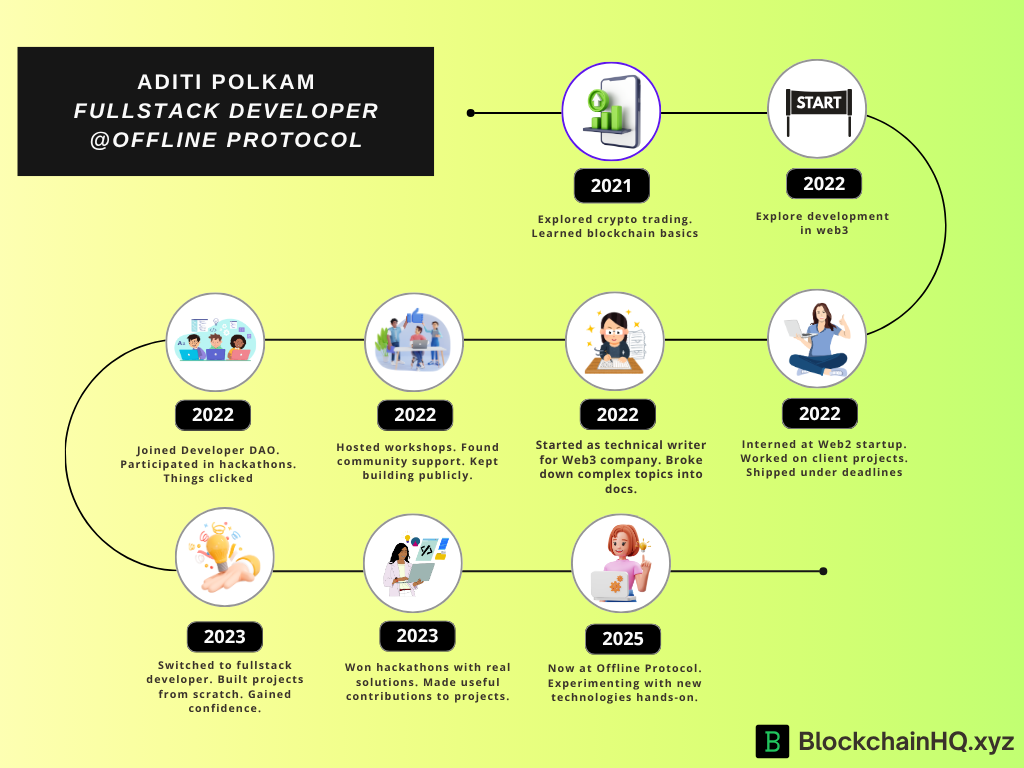
Aditi: Before Web3, I was interning at a Web2 startup where I got to work on multiple client projects. It gave me a lot of exposure to how software is built in the real world and what it means to ship things under deadlines. Around that time, I also got the opportunity to write technical content for a Web3 company. That felt like an interesting entry point, so I took it — and that’s how I slowly transitioned from just “observing Web3 from the outside” to actively contributing to it.
3. How did you first hear about Web3?
Aditi: I already had some idea about crypto during the lockdown – I was experimenting with trading and exploring the basics of how blockchains worked. But my actual journey into Web3 development started a year later, around 2022. That’s when I realized there’s a huge difference between knowing crypto as a user and actually building things that power this ecosystem.
4. What was your first step into the space?
Aditi: My very first step was as a technical writer for a Web3 company. I learned a lot while breaking down complex topics into articles and docs. Later, I switched into a more hands-on role as a fullstack developer at a startup, which gave me the confidence to actually build projects from scratch. And eventually, I started participating in hackathons, contributing to DAOs, and joining communities like Developer DAO – that’s where things really clicked for me.
5. What was one big challenge you faced early on?
Aditi: The biggest challenge was honestly the overwhelming amount of information. Everyone in Web3 talks in acronyms, there are hundreds of tools, and things evolve at lightning speed. It was easy to feel lost or feel like I didn’t belong because there was always someone who seemed to know more. There were moments where I wondered if I was even cut out for it.
6. What helped you push through?
Aditi: Two things really helped: a strong desire to learn the basics and community support. I knew I couldn’t skip fundamentals, so I made it a point to dig deeper even if it took extra time. At the same time, being part of communities, hosting workshops, and interacting with like-minded builders encouraged me to keep going. The combination of curiosity and peer support kept me motivated.
7. What are you most proud of so far in your journey?
Aditi: A few things stand out:
- Winning hackathons with projects that actually solved problems.
- The contributions I’ve made to projects that people found useful.
- Transitioning from being “just curious” to someone who can actually build and ship.
Those moments of recognition, whether through a prize or just a “this is cool” from someone, are what I look back on with pride.
8. Any major failure or learning moment?
Aditi: Plenty. I’ve had projects that didn’t ship on time, experiments that completely broke, and even ideas that never really took off. But every one of those experiences taught me something – whether it was how to plan better, how to debug smarter, or just how to be okay with things not working out the first time. I think failures in Web3 are just learning curves disguised in fancy clothes.
9. What advice would you give to someone just starting out in Web3?
Aditi: Don’t aim to “learn everything” at once – it’s impossible. Pick one area that excites you, whether it’s smart contracts, DAOs, or frontends for dApps, and start there. The rest will fall into place as you go. Also, don’t be afraid to build in public and ask questions. Three months from now, you’ll thank yourself for starting small instead of waiting to be “ready.”
10. Where can people find or follow your work?
Aditi: I’m most active on Twitter/X (@aditipolkam) and I share my projects and experiments on GitHub. That’s where you’ll see my latest updates, thoughts, and work.
11. What is that thing/challenge you would like to change in Web3-Crypto industry?
Aditi: A lot of companies are building technically sound and fancy products, but not something an average internet user would actually want to use. We need to bridge that gap – simplify UX, focus on real-world use cases, and make Web3 products less intimidating for non-crypto people. Until then, mainstream adoption will remain a buzzword.
12. Do you want us to cover anything that we missed?
Aditi: Maybe just this: experimentation is underrated. Most of what I’ve learned came from trying things, breaking things, and iterating — not from following a strict path. If you’re in Web3, don’t wait for perfect conditions. Start experimenting – that’s where the real growth happens.
From lockdown crypto curiosity to building at Offline Protocol, Aditi’s story is a reminder that Web3 careers aren’t built on perfect preparation. They’re built on willingness to experiment, fail, learn, and ship anyway. Her advice to start small and build in public isn’t just motivational talk, it’s exactly how she built her own career.
Ready to start your Web3 journey? Follow Aditi on X (@aditipolkam) and GitHub to see what happens when you stop waiting and start building.
Want to build, learn, and grow in the Web3 space alongside like-minded developers? Join the BlockchainHQ community where builders share knowledge, collaborate on projects, and support each other’s growth. Sign up from here: https://blockchainhq.xyz/auth and follow us on X https://x.com/blockchainhqxyz to become part of our invite-only Telegram community where the real conversations happen.